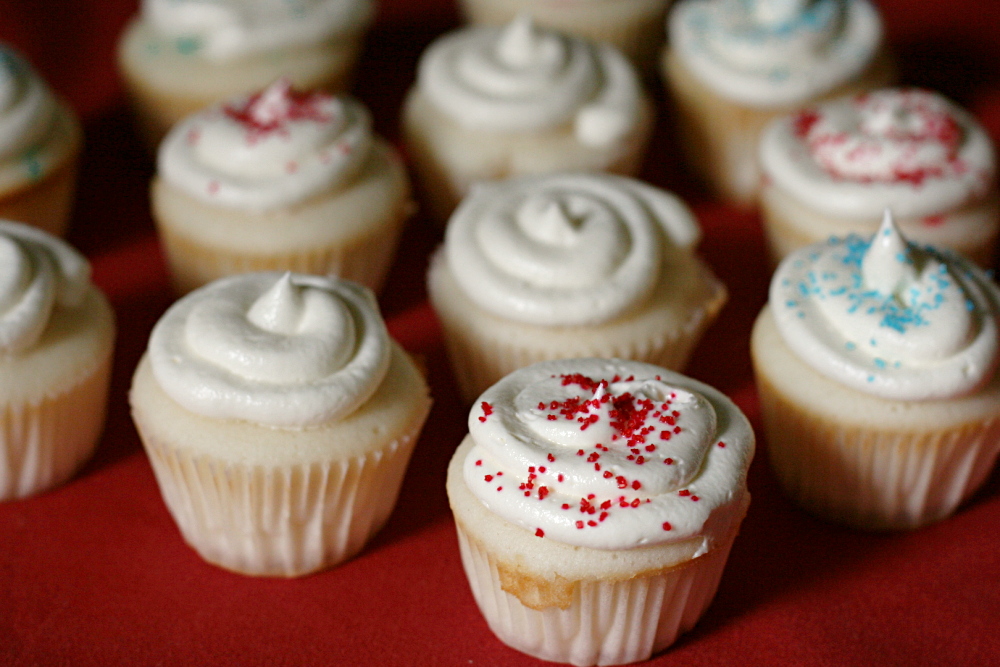
Last year, I compared three white cake recipes, including Dorie’s Perfect Party Cake. I was torn between Dorie’s recipe, which I thought tasted great, and Cooks Illustrated’s, which had the perfect texture. I had an idea for what I would try the next time I made white cake, but at the time, I was white caked out, and, indeed, I haven’t made it since. Since the Perfect Party Cake was chosen by Carol for Tuesdays with Dorie this month, it was a great opportunity to try out my adaptation and compare it to my two previous favorites.
Cooks Illustrated’s white cake recipe and Dorie’s Perfect Party Cake have different mixing methods and different ratios of ingredients, but the end results are actually quite similar. I had really enjoyed the moistness and springiness of CI’s recipe, but found it a bit too sweet. Dorie’s recipe tasted great – it’s less sweet, so a bit of tanginess is detectable. Her recipe does have less sugar, plus more milk than CI’s, presumably to make up for the moisture that sugar provides. My idea was to reduce the sugar of CI’s recipe slightly and increase the milk, keeping the other ingredients and the mixing method the same.
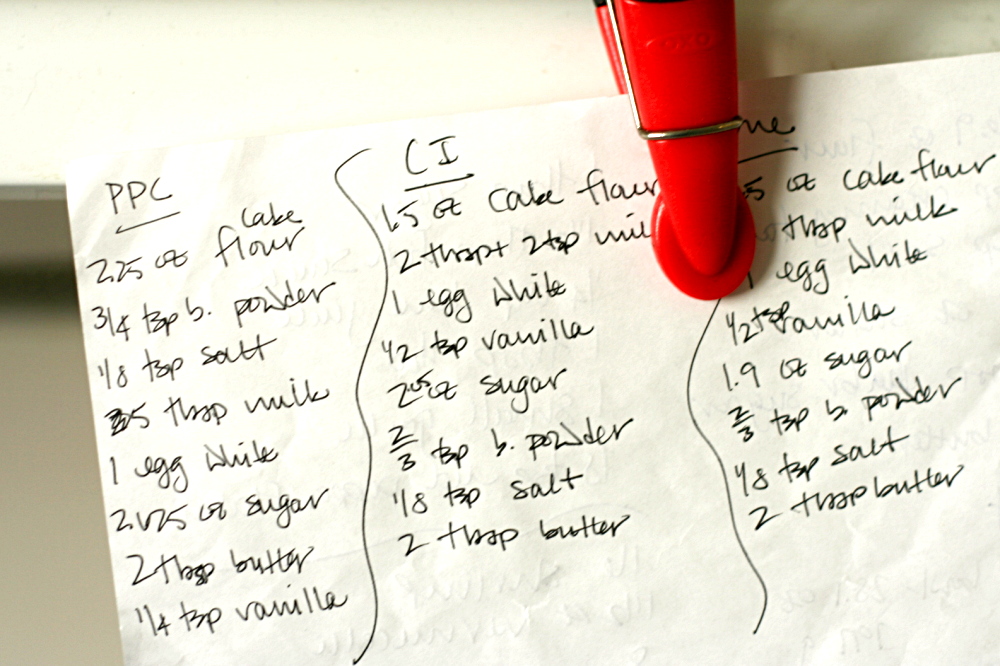
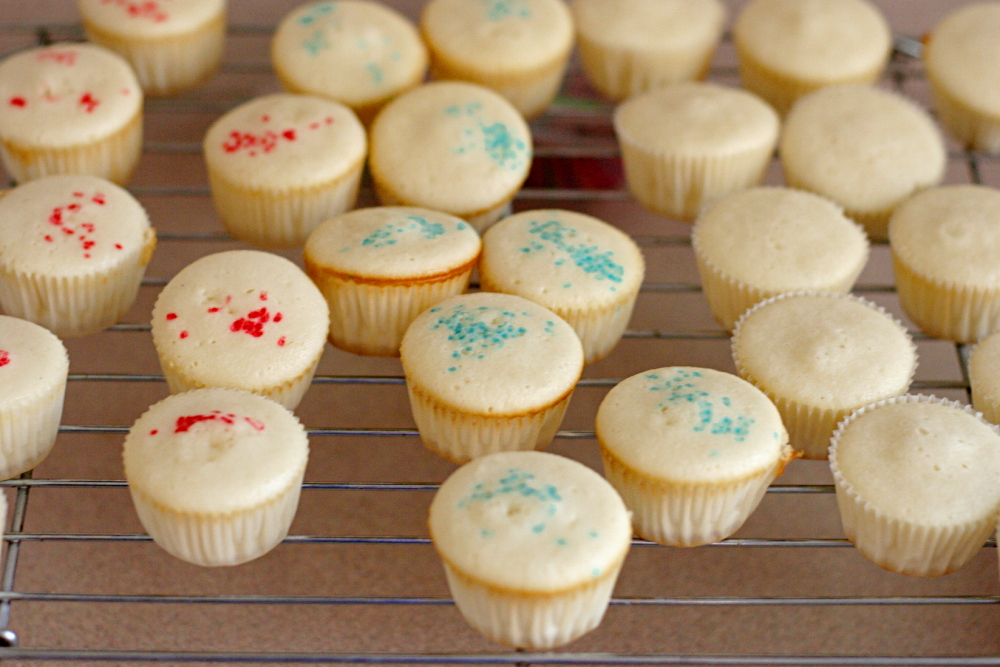
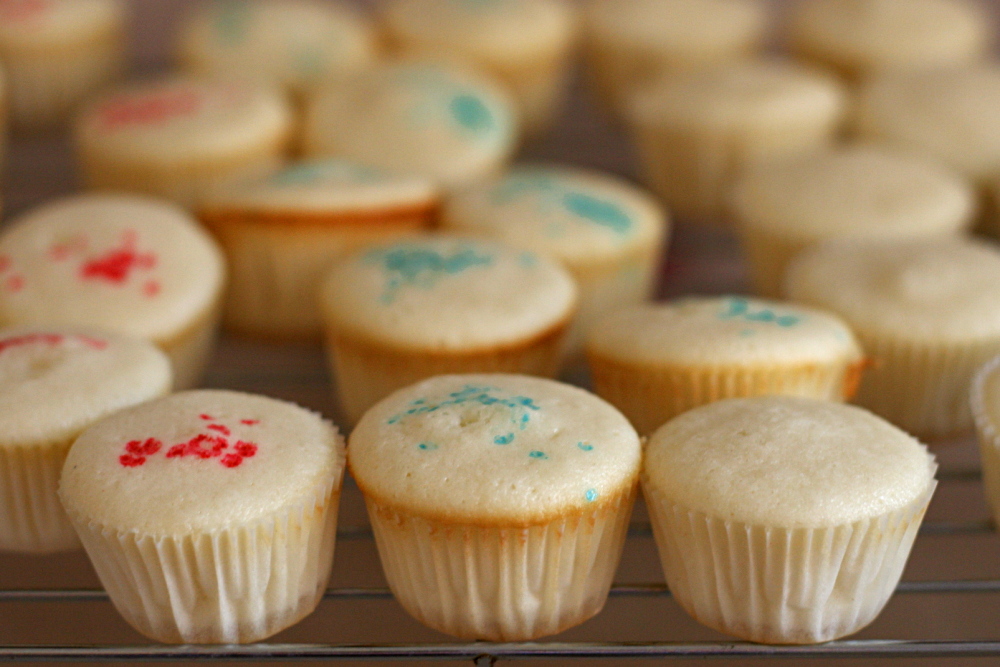
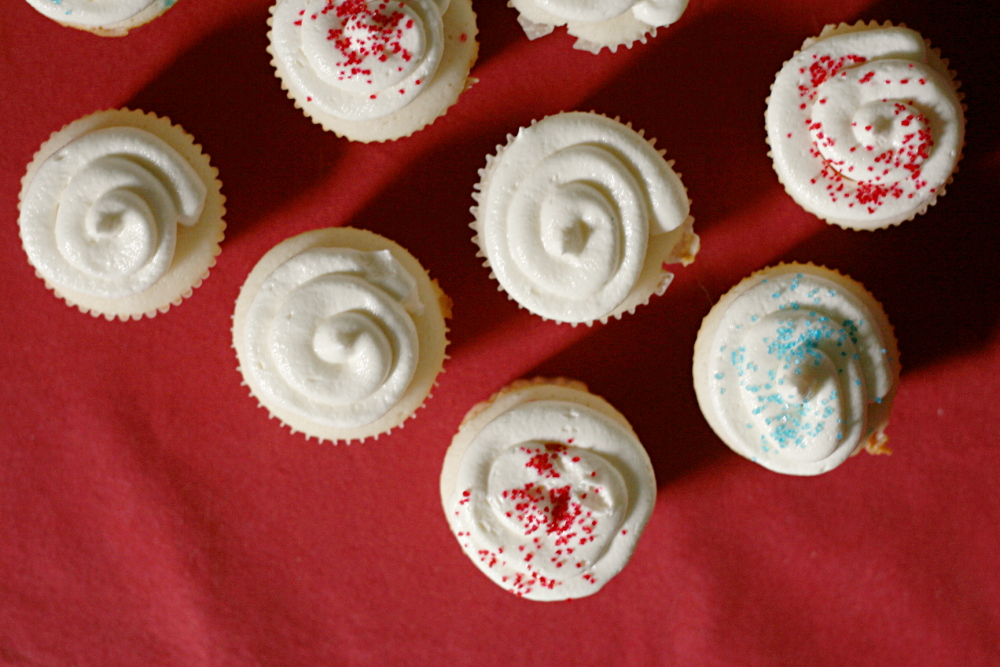
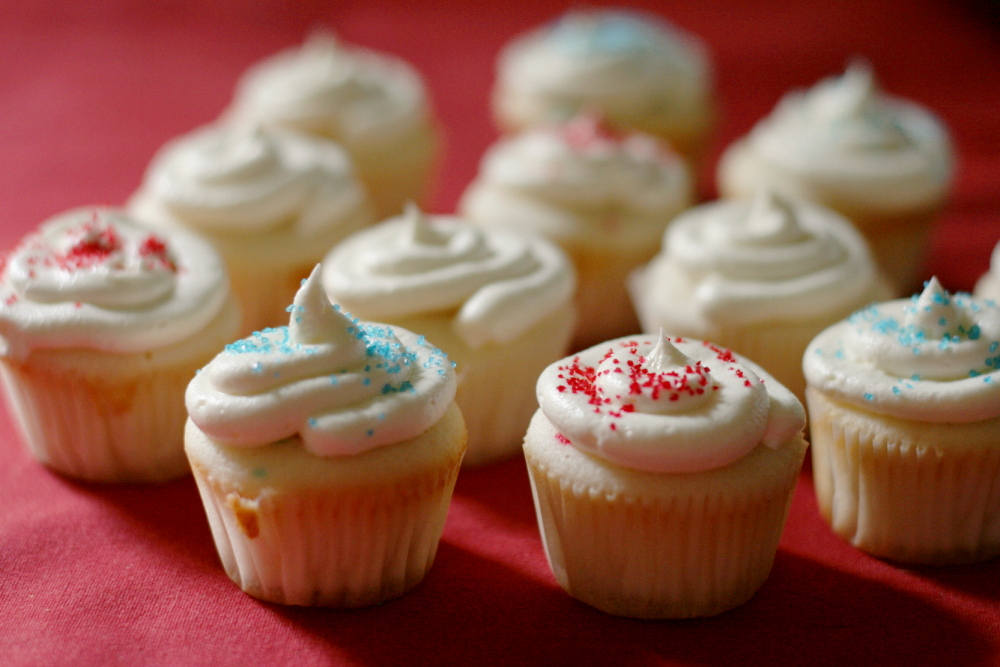
This time, I made three recipes – Dorie’s and CI’s as written, plus my adjustment of CI’s. I made mini-cupcakes of each and baked them all at 350F for 12 minutes. I did make small portions of each recipe, but I’m a pretty precise measurer, so I’m confident that this won’t have a significant impact. I flavored each cake with only vanilla, leaving out lemon and almond flavors. The sprinkling of sugar on top of each cupcake is to keep the recipes straight – white is Dorie’s, blue is CI’s, and red is my adaptation.
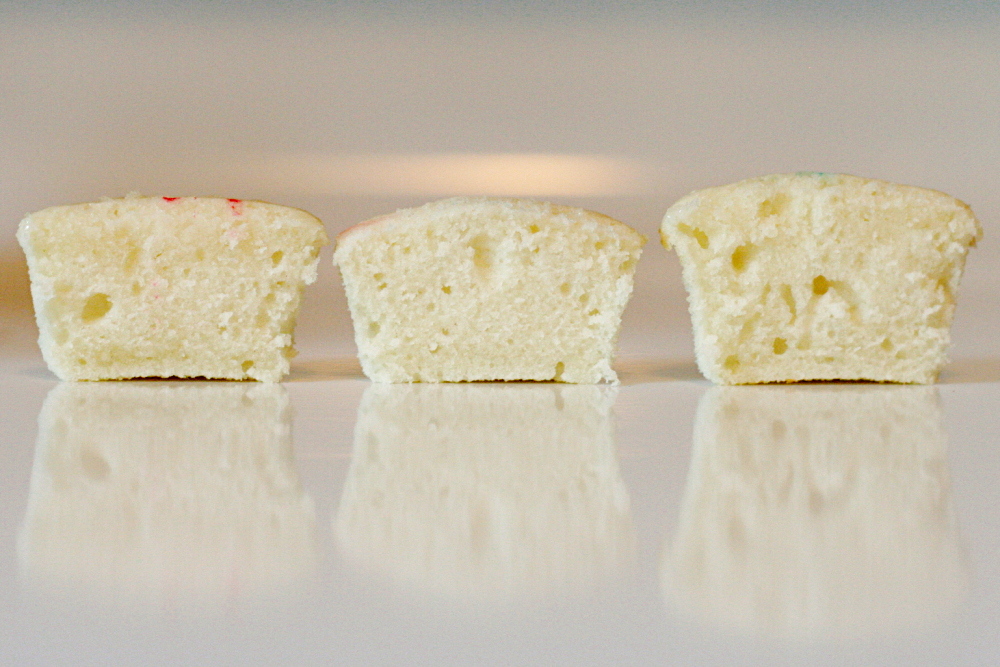 left – my recipe; middle – Dorie’s; right – CI’s
I still like the texture of CI’s better than Dorie’s. Dorie’s was just a bit dry, and CI’s has a fun sponginess to it. And I still like the flavor of Dorie’s better than CI’s – again, that slight tanginess gives some contrast to the sweetness. And, just personally, I thought my adaptation was pretty much perfect. It had the flavor I like, and it had the moist, springy texture that I like.
However, let me perfectly honest. First, all three recipes are really really good. And, frankly, really really similar. I’m really splitting hairs here. And second, Dave’s (my only other tester) preferences were exactly the opposite of mine. He liked Dorie’s recipe the best because the other two were too moist. He’s cute and all, but I’m still going to make my favorite, the adaptation of Cooks Illustrated’s recipe, in the future.
One year ago: Croque-Madame – I really need to come up with an excuse to make this again. 4th of July, maybe?
Classic White Layer Cake (from Cooks Illustrated)
Serves 12
CI note: If you have forgotten to bring the milk and egg white mixture to room temperature, set the bottom of the glass measure containing it in a sink of hot water and stir until the mixture feels cool rather than cold, around 65 degrees. Cake layers can be wrapped and stored for one day.
Nonstick cooking spray
2¼ cups cake flour (9 ounces), plus more for dusting the pans
1 cup whole milk, at room temperature
6 large egg whites (¾ cup), at room temperature
2 teaspoons almond extract
1 teaspoon vanilla extract
1¾ cups granulated sugar (12¼ ounces)
4 teaspoons baking powder
1 teaspoon table salt
12 tablespoons unsalted butter (1½ sticks), softened but still cool
1. For the Cake: Set oven rack in middle position. (If oven is too small to cook both layers on a single rack, set racks in upper-middle and lower-middle positions.) Heat oven to 350 degrees. Spray two 9-inch round cake pans with nonstick cooking spray; line the bottoms with parchment or waxed paper rounds. Spray the paper rounds, dust the pans with flour, and invert pans and rap sharply to remove excess flour.
2. Pour milk, egg whites, and extracts into 2-cup glass measure, and mix with fork until blended.
3. Mix cake flour, sugar, baking powder, and salt in bowl of electric mixer at slow speed. Add butter; continue beating at slow speed until mixture resembles moist crumbs, with no powdery streaks remaining.
4. Add all but ½ cup of milk mixture to crumbs and beat at medium speed (or high speed if using handheld mixer) for 1½ minutes. Add remaining ½ cup of milk mixture and beat 30 seconds more. Stop mixer and scrape sides of bowl. Return mixer to medium (or high) speed and beat 20 seconds longer.
5. Divide batter evenly between two prepared cake pans; using rubber spatula, spread batter to pan walls and smooth tops. Arrange pans at least 3 inches from the oven walls and 3 inches apart. (If oven is small, place pans on separate racks in staggered fashion to allow for air circulation.) Bake until thin skewer or toothpick inserted in the center comes out clean, 23 to 25 minutes.
6. Let cakes rest in pans for 3 minutes. Loosen from sides of pans with a knife, if necessary, and invert onto wire racks. Reinvert onto additional wire racks. Let cool completely, about 1½ hours.
Perfect Party Cake (from Dorie Greenspan’s Baking: From my Home to Yours)
For the Cake
2¼ cups (9 ounces) cake flour
1 tablespoon baking powder
½ teaspoon salt
1¼ cups whole milk or buttermilk (I prefer buttermilk with the lemon)
4 large egg whites
1½ cups (10½ ounces) sugar
2 teaspoons grated lemon zest
1 stick (8 tablespoons or 4 ounces) unsalted butter, at room temperature
½ teaspoon pure lemon extract
For the Buttercream
1 cup sugar
4 large egg whites
3 sticks (12 ounces) unsalted butter, at room temperature
¼ cup fresh lemon juice (from 2 large lemons)
1 teaspoon pure vanilla extract
For Finishing
2/3 cup seedless raspberry preserves stirred vigorously or warmed gently until spreadable
About 1½ cups sweetened shredded coconut
Getting Ready:
Center a rack in the oven and preheat the oven to 350 degrees F. Butter two 9 x 2 inch round cake pans and line the bottom of each pan with a round of buttered parchment or wax paper. Put the pans on a baking sheet.
To Make the Cake:
Sift together the flour, baking powder and salt.
Whisk together the milk and egg whites in a medium bowl.
Put the sugar and lemon zest in a mixer bowl or another large bowl and rub them together with your fingers until the sugar is moist and fragrant. Add the butter and working with the paddle or whisk attachment, or with a hand mixer, beat at medium speed for a full 3 minutes, until the butter and sugar are very light. Beat in the extract, then add one third of the flour mixture, still beating on medium speed. Beat in half of the milk-egg mixture, then beat in half of the remaining dry ingredients until incorporated. Add the rest of the milk and eggs beating until the batter is homogeneous, then add the last of the dry ingredients. Finally, give the batter a good 2- minute beating to ensure that it is thoroughly mixed and well aerated.
Divide the batter between the two pans and smooth the tops with a rubber spatula. Bake for 30-35 minutes, or until the cakes are well risen and springy to the touch – a thin knife inserted into the centers should come out clean. Transfer the cakes to cooling racks and cool for about 5 minutes, then run a knife around the sides of the cakes, unfold them and peel off the paper liners. Invert and cool to room temperature, right side up (the cooled cake layers can be wrapped airtight and stored at room temperature overnight or frozen for up to two months).
To Make the Buttercream:
Put the sugar and egg whites in a mixer bowl or another large heatproof bowl, fit the bowl over a plan of simmering water and whisk constantly, keeping the mixture over the heat, until it feels hot to the touch, about 3 minutes. The sugar should be dissolved, and the mixture will look like shiny marshmallow cream. Remove the bowl from the heat. Working with the whisk attachment or with a hand mixer, beat the meringue on medium speed until it is cool, about 5 minutes.
Switch to the paddle attachment if you have one, and add the butter a stick at a time, beating until smooth. Once all the butter is in, beat in the buttercream on medium-high speed until it is thick and very smooth, 6-10 minutes. During this time the buttercream may curdle or separate – just keep beating and it will come together again. On medium speed, gradually beat in the lemon juice, waiting until each addition is absorbed before adding more, and then the vanilla. You should have a shiny smooth, velvety, pristine white buttercream. Press a piece of plastic against the surface of the buttercream and set aside briefly.
To Assemble the Cake
Using a sharp serrated knife and a gentle sawing motion, slice each layer horizontally in half. Put one layer cut side up on a cardboard cake round or a cake plate protected by strips of wax or parchment paper. Spread it with one third of the preserves. Cover the jam evenly with about one quarter of the buttercream. Top with another layer, spread with preserves and buttercream and then do the same with a third layer (you’ll have used all the jam and have buttercream leftover). Place the last layer cut side down on top of the cake and use the remaining buttercream to frost the sides and top. Press the coconut into the frosting, patting it gently all over the sides and top.
Serving
The cake is ready to serve as soon as it is assembled, but I think it’s best to let it sit and set for a couple of hours in a cool room – not the refrigerator. Whether you wait or slice and enjoy it immediately, the cake should be served at room temperature; it loses all its subtlety when it’s cold. Depending on your audience you can serve the cake with just about anything from milk to sweet or bubbly wine.
Storing
The cake is best the day it is made, but you can refrigerate it, well covered, for up to two days. Bring it to room temperature before serving. If you want to freeze the cake, slide it into the freezer to set, then wrap it really well – it will keep for up to 2 months in the freezer; defrost it, still wrapped overnight in the refrigerator.
White Cake (my adaptation from Cooks Illustrated’s Classic White Cake)
Serves 12
Nonstick cooking spray
2¼ cups cake flour (9 ounces), plus more for dusting the pans
1 cup + 2 tablespoons whole milk, at room temperature
6 large egg whites (¾ cup), at room temperature
2 teaspoons almond extract
1 teaspoon vanilla extract
1½ cups + 2 tablespoons granulated sugar (11.35 ounces)
4 teaspoons baking powder
1 teaspoon table salt
12 tablespoons unsalted butter (1½ sticks), softened but still cool
1. For the Cake: Set oven rack in middle position. (If oven is too small to cook both layers on a single rack, set racks in upper-middle and lower-middle positions.) Heat oven to 350 degrees. Spray two 9-inch round cake pans with nonstick cooking spray; line the bottoms with parchment or waxed paper rounds. Spray the paper rounds, dust the pans with flour, and invert pans and rap sharply to remove excess flour.
2. Pour milk, egg whites, and extracts into 2-cup glass measure, and mix with fork until blended.
3. Mix cake flour, sugar, baking powder, and salt in bowl of electric mixer at slow speed. Add butter; continue beating at slow speed until mixture resembles moist crumbs, with no powdery streaks remaining.
4. Add all but ½ cup of milk mixture to crumbs and beat at medium speed (or high speed if using handheld mixer) for 1½ minutes. Add remaining ½ cup of milk mixture and beat 30 seconds more. Stop mixer and scrape sides of bowl. Return mixer to medium (or high) speed and beat 20 seconds longer.
5. Divide batter evenly between two prepared cake pans; using rubber spatula, spread batter to pan walls and smooth tops. Arrange pans at least 3 inches from the oven walls and 3 inches apart. (If oven is small, place pans on separate racks in staggered fashion to allow for air circulation.) Bake until thin skewer or toothpick inserted in the center comes out clean, 23 to 25 minutes.
6. Let cakes rest in pans for 3 minutes. Loosen from sides of pans with a knife, if necessary, and invert onto wire racks. Reinvert onto additional wire racks. Let cool completely, about 1½ hours.



I agree with the texture of the CI recipe…will try your adaptation out next time ~ thanks for saving me a load of time!! Your blog is beautiful!
I love your comparison posts and I’ve been looking for a great white cupcake recipe. I’m going to have to try your adaptation…
Glad you were able to try your own adaptation. I can imagine it would be hard to decide among such great cakes!
So far I prefered Dorie’s recipe but I have to admit I’d like to try your adaptation !
i love these recipe comparisons that you do! its fabulous!
This is a great comparison! I have made Dorie’s PPC and thought it was dry and flat. Have you tried any recipes from the cake bible? Just curious how they would compare to CI. Looking forward to your next comparison!!!
This is why it’s good to be a baker, you can make things exactly the way you like them. What a great comparative exercise and a lot of tasty looking cupcakes!
katie – I don’t believe I’ve tried any of Rose Levy Beranbaum’s recipes, but I should start making them, because I always hear great reviews of her stuff.
Haha, my husband and I differ on tastes all the time and then I think, omg, how can you NOT LIKE THIS ___???? Yours seems like the perfect combination to me.
another amazing comparison!
i have a few questions:
1) did you use egg whites from a carton or did you crack the eggs individually and throw away the yolks? ( i find the consistency of the two different)
2) how many cupcakes did these recipes yield?
congrats on formulating your own – i might have to give it a try after consulting your frosting comparison post and finding the best buttercream to accompany it!
thanks!
sweetie – I cracked eggs and used the whites. Each recipe makes 48 mini cupcakes.
This is why I love reading food blogs! I, in fact, have made Dorie’s Perfect Party Cake, but I found it a bit too spongy/airy. I will have to give these others a try…
I’m so glad you posted this. I’m making cupcakes this weekend and was just searching for the perfect recipe. I shall give your adapted white cake recipe a try. I can’t wait to eat one:)
What a great job! I love your dedication. The little mini’s of each look yummy.
oh my gosh…so many beautiful cupcakes! thanks for doing that leg-work for us (and your sprinkle differentiation technique is ingenious!).
re: croque madame…bastille day is coming up!
I think I’ll make this next time as mini cupcakes; I’m sure they’d freeze well, and that would be a great little after dinner snack (when I make it in cake form, I just eat huge slices. I have no discipline in regards to cake.).
Just out of curiosity, did you make Dorie’s buttercream? I did the first time I made it, and I found it a little fussy and far too buttery for my liking (I didn’t know there was such a thing). It looked wonderful, though.
Melissa – I didn’t make Dorie’s buttercream this time, but I have in the past. I haven’t had too many swiss meringue buttercreams, but hers is the only one I’ve enjoyed. Usually they taste like sweetened butter to me, and I thought hers actually tasted like frosting. Maybe because of the lemon juice?
I have the opposite problem with mini cupcakes. “Oh, they’re so small! Eating one won’t hurt.” Of course that happens several times throughout a day.
I love your comparison posts – they all do look SO good!
The lemon really saved the icing for me, but I think next time I’m going chocolate.
Good point about the mini cupcakes. 😉 It’ll give me a good excuse to make them, though, and dear god I love eating that batter. I enjoy the batter more than anything.
Good to know, I have been looking for a white cake recipe that is not dry!
I made these today and they are amazing!!! They will be up on my blog in a few days. Thanks for the great recipe:)
I’m so impressed with your recipe combination! This is going into my “I’ve got to try it” file.
I made your adaptation recipe yesterday, and it was so good! I haven’t tried the other two recipes yet, but so far, your adaptation will be my go-to recipe for white cake. Wow! I can’t stop eating the stuff! Good thing I halved the recipe.
I also want to add that I’ve tried other white cake recipes, including the (dry) Bakerella version. This version was so good. I used 3/4 tsp of almond extract and 1 tsp of vanilla in my HALVED version.
there are so cute, and very white inside!
Just read this after your last white cake comparison! Wonderful! I’m going to give your version a try tomorrow!
Thank you for doing these comparisons – it really helps! I noticed that these recipes only use the egg whites to keep the cupcake true to its name. I hate to waste the yolk – would it be a big deal if I used the whole egg? Thanks!
Christina – Well, if you add the yolks, you’re making a whole different type of cake – a yellow cake, which is also a good thing, just different. In that case, I would search out yellow cake recipes. (Smitten Kitchen has one that I haven’t yet made, but would like to.)
Betty Crocker’s Yellow Cake is also AWESOME…:) i do love the style of this web site – great foodie shots!
Has anyone attempted to make any of these with buttermilk instead of milk?
Jennifer, I have made this cake three or four times now with and without buttermilk (milk in other cases). Both ways are perfect. I didn’t notice much of a difference aside from the thickness of the batter. Buttermilk usually makes the cake more moist, but really both ways are really good.
OK please help – I have literally tried over 10 different white cake recipes in the past 2 weeks… and I have made this twice in 2 days (Bridget’s recipe) – and it just does not turn out right! The 1st time I thought my butter might be too soft, when I added the butter to the flour mixture I did not get “crumbs” I got a thick paste. When the batter came together it was thick and fluffy, but when I baked them (cupcakes for testers) they puffed up nicely, then fell into greasy balls of gross that pulled away from the papers as soon as they came out of the oven (although the flavor was just what I’ve been looking for). 2nd try, I used slightly firmer butter (but still soft) and double-weighed everything just to be sure (still did not get crumbs when I added butter, but a thick paste)… they baked up nicely but the bottom 1/4 of the cupcake is a weird hard gelatinous sponge. Any pointers, help or suggestions from experienced cake people would really be appreciated, I can make everything else I set my mind to… except a stupid cake from scratch!
Jennifer – I have no idea what’s going on. Are you using butter and not margarine? Are you sure you’re measuring all of your ingredients correctly? Are you sure you’re baking the cupcakes long enough? Are you at high altitude? Also, keep in mind that when recipes calls for ‘softened butter’, it really shouldn’t be that soft, just a bit more malleable than cold-from-the-fridge butter.
Have you tried Dorie Greenspan’s Perfect Party Cake? It has a different, more traditional mixing method, and maybe that will work better for you.
I’m sorry I can’t be more helpful! I hope something works out for you soon.
Bridget, I finally made a post about your delicious cake! Thanks again for a great recipe.
Thanks Bridget – I tried the CI one for the 4th time (OK, I’m a little OCD and don’t accept failure well). First, I measure very carefully and put everything in little bowls like they do in the cooking shows and I always weigh my flour – anyway, 4th time in I used cold butter to get a crumb like pie dough and that seemed to do the trick. I wish the directions stated as much instead of saying “room temp”. Oh well, lesson learned. Love your blog BTW, thanks!
Bridget, I thought I’d let you know that I made a strawberry cake version of this. Thank you for a great recipe again. I have another idea for this cake that is coming up later.
Strawberry cake: http://www.mangiodasola.com/2010/04/strawberry-cake.html
Thanks for doing all the work by testing the recipes!! I used yours and got a fabulous cake! (although I am wondering if i forgot to add the extra 2tbs of milk… I suppose that would have counted a little. But overall it as FANTASTIC!) I added sprinkles to make a funfetti birthday cake! 😀 I’ve posted your recipe and gave due credit & linked it back.
the CI recipe definitely has too much almond extract.. yucky
OMG!!! I just made these (your variation) and they are PERFECT!! You don’t know (well, you probably do) how frustrating it’s been trying to find a white cake recipe that doesn’t taste/feel like cornbread! These are fluffy, moist, and awesome. Thanks sooooo much!!
Do you think I could manage to fit your recipe into three pans nicely, but still have a good enough height to level and split the layers?
Linda – No, I don’t think they’ll be thick enough to split if you divide the batter between three pans.
I love the CI recipe, although the texture is very light anf fluffy and not good for fondant or two tiered cakes. Do you reccomend the dorie PPC cake instead. I need a tasty, sturdy vanilla cake for stacking and fondant work. I would appreciate your advice.
How did I miss this post? I must have not scrolled enough! 🙁 Thanks for the comparison. I actually thought Dorie’s was pretty good. I can’t wait to try the CI per your recommendation! 🙂
So glad to know I’m not the only one having issues with “cornbread” vanilla cupcakes! I’d love to know the science behind the cornbread results; it can’t just be cake flour vs. AP flour because the vanilla is the same regardless. I made another recipe from the net yesterday (in search of my “go-to” recipe for several years now. I’m a bit of a perfectionist) that was good but had beaten egg whites folded in and was just a bit too light. I look forward to trying your recipe and hope my search is over! Thanks for doing the science work for us.
OMGeezy awesome blog beautifully tried tested and written…..I have been searching for the perfect white cake with fluffy texture and I can’t thank you enough for doing the leg work!! wohoooo so happy thanks for sharing as we all know with our treats our words sharing is caring!!
Bridget I need to make a double layered 13×9 cake with strawberries and mousse filling…Will doubling your recipe be good enough? Do you have an awesome mousse filling as the jello/whipping cream versions always fail me!!
Lani – Yes, doubling this recipe will be the right amount of batter (maybe slightly more) for two 9×13-inch pans. Sorry I don’t have any experience with cake fillings!
Do you think if I swirled some jam/preserves into the batter it would cause disasterous results (i.e. the dreaded sunken cakes)? I really want a strawberry-vanilla cake!
Kthro – Interesting idea! I really don’t know if it’ll work. If you try it, definitely let me know how it goes! Another option is to spread of layer of jam in between each cake layer, as instructed in Dorie’s Perfect Party Cake recipe.
Hi! I asked for advice on thenest for the best white cake, and you pointed me to these. I was going to try Dorie’s, but I didn’t have a few of the ingredients. I ended up making your CI recipe and it was FANTASTIC! I won’t say it’s totally converted me to white cakes (I’m definitely a chocolate gal), but it was delicious 🙂 Thank you so much 🙂
I’m in the midst of my own white cake comparison. Round 1 was CI, PPC and Rose Levy Berenbaum’s white velvet cake. I found CI the most bland. I loved the texture of RLB and the flavor of PPC. My next round will include Sky High’s Vanilla Bean cake which I already know I love. RLB’s cake is the only one that uses superfine sugar and in the book she attribute’s the cake’s texture to the sugar. So I may make it again with regular sugar and then in the end compare my favorite with the same recipe only using superfine sugar. You might want to try substituting superfine sugar next time to see how you like it.
I have been on the hunt for the perfect white cupcake recipe as well. I tried your version, but did buttermilk instead of milk and only vanilla extract. It was AMAZING. Hands down winner. My search is over. SOOOOO happy. Thank you a million times over.
I’ve made these three times now, and while the taste is out of this world, I can’t get mine to look as pretty as yours are in the pictures. They tend to want to spill over the top onto the muffin pan and get a little golden crusty stuck to the pan. I’ve tried filling them only 1/2 full and then they are so short and squatty, that they don’t have any kind of pretty rounded top. Even the ones that are filled with batter with the perfect amount have a flat top after they start cooling on a wire rack.
Any thoughts on how to get a nicely rounded top? or at least not have the spill over problem?
Anissa – Using buttermilk instead of regular milk is going to change the acidity of the batter and affect the way the cake rises. Recipes that contain buttermilk often use a small amount of baking soda in addition to baking powder. I don’t know the conversion though. You might want to try whole milk instead of buttermilk to see how you like it. Other than that, the only thing I can think of is that your cake seems to be over-rising. I don’t suppose you’re baking at high altitude?
Bridget, my cakes are cooling right now but they seem ‘off’. While they were cooking, they had a sort of wrinkled appearance. Now that they’re cooling, it’s not there anymore but there’s a strange pattern there and it smells weird. I think maybe it’s because I used too much egg whites? I used 6 eggs but when I looked at the measurements, there was more than 3/4 C, with the milk it was slightly more than 2 C. What do you think’ll happen? I haven’t tasted them yet.
HI Bridget – Thank you so much for the tips!!! I think you’re spot on about the baking soda and I’m going to try again (and again and again) with that addition to see if I can’t get it to rise properly.
I took these cupcakes to a birthday party and everyone said they were some of the best they’ve ever tasted. Can’t beat that feedback! 🙂
Hi Bridget~I used your version of the white cake this past week while making my brother’s wedding cake. I made 3 round cakes (5 batches of cake mix to make a 10, 12, and 14 inch rounds), filled them with raspberry filling, frosted with buttercream and covered with fondant. Yesterday was the big day and the cake was delicious. Everybody loved it! Thanks so much for sharing this recipe!! 🙂
I’m going to try this recipe today. After going over all the ingredients I have a question about the amount of cake flour in all three recipes. It calls for 2 1/4 cup (9oz) of cake flour. My question is 1 cup is equal to 8 oz, so do I go with 2 1/4 cup or 9 oz. 2 1/4 cup would be a lot more than 9oz.
Thanks!!
Rhonda – 1 cup of cake flour is 4 ounces by weight; 1 cup of anything is 8 ounces by volume. The ounces referenced in the recipes are weight measurements.
Just made these (your version of the CL recipe) and they AWESOME!!!!! hint: if you over cook them by even a couple of minutes, they get dry…
I have been looking for a good white cake recipe. I was told CI had the best recipe. Thats when I came across your website and I am really looking foward to trying your recipe, but my question is I really do not like the taste of almond flavoring and can I just increase the vanilla ? Can you taste the almond flavoring once the cake is baked?
Thanks
I began this very process with different recipes 3 years ago when making a cake for my grandbaby’s first birthday. I did settle on one that I have used, just not having the time to actually complete what I wanted to do. Most of the time we make chocolate. I am so excited to find your blog, because I have to begin again, needing a reliable recipe for a wedding cake. Usually, I use mixes. Do you have any experience baking larger layers?
Thanks!
Marlene – I don’t, but if you haven’t checked out Smitten Kitchen, that might be a good place to look for someone’s personal experience. She made a wedding cake a few years ago and blogged about the process, including adapting recipes for larger layers.
Wanted to know how much to increase this batter to accommodate a 10×15 sheet pan…please and thank you.
Deb – These recipes are all designed for two 9-inch cake pans, which each cover about 64 square inches, for a total of 128 square inches of cake. A 10×15-inch sheet pan coveres 150 square inches. If you’re willing to have a slightly shorter cake, you can use the recipes as they are. If not, you’ll want to increase them by 25%. This is easy in the case of Dorie Greenspan’s Perfect Party Cake, because you’d just use 5 eggs instead of 4 eggs (and increase the other ingredients similarly). The other recipes, with 6 egg whites, would require 7.5 egg whites, which is awkward. Instead, I would increase those recipes by 33%, which would use 8 egg whites. This will result in a taller cake and a slightly longer baking time.
I tried your version…..not too bad. CI’s recipe uses too much sugar for me, however, I think your version is just as good as theirs as far as texture. Now I will try Dorie’s.
Thanks.
Hi, I’m going to try this recipe tomorrow. But every time I try to adapt my cake recipes (I’m at 5,000 feet), they still fall. Has anyone tried this at high altitude? Bridget, do you have any experience with these type of conversions? I usually do three things: increase temp 25 degrees for half the cooking time; subtract baking powder and add wet (milk)
also, I just tried Rose Levy Bernbaum’s recipe but subbed out the cake flour for AP flour with corn starch and it tasted like pancake to me 🙁
now that i’ve read the other posts i know what my problem was with RLB’s recipe–it tasted like CORNBREAD not pancake! Do you think it’s b/c i swapped AP flour and corn starch for the cake flour? One commenter thought this couldn’t be the reason. I’m curious about another commenter’s question, too, about swapping out the almond extract and just using all vanilla extract? Do you think that would work well if someone doesn’t like the flavor of almond extract? I’m worried it’ll come out too yellow.
Nathalie Belmore – I’ve never tried RLB’s recipe (and now I don’t think I’ll be bothering to!), but I think the cornbread issue might be a result of the types of leaveners used. This is based on the time I made cupcakes with too much baking soda, and the batter looked like pancake batter, then the cupcakes tasted like pancakes.
You can definitely replace the almond extract with vanilla. The almond extract flavor isn’t obvious, but if you’d rather use vanilla, such a small amount won’t change the color of the cakes.
Just came across you site and I’m so glad I’m not the only one who does side by side recipe comparisons like this. Yours looks like a gorgeous recipe and I’ll definately have to try it. Thus far the best I’ve come across has been Baked’s White Out Cake. It is a must try.
my white cakes never turn out good and I’m so happy to report i tried your version over a year ago and it was the most perfect white cake ever ! I am obsessive about weighing ingredients and i remember i had meticulously converted even the egg whites and milk to grams. One cup of milk to 242 gms. I chalked up a large egg white to 30 grams so thats 6into 30 = 180 grams of egg white however i noticed on memorias site ( mangio da sola) that she used around 228 gms of egg white for this very recipe . Very confused about what to go with since the difference chalks up to an extra egg. I know i sound obsessive but would be very grateful if you could tell me how much you use . Was planning to bake tomorrow so any help you could extend as soon as possible would be great =) Thank you !
I just discovered this website! Thanks for the comparison on the two recipes and for creating the third, your own. I just made Dorie’s PPC into cupcakes yesterday. Mine were not at all dry; as a matter of fact they were perfect and the moistest vanilla cake I’ve ever made, mind you I did not have milk or buttermilk on hand so I used the 18% table cream in my fridge. I can tell you that today they are still very moist so I am very impressed with Dorie’s recipe. I am curious about your fusion recipe so I will try it next time I make vanilla cupcakes. Thanks for the great post and I will be sure to check out your other comparison posts!
I am making my sister a birthday cake next week, and your recipe seems perfect, but she wants a chocolate cake. How would I make this chocolate and keep the texture?
Felicia – You wouldn’t be able to simply add cocoa or chocolate to this recipe without drastically changing the texture. You’d be much better off starting with a chocolate cake recipe.
Wow. This seems like the go to recipe for white cake. I would love to try this for my grans 95th birthday. May I ask, if I only have 2x 8″ pans how long would they cook for? I know usually it’s okay to swap this size and keep checking but I know with white cakes even a few minutes too long can dry them out. Thank you so much!
annabelle – It won’t be too much longer, just a few minutes extra for a total of maybe 26 to 28 minutes.