pigs in a blanket

Dave’s co-workers tease him about how he always gets to eat gourmet food. “So she makes gourmet lunches for you to bring to work, and then you go home and eat gourmet dinners, and before bed have a gourmet dessert.” Um. Not always. I wonder what they’ll have to say about the leftovers from this meal?

I wasn’t sure what to do with the hot dogs leftover from the franks and beans. In my opinion, the only good way to eat hot dogs is crispy and a bit blackened from a grill or fire, preferably topped with chili. Since I don’t have a grill, my options were limited. Boiled (or worse – microwaved) hot dogs didn’t sound appetizing.

copy-of-img_1739Updated 3/20/09: Also good in mini!

Lemontartlet inspired me to wrap them in bread and bake them. It solves the problem of how to cook the hot dogs indoors, and I guarantee that my homemade bread is far tastier than a storebought hot dog bun. (Lemontartlet used biscuit dough, but I made a yeast bread.)
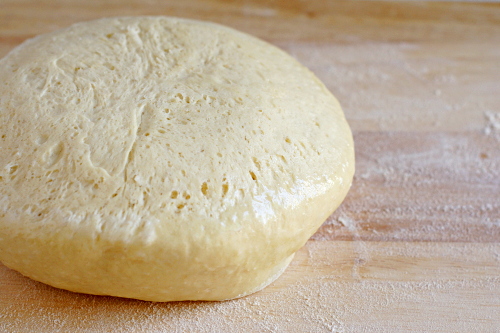
I based the bread recipe on a recipe for Parker House rolls, thinking that the butter in the recipe would give make it nice and tender, while the sugar would provide the flavor I wanted. It was a perfect match. The bread did expand more than I was expecting when I baked it, and I might (if such a thing is possible) have ended up with too much bread per dog. I’ll adjust the recipe and give better proportions below.

I found that the best method for rolling out the dough was to use my fingertips to flatten the dough balls a bit, and then roll in only one direction. I was using Nathan’s Beef Franks (recommended by Cooks Illustrated and definitely the best hot dogs I’ve had), which I think are a little shorter than most. Most of my rolls ended up just the right width to almost-but-not-quite coat the whole dog.

If you’re a perfectionist and want your pigs perfectly wrapped in those blankets, which I did but I didn’t figure out this trick until the last one, you can roll the bread dough out a little wider than the dog, then fold in the edges and roll a few times in the other (long) direction. You’ll have a more perfect rectangle, which will more perfectly coat your hot dog and evenly distribute your bread. And look a teensy bit better.

Either way, these are super fun, and other than roasting them over a fire until they’re slightly blackened, this has to be my favorite way to eat hot dogs!
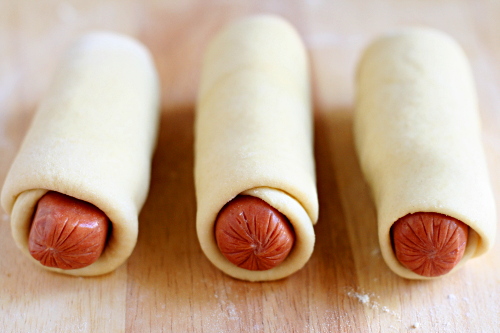
Pigs in a Blanket (bread recipe adapted from Ultimate Bread, by Eric Treuille and Ursula Feriggno)

This is enough bread dough for 10 hot dogs.  If your package only has 8, you can make dinner rolls out of the remaining dough.

Bread dough:
3 tablespoons unsalted butter
¾ cup milk
1½ tablespoons sugar
2 eggs
3½ cups (17½ ounces) unbleached flour
1½ teaspoons instant yeast
1½ teaspoons salt

10 hot dogs
2 tablespoons milk

1. Heat butter in small saucepan over medium heat until just melted. Add ¾ cup milk and sugar. If butter re-solidifies, heat until it’s completely melted. Remove from the heat and beat in the eggs.

2. Mix flour, salt, and yeast in bowl of standing mixer fitted with dough hook. Turn machine to low and slowly add milk mixture. When dough comes together, increase speed to medium (setting number 4 on a KitchenAid mixer) and mix until dough is smooth, shiny, and elastic, stopping machine two or three times to scrape dough from hook if necessary, about 8 minutes. Knead in extra flour, 1 tablespoon at a time, if the dough is too sticky. The dough should be not be dry, but soft. Turn dough onto lightly floured work surface; knead to form smooth, round ball, about 15 seconds. (Alternatively, you can knead by hand for 10 minutes.)

2. Place dough in very lightly oiled bowl, rubbing dough around bowl to lightly coat. Cover bowl with plastic wrap; place in warm, draft-free spot until dough doubles in size, about 1-1½ hours.

3. Divide the dough into 10 pieces. Shape each piece into a smooth ball. Let rest 10 minutes. Line baking pan with silicon baking mat or parchment paper.

4. Flatten each piece into a rough rectangle using the tips of your fingers. Roll in one direction until dough is ¼-inch thick. Roll in opposite direction (across shorter width) a few times, then fold in long edges to make perfect rectangle. Roll in long direction until dough is 1/8-inch thick. Place 1 hot dog near a short end, then tightly roll, keeping the tips of the hot dog exposed. Place seam side down on prepared baking pan. Repeat with remaining dough and hot dogs.

5. Cover with plastic wrap and let rise until dough is slightly inflated, about 30 minutes. Meanwhile, heat oven to 375 degrees.

6. Brush the dough with milk. Bake for 20-25 minutes, until golden. Let cool 15 minutes before serving.

cappuccino cream puff rings (twd)

I pulled a Peabody this week and tweaked the TWD recipe. (Not as much or as creatively as she usually does, I admit.) Caroline chose Peppermint Cream Puff Ring as this week’s recipe, but peppermint screams Christmas to me, and I’m loving summer too much to think about Christmas right now.

In the original recipe, the filling is made from cream that’s been steeped in mint leaves. I didn’t want the mint, but I did like the steeping. I considered a tea-flavored cream filling, but ultimately decided on a cappuccino-flavored dessert with coffee cream filling. Generally, coffee flavor is incorporated into desserts using instant espresso, but since even one slice of tiramisu will keep me up for hours, I wanted my cream puff to be decaf. I heated decaf coffee and cream until it boiled, then strained out the coffee and chilled the cream. When it was cold, I whipped it and folded in sour cream. I was a little unsure about the sour cream addition, but I surprised myself by really liking the tang that it added.

I also made individual serving sized rings, instead of one large ring, taking inspiration and tips from Eliza. I wish they were a little more robust; I should have used a larger piping tip or made three rings, with one stacked on the other two, like Dorie instructs for the larger ring. Because a few other members had had problems with the pastry collapsing, I was exceedingly careful when making mine. I beat the cooked flour-butter-liquid mixture for a few seconds before adding the eggs to make sure the eggs wouldn’t get too hot, and I pricked each ring with a paring knife after baking and before putting them back into the just-turned-off oven with the door propped open for half an hour.

I topped my rings with chocolate ganache and sprinkled them with cinnamon. (Not that I ever put either chocolate or cinnamon in my cappuccino, but the flavors did end up working here.) They look a little more like donuts than I prefer, but overall, I was surprised by how much I liked these. To be honest, I made them in the evening on a night when Dave was away for dinner, and I basically ate cream puffs for dinner. And dessert.

The original recipe has been published on epicurious.

deep dark chocolate cookies

I’m helpless in the face of recipes with names like Deep Dark Chocolate Cookies, even when I already have a deep, dark chocolate cookie recipe that I’m very happy with. I was intrigued by the lack of flour, butter, and egg yolks in this one. It seemed like that would produce a texture similar to a meringue cookie, but the recipe specifically refers to the cookies as dense and chewy.

Although the recipe was published in Bon Appetit’s fast and easy section, I’d say that the amount of work involved in on par with other cookie recipes. Chocolate is melted in one bowl, egg whites and sugar are beaten in another, and the dry ingredients – sugar and cocoa with just a bit of cornstarch and salt – are mixed in a third. The contents of the three bowls are blended together with an additional handful of chocolate chips. I considered it a good sign that the recipe contained chocolate in three forms.

The recipe states that once all of the ingredients are mixed together, the dough will become very stiff, and should then be rolled into balls and coated in powdered sugar. My dough was not “roll into balls” consistency. It was more like a really fudgy chocolate frosting than cookie dough. I simply scooped out a spoonful of dough, dropped it in powdered sugar, and pushed it around until it was evenly(ish) coated.

While the cookies were nice and chocolately, and I suppose dense and chewy, I considered the texture a bit off from what I prefer. There was indeed a similarity to meringue cookies, especially around the edges. I also thought the cookies were too sweet, which would be easily remedied by reducing the powdered sugar.

I definitely prefer my other recipe for chocolate cookies. However, these are the best gluten-free cookie I’ve ever eaten, with none of the “off” flavors that can sometimes occur in cookies based on gluten-free flour mixes. The cookies are also a bit healthier than your average cookie. The only fat in the recipe is chocolate, and once the sugar is reduced a bit (I’d say to ¾ cup in both the egg white mixture and the cocoa mixture instead of 1 cup), there’s about 100 calories per cookie, about 25% less than my favorite chocolate chip cookies.

Deep Dark Chocolate Cookies (from Bon Appetit June 2008 )

BA note: Made without butter or flour, these dense, chewy cookies will satisfy even the most intense chocolate craving.

Bridge note: I’d reduce the powdered sugar to ¾ cup (3 ounces) each in the egg white mixture and in the cocoa mixture. I also baked the cookies for 8 minutes.

Servings: Makes about 24

Nonstick vegetable oil spray
1½ cups bittersweet chocolate chips (about 9 ounces), divided
3 large egg whites, room temperature
2½ cups (10 ounces) powdered sugar, divided
½ cup (1½ ounces) unsweetened cocoa powder
1 tablespoon cornstarch
¼ teaspoon salt

Preheat oven to 400°F. Spray 2 large baking sheets with nonstick spray. Melt 1 cup chocolate chips in glass bowl in microwave, stirring twice, about 2 minutes. Cool slightly.

Using electric mixer, beat whites in large bowl to soft peaks. Gradually beat in 1 cup (4 ounces) sugar. Continue beating until mixture resembles soft marshmallow creme. Whisk 1 cup sugar (4 ounces), cocoa, cornstarch, and salt in medium bowl to blend. On low speed, beat dry ingredients into meringue. Stir in lukewarm chocolate and ½ cup chocolate chips (dough will become very stiff).

Place ½ cup (2 ounces) sugar in bowl. Roll 1 rounded tablespoon dough into ball; roll in sugar, coating thickly. Place on prepared sheet. Repeat with remaining dough, spacing 2 inches apart. Bake until puffed and tops crack, about 10 minutes. Cool on sheets on rack 10 minutes. Transfer to rack; cool.

poached eggs with arugula and polenta fingers

This is the weirdest thing I’ve made in a long time. I think I saw the recipe in Bon Appetit and caught that I liked each component – arugula salad, poached eggs, polenta – but didn’t stop to consider that those items might not belong on the same plate.

I’m not really that close-minded. Someone obviously enjoyed this, so there must be something good about it. I just needed to focus on that good.

There were moments of doubt. The coconut milk in the polenta is unusual, not to mention fattening, but then tasted surprisingly good. The original recipe recommends frying the polenta fingers on high in extra virgin olive oil, which is silly. I used a mixture of olive oil (not virgin) and canola oil, and it still smoked on medium-high heat. I did find that the heat must be turned up pretty high to brown the polenta.

I doubled the amount of dressing and greatly increased (quadrupled maybe) the amount of arugula. It was all going fine until I was actually putting the egg on the salad, and then I realized that egg on salad actually might not be my thing.

But, never mind, I guess it is my thing, and maybe Dave’s too. The egg was quite a nice topping for the salad, and the polenta fingers were a great accompaniment, especially when they were used to sop up extra vinaigrette. So if poached egg on salad is your thing, or if you’re willing to try something new, this recipe is worth your effort.

Poached Eggs with Arugula and Polenta Fingers (adapted from Bon Appetit May 2008 )

Makes 4 servings

Bridget note: I’ve made the recipe a bit more detailed than it is in the magazine, as well as changing the polenta and poached egg method to those of Cooks Illustrated.

For the polenta:
1 13.5- to 14-ounce can unsweetened coconut milk
water
½ cup polenta or coarse cornmeal
¼ teaspoon salt
2 tablespoons parmesan cheese
1 tablespoon olive oil
1 tablespoon canola oil

For the salad:
8 cups arugula
2 teaspoons balsamic vinegar
2 tablespoons olive oil
pinch salt
pinch black pepper

For the poached eggs:
4 eggs, each cracked into a small handled cup
2 tablespoons white vinegar
1 teaspoon salt

1. For the polenta: Pour coconut milk into 2-cup measuring cup and add enough water to make 2 cups liquid. Bring liquid to boil in medium heavy-bottomed saucepan over medium-high heat. Reduce the heat to the lowest possible setting, add salt, and pour the cornmeal into the water in a very slow stream from a measuring cup, all the while whisking in a circular motion to prevent lumps.

2. Cover and cook, vigorously stirring the polenta with a wooden spoon for about 10 seconds once every 5 minutes and making sure to scrape clean the bottom and corners of the pot, until the polenta has lost its raw cornmeal taste and becomes soft and smooth, about 30 minutes. Stir in the parmesan and season with salt and pepper to taste.

3. Spray 8-inch square baking pan with nonstick cooking spray. Pour polenta into pan and spread to corners. Press plastic wrap directly on surface of polenta and chill until firm, about 1 hour. (Can be made 1 day ahead and refrigerated.)

4. Turn polenta out onto cutting board. Cut into 4×1-inch rectangles. Heat oils in 12-inch nonstick skillet over medium-high heat. Working in two batches, add polenta fingers; cook until golden, about 3 minutes per side.

5. For the salad: While first batch of polenta cooks, whisk oil, vinegar, salt, and pepper in small bowl until combined. In large bowl, toss arugula with dressing and divide among salad plates.

6. For the poached eggs: While last batch of polenta cooks, fill an 8- to 10-inch nonstick skillet nearly to the rim with water, add the salt and vinegar, and bring the mixture to boil over high heat. Lower the lips of each cup just into water at once; tip eggs into boiling water, cover, and remove from heat. Poach until yolks are medium-firm, exactly 4 minutes. For firmer yolks (or for extra large or jumbo eggs), poach 4 ½ minutes; for looser yolks (or for medium eggs), poach 3 minutes.

7. Top each salad with a poached egg. Break yolks with tip of knife. Sprinkle with black pepper. Serve with polenta.

la palette’s strawberry tart

I joined TWD right at the beginning of strawberry season – when the first flavorless strawberries started showing up in stores, and I bought them just because I was excited about warmer weather and everything that goes along with it. I was eager to make one strawberry dessert after another during their short season, but the TWD recipe-choosers haven’t been on that same wavelength. (Of course, not all of TWD’s members are in the Northern Hemisphere anyway.) I still bought strawberries each week, and every week they’re more flavorful than the last. The strawberry tart that Marie chose for this week’s recipe was a perfect way to showcase delicious seasonal strawberries.

I make only a portion of most TWD recipes, since I’m only cooking for myself and Dave, and my capacity to bake outstrips our capacity to eat. But I didn’t want to take pictures of yet another mini-tart. I actually don’t have a fluted 9-inch tart pan, but I’ve successfully used my 9-inch springform pan for tarts in the past.

Dorie calls this dessert “rustic in the extreme”, so I decided to play that up. A rustic tart has no need for fluted, or even neat, edges, so I just quickly pressed the dough into the pan. A number of people had problems with the crust being too hard, so I was careful to only lightly press the dough. It did, however, end up ever so slightly more rustic than I had intended…

Although the recipe sounds extraordinarily simple – crust, jam, strawberries, whipped cream – it really does add up to more than its parts. I was surprised by how much the jam added to the flavor of the tart. My crust seemed more tender than most people described theirs, so maybe lightly pressing it into the pan worked? (Scratch that – I just cut the crust into slices, and it was a crumbly crackly mess.) I haven’t tried sprinkling the strawberries with Dorie’s suggested black pepper, but after reading a few positive reviews on that method, I’m going to try it with tonight’s serving. Although strawberry shortcake isn’t going anywhere as my favorite strawberry-showcasing dessert, I’m looking forward to finishing up this tart throughout the week.

Dorie has discussed this dessert and provided the recipe on Serious Eats. I made the recipe without any changes, but in the future, I’d like another 1/8 teaspoon salt in the crust.

pita

Pita is one of those things that is just so much better when made at home than bought from the grocery store. Or at least this recipe, which is the only pita I’ve made, is. The bread is more tender and of course flavorful than what I buy.

Pita isn’t any harder to make than other homemade bread. The dough is kneaded and allowed to rise, like other bread recipes. It’s then shaped into balls, left to rest a few minutes, and rolled into a thin oval. Like most kneaded doughs, this one doesn’t like to be rolled out and will probably need to rest half way through to let the gluten strands relax. Otherwise it’ll be like trying to roll out a giant rubber band.

Only the baking process differs substantially from other breads. Pita is baked on a pre-heated surface, which I’m guessing is what produces the characteristic pocket. I’ve seen recipes that use a pizza stone for this, but I’ve always just preheated a flour-coated baking pan. As much as I love my pizza stone, the baking pan seems a little easier.

These pita were a fantastic addition to the Middle Eastern feast I made a few weeks ago. But my lunch of leftovers the next day was at least as good as the dinner – hummus, falafel, and vegetables stuffed into the pita’s pocket made for an incredibly satisfying mid-day meal.

Pita (adapted from Ultimate Bread, by Eric Treuille and Ursula Feriggno)

UB note: The staple bread of the Middle East, called Khubz in Arabic, is more commonly known by its Greek name, Pita, in the west. Its soft, chewy crust, absorbent crumb, and hollow pouch make it the most versatile of breads, ideal to scoop up, dip in, wrap around, or be filled with all manner of food. Best served warm, Pita can be easily reheated: sprinkle lightly with water and warm in the oven. Keep Pita in a sealed plastic bag to prevent dryness.

Bridget note: The only things I’ve changed from the original recipe are adapting it for instant yeast and for a stand mixer.

Makes 8 breads

3½ (17.5 ounces) cups unbleached flour
2 teaspoons instant dry yeast
½ teaspoon sugar
1 teaspoon salt
1¼ cups water
1 tablespoons olive oil

1. Mix flour, salt, sugar, and yeast in bowl of standing mixer fitted with dough hook. Mix water and olive oil in 1-quart Pyrex liquid measuring cup. Turn machine to low and slowly add liquid. When dough comes together, increase speed to medium (setting number 4 on a KitchenAid mixer) and mix until dough is smooth, supple, and elastic, stopping machine two or three times to scrape dough from hook if necessary, about 10 minutes. Initially, the dough will be quite stiff. It will soften and stretch as you continue kneading. Turn dough onto lightly floured work surface; knead to form smooth, round ball, about 15 seconds. (Alternatively, you can knead by hand for 15 minutes.)

2. Place dough in very lightly oiled bowl, rubbing dough around bowl to lightly coat. Cover bowl with plastic wrap; place in warm oven until dough doubles in size, about 1½ hours.

3. Preheat oven to 425 degrees.

4. Divide the dough into 8 pieces. Shape each piece into a smooth ball. Let rest 10 minutes.

5. On a lightly floured work surface, roll out each ball to form an oval, 9 inches long and ¼ inches thick. Cover with a dish towel and proof until slightly risen, about 20 minutes.

6. Dust two baking sheets with flour and preheat in the oven for 5 minutes. Place the dough ovals on the hot baking sheets and return immediately to the oven. Bake for 5 to 10 minutes, until puffy. Wrap in a clean, dry cloth to keep the crusts soft and to prevent drying out.

I think these are the last of the pictures from my old camera. Woohoo!

5 question meme

Ah, that was possibly the best vacation ever. Six days with nothing to do but play in the waves, take pictures of my nephews, and drink beer on the beach. Everyone got along at least as well as could be expected, and I found that family vacations are that much more enjoyable when my husband is there too.

Shortly before I left, I was tagged by Elizabeth for the meme that’s been going around.

What were you doing 10 years ago?

Ten years ago I had just finished my first year of college, and I was spending the summer back at home working at a shoe store. I remember going hiking with my high school friends and my college roommate coming over once a week to eat tomato soup and watch TV.

What are 5 things on your to-do list today?

1 – Balance the checkbook and pay bills
2 – See a movie (We’ll do rock-paper-scissors to decide if we see Indiana Jones or Sex and the City)
3 – Pick through my pictures from the vacation, deleting the blurry or redundant ones
4 – Work on some job search correspondence
5 – Go to the bookstore and drink a cappuccino

5 snacks that I enjoy

1 – Ripe, seasonal fruit
2 – Cheese and crackers
3 – Beer (hey, it’s filling)
4 – Crudite, especially cauliflower, with dip
5 – Treats!  Cookies, brownies, muffins, any of that…

Things I would do if I was a billionaire:

1 – Various donations and such
2 – Buy a house on the beach
3 – Buy a boat and spend tons of time on it
4 – Pay for all of my nephews and nieces (and I suppose my kids when I have them) to go to the college of their choice
5 – Never work a 9-to-5 desk job

Places I’ve lived:

Buffalo Grove, IL
Hafr Al Batin, Saudi Arabia
Carlsbad, NM
Albuquerque, NM
Las Cruces, NM
(Carlsbad, NM, again)
South Bend, IN
Binghamton, NY
Syracuse, NY
Philadelphia area, PA

Jobs I’ve had:

Cashier and cook at a pizza joint
Stocker at a shoe store
Tutor during college
Intern at the Waste Isolation Pilot Plant
Cashier at Blockbuster
Teaching assistant while working on my master’s degree
Research assistant while working on my PhD
Adjunct professor

Since I’m late getting to this meme and it looks like most people have participated, I’m not going to tag anyone.

baba ghanoush, falafel, hummus

Oh my gosh, this was such a great meal. I had something similar at a restaurant a while ago when Dave and I stopped for lunch in Syracuse’s university area. I got the vegetarian combination plate, which included hummus, falafel, baba ganoush, pita, and I think tabbouleh. I was trying to recreate that fantastic meal at home. I forgot to make tabbouleh this time, which was fine because this was plenty of cooking as it was.

I took the easy way out and made all Cooks Illustrated recipes. The hummus is their recently published Restaurant-Style Hummus recipe, which has gotten some great reviews. I thought it was really good, although I don’t know if it was that much better than any other hummus I’ve made. But – then I made it again a few weeks later with beans I cooked myself and Oh.My.God, that was so good. I had no idea it would make that much of a difference.

Other than that lunch in Syracuse, this is the only baba ghanoush I’ve ever had. You’re supposed to grill the eggplant until it’s completely soft and smoky, but grilling isn’t an option for me, so I had to use the oven. I still thought it was really good. It reminds me a lighter, more vegetal hummus.

The falafel was my favorite part of the meal. Shocking, I know, that Dave and I both liked the deep-fried food the best. Also, this was my first experience with dried chickpeas, and I loved them. The same funky shape as canned chickpeas but absolutely hard as rocks.

There’s some overlap between these three items – tahini or chickpeas showed up in everything – but they still have very distinct personalities. Tabbouleh would have been a nice light contrast, so I’ll have to remember that next time. And I can’t wait until next time!

(I’ll talk about the pita in my next post.)

Baba Ghanoush, Oven Method (from Cooks Illustrated July 2001)

CI note: When buying eggplant, select those with shiny, taut, and unbruised skins and an even shape (eggplant with a bulbous shape won’t cook evenly). We prefer to serve baba ghanoush only lightly chilled. If yours is cold, let it stand at room temperature for about 20 minutes before serving. Baba ghanoush does not keep well, so plan to make it the day you want to serve it. Pita bread, black olives, tomato wedges, and cucumber slices are nice accompaniments.

Bridget note: Cooks Illustrated has grilling methods for this recipe as well, but I don’t have a grill, so the oven it was.

Makes 2 cups

2 pounds eggplant (about 2 large globe, 5 medium Italian, or 12 medium Japanese), each poked uniformly over surface with fork to prevent bursting
1 tablespoon lemon juice
1 small clove garlic , minced
2 tablespoons tahini paste
Table salt and ground black pepper
1 tablespoon extra-virgin olive oil , plus extra for serving
2 teaspoons chopped fresh parsley leaves

1. Adjust oven rack to middle position and heat oven to 500 degrees. Line rimmed baking sheet with foil, set eggplants on baking sheet and roast, turning every 15 minutes, until eggplants are uniformly soft when pressed with tongs, about 60 minutes for large globe eggplants, 50 minutes for Italian eggplants, and 40 minutes for Japanese eggplants. Cool eggplants on baking sheet 5 minutes.

2. Set small colander over bowl or in sink. Trim top and bottom off each eggplant. Slit eggplants lengthwise and use spoon to scoop hot pulp from skins and place pulp in colander (you should have about 2 cups packed pulp); discard skins. Let pulp drain 3 minutes.

3. Transfer pulp to workbowl of food processor fitted with steel blade. Add lemon juice, garlic, tahini, ¼ teaspoon salt, and ¼ teaspoon pepper; process until mixture has coarse, choppy texture, about eight 1-second pulses. Adjust seasoning with salt and pepper; transfer to serving bowl, cover with plastic wrap flush with surface of dip, and refrigerate 45 to 60 minutes. To serve, use spoon to make trough in center of dip and spoon olive oil into it; sprinkle with parsley and serve.

Chickpea Fritters-Falafel (from Cooks Illustrated’s The Best International Recipe)

The chickpeas in this recipe must be soaked overnight; you can not substitute canned beans or quick-soaked chickpeas because their texture will result in soggy falafel. A wire spider comes in handy here when cooking the falafel. Serve the falafel in lavash or pita bread with lettuce, pickled vegetables, and chopped tomatoes or cucumbers, or as an hors d’oeuvres with tahini sauce as a dip.

Makes 20 falafel

6 ounces dried chickpeas (1 cup), rinsed, picked over, and soaked overnight in water to cover by an inch
5 scallions, chopped coarse
½ cup packed fresh parsley leaves
½ cup packed fresh cilantro leaves
3 medium garlic cloves (about 1 tablespoon), minced or pressed through a garlic press
1 teaspoon salt
½ teaspoon ground black pepper
¼ teaspoon ground cumin
⅛ teaspoon ground cinnamon
2 quarts vegetable oil, for frying
1.Adjust an oven rack to the middle position and heat the oven to 200 degrees. Drain the chickpeas, discarding the soaking liquid. Process all of the ingredients except for the oil in a food processor until smooth, about 1 minute, scraping down the bowl as needed. Form the mixture into 1 tablespoon-sized disks, about ½ inch thick and 1 inch wide, and arrange on a parchment paper-lined baking sheet. (The falafel can be refrigerated at this point for up to 2 hours.)

3. Heat the oil in a 5-quart large Dutch over medium-high heat to 375 degrees. (Use an instant-read thermometer that registers high temperatures or clip a candy/deep-fat thermometer onto the side of the pan.) Fry half of the falafel, stirring occasionally and adjusting the heat as needed to maintain 375 degrees, until deep brown, about 5 minutes. Transfer to a paper towel-lined baking sheet using a slotted spoon or wire spider and keep warm in the oven. Return the oil to 375 degrees and repeat with the remaining falafel. Serve immediately with the sauce.

I’m out of town right now, eating truffles and drinking wine. I’ll be back next week to catch up on comments and other blogs!

french chocolate brownies (twd)

One of my favorite aspects of Dorie Greenspan’s Baking is that she gives twelve brownie recipes. There’s so much discussion about the best brownie recipe that it seems like sometimes the variety between brownies gets overlooked. Not only are there different add-ins – turtle brownies, espresso brownies, creme de menthe brownies – but there are different textures, and one isn’t necessarily better than another. Di’s TWD choice of French Chocolate Brownies was the first of Dorie’s brownies recipes that I tried.

Dorie tells a story of how these brownies were intended to be a rich chocolate cake, but her guests mistook them for brownies, and she didn’t correct them. I can see the confusion. The ingredient list is classic brownie, but the mixing method and resulting texture bridge the line between brownie and cake. Beating the eggs and sugar together until they’re thick creates a light, airy confection that is at the same time tender and moist and far less dense than most brownies.

Dorie calls for the unusual addition of flambéed raisins to the brownies, which most members of TWD weren’t excited about. I considered leaving that step out altogether, but didn’t want to miss out on the fun of flambéing. One of my favorite dessert combinations is raspberries and chocolate, so I used fresh raspberries. It was perfect. I think I’ll always add the raspberries to this recipe.

My only disappointment with these brownies was that they weren’t as chocolately as I would prefer, but I don’t blame Dorie for that. She says she prefers bittersweet chocolate over semisweet, but of course those words don’t have any official meaning in the US. I usually bake with Ghirardelli, whose bittersweet chocolate is 60% cacao, but this time I used Sharffenberger, whose semisweet is 60%, so I bought the semisweet. I probably should have used their bittersweet. On top of that, I read a Cooks Illustrated’s review of dark chocolates, and their comments for Sharffenberger included “lacked choco-oomph.” So perhaps it wasn’t the best choice of chocolate for this recipe.

But regardless, I’m nitpicking (again). I savored every single bite I took of these brownies, and I was sad when I finished each serving. I love that they’re chocolately and rich, but also unique for a brownie in their cakelike tenderness. And, an added bonus for a middle-brownie lover? There’s really no difference between the edges and middle. Every single serving is moist and light.

French Chocolate Brownies (from Dorie Greenspan’s Baking: From My Home to Yours)

16 brownies

Bridget note: I substituted about ½ cup fresh raspberries, halved, for the raisins. Instead of boiling them in water as in step 2, I gently heated them in a small skillet before adding the rum and continuing with step 2.

Update: I made these again, this time using a Pyrex dish instead of the metal pan I used for the original entry.  I don’t know if things bake faster in glass or what, but I must have overbaked them, because the brownies were too dry.   So check for doneness early!

½ cup all-purpose flour
⅛ teaspoon salt
⅛ teaspoon cinnamon (optional)
⅓ cup raisins, dark or golden
1½ tablespoons water
1½ tablespoons dark rum
6 ounces bittersweet chocolate, finely chopped
1½ sticks (12 tablespoons; 6 ounces) unsalted butter, at room temperature and cut into 12 pieces
3 large eggs, at room temperature
1 cup sugar

Getting ready: Center a rack in the oven and preheat the oven to 300°F. Line an 8-inch square baking pan with foil, butter the foil, place the pan on a baking sheet, and set aside.

1. Whisk together the flour, salt and cinnamon, if you’re using it.

2. Put the raisins in a small saucepan with the water, bring to a boil over medium heat and cook until the water almost evaporates. Add the rum, let it warm for about 30 seconds, turn off the heat, stand back and ignite the rum. Allow the flames to die down, and set the raisins aside until needed.

3. Put the chocolate in a heatproof bowl and set the bowl over a saucepan of simmering water. Slowly and gently melt the chocolate, stirring occasionally. Remove the bowl from the saucepan and add the butter, stirring so that it melts. It’s important that the chocolate and butter not get very hot. However, if the butter is not melting, you can put the bowl back over the still-hot water for a minute. If you’ve got a couple of little bits of unmelted butter, leave them-it’s better to have a few bits than to overheat the whole. Set the chocolate aside for the moment.

4. Working with a stand mixer with the whisk attachment, or with a hand mixer in a large bowl, beat the eggs and sugar until they are thick and pale, about 2 minutes. Lower the mixer speed and pour in the chocolate-butter, mixing only until it is incorporated-you’ll have a thick, creamy batter. Add the dry ingredients and mix at low speed for about 30 seconds-the dry ingredients won’t be completely incorporated and that’s fine. Finish folding in the dry ingredients by hand with a rubber spatula, then fold in the raisins along with any liquid remaining in the pan.

5. Scrape the batter into the pan and bake 50 to 60 minutes, or until the top is dry and crackled and a knife inserted into the center of the cake comes out clean. Transfer the pan to a rack and allow the brownies to cool to warm or room temperature.

6. Carefully lift the brownies out of the pan, using the foil edges as handles, and transfer to a cutting board. With a long-bladed knife, cut the brownies into 16 squares, each roughly 2 inches on a side, taking care not to cut through the foil.

Serving: The brownies are good just warm or at room temperature; they’re even fine cold. I like these with a little something on top or alongside-good go-alongs are whipped crème fraiche or whipped cream, ice cream or chocolate sauce or even all three!

Storing: Wrapped well, these can be kept at room temperature for up to 3 days or frozen for up to 2 months.

I’m out of town this week, building sand castles and burying nephews in the sand. I’ll be back next week to catch up on comments and other blogs!

kaiser rolls

I said recently that my health nut phase didn’t last long, and while I no longer stress about eating white rice or refined sugar, I do feel a little guilty buying white bread. There are some breads, mostly artisanal, that I prefer made with all white flour, but usually I like the flavor and nutrition of at least a portion of whole wheat flour.

I love Kaiser rolls for sandwiches, and Peter Reinhart’s Bread Baker’s Apprentice has some enticing pictures accompanying his recipe. The recipe follows Reinhart’s standard method of using a portion of pre-fermented dough to maximize the flavor of the final product.

The result, of course, was very good. But, there are a few changes I want to make. Mostly I want them to be a little sweeter. The only sugar in the recipe is just a bit of barley malt syrup. In the future, I’ll add honey or granulated sugar. Also, Reinhart’s photo looks like he used an egg wash or something, which he doesn’t call for in the recipe. His are so shiny and pretty, I think I might use an egg wash, or at least milk, next time.

Overall though, these were good, and fun. And with the whole wheat flour I added, just a bit healthier than what I would have got from the grocery store.

Kaiser Rolls (from Peter Reinhart’s Bread Baker’s Apprentice)

Makes 6 large rolls or 9 smaller rolls (I made 8 rolls and thought they were pretty big)

Bridget note: Next time, I’ll add 2 tablespoons honey or 3 tablespoons granulated sugar to the dough. I’ll also brush the rolls with milk just before baking.

1½ cups (8 ounces) pate fermentée
1¼ cups (10 ounces) unbleached bread flour
¾ teaspoon plus a pinch (0.2 ounce) salt
1 teaspoon (0.11 ounce) instant yeast
1 large egg, slightly beaten
1½ teaspoons (0.33 ounce) barley malt syrup
1½ tablespoons (0.75 ounce) vegetable oil or shortening, melted
10 tablespoons to ¾ cup (5 to 6 ounces) water lukewarm

1. Take the paté fermentée out of the refrigerator 1 hour before making the dough. Cut it up into about 10 small pieces with a pastry scraper or serrated knife. Cover it with a towel or plastic wrap and let sit for 1 hour to take off the chill.

2. Stir together the flour, salt, and yeast in a 4-quart bowl (or in the bowl of an electric mixer). Add the pate fermentée, egg, barley malt syrup, oil, and 10 tablespoons water. Stir (or mix on low speed with the paddle attachment) for 1 minute, or until the ingredients form a ball. If there is still some loose flour, add the remaining 2 tablespoons water.

3. Lightly dust the counter with flour, transfer the dough to the counter, and begin kneading (or mix on medium speed with the dough hook). Knead for about 10 minutes (6 minutes by machine), adding flour, if needed, to make a dough that is soft and supple, tacky but not sticky. The dough should pass the windowpane test and the internal temperature should register 77 to 81 degrees. Lightly oil a large bowl and transfer the dough to the bowl, rolling it to coat with the oil. Cover the bowl with plastic wrap.

4. Ferment at room temperature for 2 hours, or until the dough doubles in size. If the dough doubles in size before 2 hours have elapsed, remove it, knead it lightly to degas it, and return it to the bowl to continue fermenting until doubled from original size or until 2 hours have elapsed.

5. Remove the dough from the bowl and divide it into 6 to 9 equal pieces (4 ounces for large rolls, 2⅔-ounce pieces for smaller rolls). Form the pieces into rolls. Mist the rounds lightly with spray oil, cover with a towel or plastic wrap, and let the dough relax for 10 minutes. Meanwhile, line a sheet pan with baking parchment, lightly mist it with spray oil, and then dust with semolina flour or cornmeal.

6. Prepare the individual rolls by cutting them with a Kaiser rolls cutter or knotting them. To knot them, roll out a round of dough into a 12-inch strand (shorter for smaller rolls). Tie a simple knot. Loop the two ends through the center of the knot a second time (see pictures) Place the rolls, cut side down, on the parchment, mist lightly with spray oil, and loosely cover the pan with plastic wrap of a food-grade plastic bag.

7. Proof the rolls for 45 minutes at room temperature, then flip them over so the cut or folded side is facing up. Mist again with spray oil, cover the pan, and continue proofing for another 30 to 45 minutes, or until the rolls are double their original size.

8. Preheat the oven to 425 degrees with the oven rack on the middle shelf. Uncover the rolls and prepare them for baking. If you want seeds on your rolls, mist them with water and sprinkle poppy seeds over the top. If not, just mist them with water.

9. Place the pan in the oven, spray the oven walls with water, and close the door. After 10 minutes, rotate the pan for even baking and lower the oven setting to 400 degrees. Continue baking until the rolls are a medium golden brown and register approximately 200 degrees in the center. This will take 15 to 20 minutes for large rolls, or less for smaller rolls.

10. Remove the rolls from the pan and transfer to a cooling rack. Wait at least 30 minutes before serving.

Pate fermentée

This is twice what you need for one recipe of Kaiser rolls.

1 1/8 cups (5 ounces) unbleached all-purpose flour
1 1/8 cups (5 ounces) unbleached bread flour
¾ teaspoon salt
½ teaspoon instant yeast
¾ cup to ¾ cup plus 2 tablespoons (6 to 7 ounces) water

1. Stir together the flours, salt, and yeast in a 4-quart bowl (or in the bowl of a standing mixer). Add ¾ cup of the water, stirring until everything comes together and makes a coarse ball (or mix on low speed for 1 minute with the paddle attachment). Adjust the flour or water, according to need, so that the dough is neither too sticky nor too stiff. (It is better to err on the sticky side, as you can adjust easier during kneading. It is harder to add water once the dough firms up.)

2. Sprinkle some flour on the counter and transfer the dough to the counter. Knead for 4 to 6 minutes (or mix on medium speed with the dough hook for 4 minutes), or until the dough is soft and pliable, tacky but not sticky. The internal temperature should be 77 to 81 degrees.

3. Lightly oil a bowl and transfer the dough to the bowl, rolling it around to coat it with oil. Cover the bowl with plastic wrap and ferment at room temperature for 1 hour, or until it swells to about 1½ times its original size.

4. Remove the dough from the bowl, knead it slightly to degas, and return it to the bowl, covering the bowl with plastic wrap. Place the bowl in the refrigerator overnight. You can keep this in the refrigerator for up to 3 days, or freeze it in an airtight plastic bag for up to 3 months.

I’m out of town this week, walking along the ocean and hiking around a lake. I’ll be back next week to catch up on comments and other blogs!