summer fruit galette (twd)

It’s safe to say that this Summer Fruit Galette, chosen for TWD by Michelle, wasn’t my best effort. My baking has gotten really out of control lately – my freezer is full of cupcakes, cookies, muffins, and breads. There’s cookie dough and half a cake in my refrigerator. (But I finally found someone to offload some of this excess onto, so I’m excited about that!) My capacity to bake has far outstripped our capacity to eat. I thought the galette would fit into this pattern perfectly because I could pare down the recipe, which would be tricky with a regular pie.
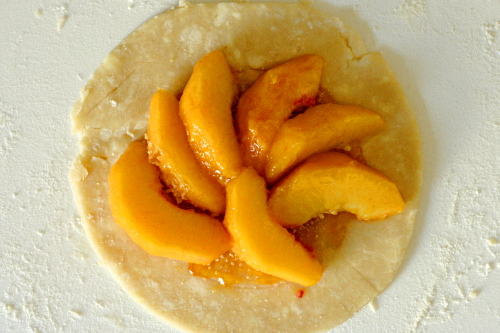
Last time I made Dorie’s pie crust, I was pretty happy with it, but was put off by the shortening. Mari suggested substituting lard for the shortening, and since the galette uses the same dough as the blueberry pie did, I had that opportunity. I didn’t notice any big differences between the crusts made with shortening and with lard – they seemed equally easy to work with and flavorful. But a few weeks ago, I had noticed two or three TWD members who had problems with the pie crust sort of melting in the oven, and I had a little of that problem this time. In short, I’m going to stick with my old favorite pie crust. They’re both good, but I’ve been using that one for years and I’ve always been happy with it. (I’ll put it on my blog at some point or another – probably the next pie recipe TWD makes.)

The rest of my problems with the galette were my fault. I only made a quarter of the recipe, and I’m afraid that that’s an impractically small fraction. The ratio between the area necessary to hold fillings and the area necessary to pleat the edges gets thrown off, and you end up with far more crust per filling than the recipe intended. And one of the parts of this recipe that I was very interested in was the custard topping that gets poured over the fruit, but again, with so little filling exposed, I was only able to dribble in the slightest amount of custard mix before it overflowed and made a mess.

Despite all of my foibles making this dessert, I still really enjoyed it. I can tell the potential for a really amazing dessert is there. This is another example of how Dorie takes just a few ingredients and shows them off to their best advantage.

The recipe can be found on Melissa’s website.

white cake comparison

Several months ago for the Daring Bakers, I made Dorie Greenspan’s Perfect Party Cake. Most of the group members, including myself, had very positive things to say about this cake. However, many of us, again including myself, found that the cake didn’t rise much. Granted, the copy of the recipe I used had a typo in it regarding the amount of flour, but that wasn’t the case with everyone who had problems.

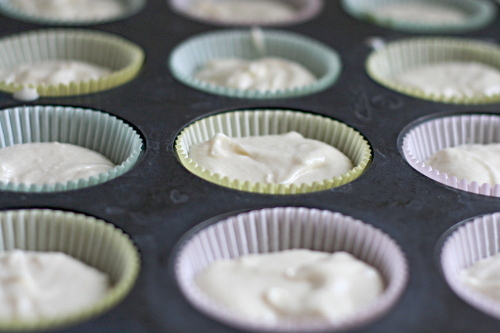
So a few weeks ago when I made white cupcakes, I used a different recipe, by Nick Malgieri. The recipe calls for 2 cups all-purpose flour, but I was pretty sure I’d like it better with cake flour, so I used 2¼ cups cake flour instead. The cupcakes were definitely good, but just the slightest bit dry.

Now I was on a mission. Is it just a characteristic of white cake that it’s dry? Would Dorie’s recipe be perfect if I used the correct amount of flour, or would Nick’s be better if I followed it exactly? And why not throw a third recipe into the mix, and try one from my old favorite, Cooks Illustrated?

I pared the recipes down so that they each used 2 eggs, and I made cupcakes. I made them all in one afternoon, leaving the oven on between batches and not adjusting the dial, to make sure oven temperature wasn’t a factor in any differences. I left out any flavorings besides vanilla, used the same amount of vanilla in each, and used whole milk in all three recipes.

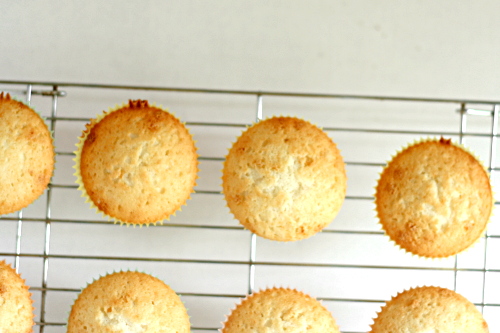
You can see that the three look very different. Left to right, the photos show Dorie’s, Nick’s, and CI’s. Nick’s looks drastically different, which I can attest is due to the all-purpose flour. The photo below shows the result of Nick’s recipe when made with cake flour. It more closely resembles the other two.

The difference in taste and texture mirrors the difference in looks. Nick’s cupcakes are far drier than Dorie’s and CI’s. You can see that their texture looks more muffin-like with a coarser crumb. Dorie and CI’s are more similar. They’re both fluffy and light with a nice resiliency. Dorie’s cupcakes rose nicely, in contrast to when I made the layer cake in March.

At first, Dave and I agreed that CI’s beat out Dorie’s by a hair. They seemed moister and more flavorful. But later on, I did a comparison of just those two, unfrosted, and I was able to spot some subtle differences. CI’s cupcakes are undeniably moister. They are also sweeter. Dorie’s cupcakes aren’t as sweet, but I do like their flavor. Without the sweetness, some of the other flavors in the cupcake are noticeable.

The question then arises – what causes these differences? I’ve laid out the points of the recipe that I think would have the most significant impact on the outcome. I’ve entered Malgieri’s recipe as using 9 ounces (2¼ cups) cake flour instead of 10 ounces (2 cups) flour, since it seems pretty clear that all-purpose flour in a cake as light as white cake is a bad idea. I’m guessing Malgieri’s cupcakes are drier because they use less milk. Obviously CI’s are sweeter because they have more sugar. Dorie’s and CI’s recipes, which produced similar results, are actually pretty different. Dorie’s uses less butter and sugar, which I’m assuming is balanced by more milk and less egg whites so the cupcakes aren’t dry. I think the coarser, more muffin-like texture of Malgieri’s cupcakes might arise from the lack of a final beating step after all the ingredients are added.

I wonder if I can tweak the recipes to get my favorite aspects of each. It’s not as simple as just reducing the sugar in CI’s recipe, because sugar contributes moistness. But maybe I should reduce the sugar by 2 tablespoons and increase the milk by 2 tablespoons. It’s worth trying, but to be honest, after this experiment, I think it’s going to be a while before I feel the urge to make white cake again!

Classic White Layer Cake (from Cooks Illustrated)

Serves 12

CI note: If you have forgotten to bring the milk and egg white mixture to room temperature, set the bottom of the glass measure containing it in a sink of hot water and stir until the mixture feels cool rather than cold, around 65 degrees. Cake layers can be wrapped and stored for one day.

Nonstick cooking spray
2¼ cups cake flour (9 ounces), plus more for dusting the pans
1 cup whole milk, at room temperature
6 large egg whites (¾ cup), at room temperature
2 teaspoons almond extract
1 teaspoon vanilla extract
1¾ cups granulated sugar (12¼ ounces)
4 teaspoons baking powder
1 teaspoon table salt
12 tablespoons unsalted butter (1½ sticks), softened but still cool

1. For the Cake: Set oven rack in middle position. (If oven is too small to cook both layers on a single rack, set racks in upper-middle and lower-middle positions.) Heat oven to 350 degrees. Spray two 9-inch round cake pans with nonstick cooking spray; line the bottoms with parchment or waxed paper rounds. Spray the paper rounds, dust the pans with flour, and invert pans and rap sharply to remove excess flour.

2. Pour milk, egg whites, and extracts into 2-cup glass measure, and mix with fork until blended.

3. Mix cake flour, sugar, baking powder, and salt in bowl of electric mixer at slow speed. Add butter; continue beating at slow speed until mixture resembles moist crumbs, with no powdery streaks remaining.

4. Add all but ½ cup of milk mixture to crumbs and beat at medium speed (or high speed if using handheld mixer) for 1½ minutes. Add remaining ½ cup of milk mixture and beat 30 seconds more. Stop mixer and scrape sides of bowl. Return mixer to medium (or high) speed and beat 20 seconds longer.

5. Divide batter evenly between two prepared cake pans; using rubber spatula, spread batter to pan walls and smooth tops. Arrange pans at least 3 inches from the oven walls and 3 inches apart. (If oven is small, place pans on separate racks in staggered fashion to allow for air circulation.) Bake until thin skewer or toothpick inserted in the center comes out clean, 23 to 25 minutes.

6. Let cakes rest in pans for 3 minutes. Loosen from sides of pans with a knife, if necessary, and invert onto wire racks. Reinvert onto additional wire racks. Let cool completely, about 1½ hours.

Dorie Greenspan’s Perfect Party Cake recipe can be found here.

Classic White Cake (from Nick Malgieri)

12 tablespoons (1½ sticks) unsalted butter, softened
1½ cups sugar
2 cups all-purpose flour
2 teaspoons baking powder
¼ teaspoon salt
6 large egg whites (¾ cup)
¾ cup milk
2 teaspoons vanilla extract
2 (9-inch) diameter by 1 ½ -inch deep layer pans or 1 (13 by 9 by 2-inch) pan, buttered and bottoms lined with parchment or waxed paper

Set a rack at the middle level of the oven and preheat to 350 degrees. In a large mixing bowl, beat butter and sugar for about 5 minutes, until light and fluffy. Stir together flour, baking powder and salt. Set aside. Combine egg whites, milk and vanilla extract. Add ⅓ of the flour mixture to butter mixture then add half the milk mixture. Continue to alternate beginning and ending with flour mixture. Scrape bowl and beater often. Pour batter into prepared pan(s) and smooth top with a metal spatula. Bake cake(s) about 25 to 30 minutes, or until a toothpick inserted in the center emerges clean. Cool in pan on a rack for 5 minutes, then turn out onto a rack, remove paper and let cool completely.

*To make cupcakes from any of these recipes, line a standard-sized muffin pan with baking-cup liners. Fill cups just over ½ full with batter. Bake at 350 degrees for 18-21 minutes.

cherry rhubarb cobbler (twd)

Amanda chose possibly the healthiest recipe in the TWD cookbook. A portion of the flour in the biscuits is whole wheat and there’s <gasp> less than a tablespoon of butter per serving.

Combining rhubarb and cherries is a little unusual – Dorie does it because they have contrasting and complimentary flavors. Fair enough, but they also both have notoriously short seasons that only slightly overlap. I was lucky to find fresh rhubarb still available.

I love rhubarb in uses like this – it cooks down so soft as to be unnoticeable except for the sweet-tart flavor it lends. Sweet cherries, it turns out, I’m not so fond of in cooked fruit desserts. It sounds weird, but I’m annoyed at how well they hold their shape. I guess I want them to cook down and blend in with the other filling ingredients.

The biscuits were fine. Not as light and tender as the ones from Dorie’s other cobbler; these were more dense and bready. (I swear I didn’t overmix them.) They weren’t bad by any means, but maybe a little more wholesome than I prefer for dessert.

Dave, of course, loved the whole thing. He generally prefers healthier food than I do. When we eat out, I order steak and potatoes while he gets fish and vegetables. This cobbler was right up his alley.

Amanda will post the recipe on her blog.

chocolate pudding (twd)

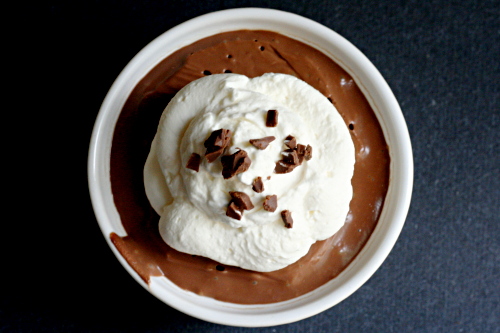
Melissa’s TWD pick of chocolate pudding really hit the spot for me this week. I hadn’t made anything chocolately in a while, and something smooth and cool like pudding is perfect for the hot summer weather right now. Also, as much as I like to cook, it’s nice to have something simple every once in a while.

Oh, except that I’m incapable of keeping things simple in the kitchen. I’ve had my eye on the chocolate pudding recipe that Deb posted a few months ago. Deb was looking for an easy pudding recipe after making her way through a disappointing one that sounds suspiciously familiar now that I’ve made Dorie’s pudding recipe. Deb’s pudding looks dark and chocolately and delicious, and as an added bonus, there’s no egg yolks to mess with. I decided to make both recipes and compare them. (I made a third recipe as well, but it didn’t set properly, so I’m not going to review it on the assumption that I screwed something up.)

Both puddings had their strong points. The eggless pudding had a much darker chocolate flavor, which I like but Dave isn’t crazy about. It was also really firm. Overall, it reminded me more of chocolate pots de crème than good ol’ pudding. In contrast, the chocolate flavor of Dorie’s pudding seemed weak, at least to me. However, the texture was that of a perfectly smooth and refreshing pudding.

Clearly, Dorie’s recipe requires more effort, what with moving the pudding back and forth between the food processor and the stove. I haven’t decided if it was worth it. I’d like to take Deb’s recipe (or maybe the third recipe I tried, which was similar), and tweak it. I think if I just add a little more milk, it won’t be so overpoweringly chocolately and the texture will soften to be more like a pudding. But we’ll see.

Dorie’s pudding recipe can be found on her blog.

Silky Chocolate Pudding (adapted from Smitten Kitchen; originally from John Sharffenberger)

Serves 6

Bridget note: There was no coating the back of a spoon after 20 minutes on a double boiler over gently simmering water. I’m assuming this is because I used a glass bowl instead of a metal bowl. I cranked the heat up and cooked it for another 10 minutes or so over a very lively simmer, and that did the trick.

¼ cup cornstarch
½ cup sugar
⅛ teaspoon salt
3 cups whole milk
6 ounces 62% semisweet chocolate, coarsely chopped
1 teaspoon pure vanilla extract

1. Combine the cornstarch, sugar and salt in the top of a double boiler. Slowly whisk in the milk, scraping the bottom and sides with a heatproof spatula to incorporate the dry ingredients. Place over gently simmering water and stir occasionally, scraping the bottom and sides. Use a whisk as necessary should lumps begin to form. After 15 to 20 minutes, when the mixture begins to thicken and coats the back of the spoon, add the chocolate. Continue stirring for about 2 to 4 minutes, or until the pudding is smooth and thickened. Remove from the heat and stir in the vanilla.

2. Strain through a fine-mesh strainer into a serving bowl or into a large measuring cup with a spout and pour into individual serving dishes.

3. If you like pudding skin, pull plastic wrap over the top of the serving dish(es) before refrigerating. If you dislike pudding skin, place plastic wrap on top of the pudding and smooth it gently against the surface before refrigerating. Refrigerate for at least 30 minutes and up to 3 days.

blueberry pie (twd)

Blueberry season snuck up on me. When I first saw that Amy’s TWD pick this week was blueberry pie, I hadn’t yet seen seasonal blueberries at the store. But when I went just a few days later, blueberries had replaced strawberries in the produce place of honor. Phew. (Then we went camping in the supposed “blueberry capital of the world”, so…yeah, finding blueberries didn’t end up being a problem.)

Like most somewhat experienced bakers, I already have a favorite pie crust recipe. It’s tasty, flaky, easy to work with, and doesn’t require shortening. However, if I stubbornly cling to my old favorites and refuse to try new recipes, I’ll stagnate as a baker and a cook. I was certainly willing to give Dorie’s pie crust recipe a try.

I also have a favorite blueberry pie recipe, but again, with the trying new things…

Dorie’s pie crust knocked my socks off. It was delicious, flaky, tender, and even easier to work with than my other recipe. However, the shortening is actually a deal breaker with me. I’d rather be careful that my pie crust is chilled enough when I’m rolling it out than eat hydrogenated fats. Also, I think Dorie’s recipe needs to be scaled back a bit. It makes about 20% more crust than other recipes I’ve used, and as a result, the pie had a higher crust to fruit ratio than I like, even though I think I like pie crust more than most people. (Depending on the quality of the crust, of course.)

The filling, well, it reminded me that I love blueberry pie. I ate four (small, I swear!) pieces in one day. I reduced the sugar from 1 cup to ¾ cup, and I’m glad I did, I think I used just the right amount of sugar. I also didn’t have the lemon zest that I was supposed to use, so I fudged that with a bit of lemon extract. I still like my other recipe better – it uses cinnamon as a supporting flavor instead of Dorie’s lemon, and the cinnamon is surprisingly perfect with the blueberries.

The recipe calls for bread crumbs to be scattered on the bottom crust before the filling ingredients are added. I’m not putting breadcrumbs in blueberry pie; it’s just not happening. I considered using graham cracker crumbs, but ultimately got lazy and skipped this step entirely. I bake pies on a preheated baking sheet, which I think helps brown the bottom crust and keep it crispy. I had no problems with my crust getting soggy.

The recipe can be found on Amy’s blog.

vanilla ice cream

I love it when I get food as gifts. There’s so many great foods out there that I’m too frugal to splurge on for myself even though I really want to try them. I’ve never had artisanal balsamic vinegar or Valrhona chocolate, and I can never bring myself to get the expensive bottle of olive oil. My sister gave me this chocolate wine sauce for Christmas, and it’s a perfect example. I would have tried the free sample of this and thought “oh, it’s so good, I want to take some home!” and then I would have looked longingly at it and talked myself out of buying any.

So I was really excited to get it as a gift – so excited, in fact, that I waited 6 months to open it. That’s right, I’m one of those people who has to wait for the perfect opportunity for open that special bottle. I had told myself that I wanted to have the sauce on homemade vanilla ice cream, and I just never got around to making it earlier in the year. What’s really silly is that I made three pound cakes in March! But I was too stubborn to open the bottle for pound cake.

Ah, but it was worth the wait. Of course I knew that I liked red wine and that I liked chocolate, but I had forgotten how much I like red wine and chocolate together. The sauce has the perfect proportions of each component. It seems really sweet to me, but that’s probably because I like chocolate really dark.

The ice cream should in no way be passed over in favor of the sauce. This is the third vanilla ice cream recipe I’ve made (after Cook’s Illustrated’s and Alton Brown’s) and by far the smoothest. I do have in mind to try one more vanilla ice cream recipe, but it has a lot of live up to after this one.

Vanilla Ice Cream (from David Lebovitz)

About 1 quart

1 cup milk
a pinch of salt
¾ cups sugar
1 vanilla bean
5 egg yolks
2 cup heavy cream
a few drops of vanilla extract

1. Heat the milk, salt, and sugar in a saucepan. Split the vanilla bean lengthwise and scrape the seeds into the milk with the tip of a paring knife. Add the bean pod to the milk.

2. Stir together the egg yolks in a bowl and gradually add some of the warmed milk, stirring constantly as you pour. Pour the warmed yolks back into the saucepan.

3. Cook over low heat, stirring constantly and scraping the bottom with a heat-resistant spatula until the custard thickens enough to coat the spatula. Strain the custard into the heavy cream. Rinse the vanilla bean and put it back into the custard and cream to continue steeping. Chill thoroughly, then remove the vanilla bean and freeze in your ice cream maker according to the manufacturer’s instructions.

danish braids (daring bakers)

Wow, who knew making Danish dough would be so easy? I’d previously considered making some sort of laminated dough, Danish or croissants or the like, but the number of steps involved with those recipes made me think that it would be an intense project requiring the better part of a day.

Not so. While the dough needs some babysitting, each step of rolling the dough flat and folding it into thirds, repeated three times, takes only a minute or two.

And good thing, because I made two separate Danish doughs. After I quickly scanned the recipe near the beginning of the month, I started thinking about what I wanted to fill my Danishes with. I settled on a savory and a sweet version, and it wasn’t until a few days before the posting date, when I looked closer at the recipe, that I realized that the dough itself was sweet and might not be a good match for the red pepper, Italian sausage, and parmesan I’d planned to fill it with. So I made the dough twice, once as written (except leaving out the cardamom, orange zest, and vanilla bean due to laziness) to be filled with cherries and almonds, and another time, reducing the sugar, increasing the salt, replacing the orange juice with water, and eliminating the vanilla extract.

I was very happy with both the sweet and the savory breads. I thought the dough might be flakier than it was, but perhaps this was due to the heat in my kitchen when I was working with the dough. Maybe the butter melted into the dough instead of remaining as separate layers. Or maybe that’s just how this dough is. Regardless, it was very tender. I did think that it needed a bit more salt, and this is something I’ll take into account in the future.

Overall, this was a great learning experience. Now that I know what’s involved with making a laminated dough, I feel much more confident trying similar recipes, like croissants and puff pastry.

Danish Braids

This is the recipe as I made it. You can find the original recipe at this month’s hosts’ sites.

Sweet Danish Dough:
¾ teaspoon active dry yeast
2 tablespoons whole milk
1½ tablespoons sugar
½ teaspoon vanilla extract
½ large eggs, chilled
1 tablespoon fresh orange juice
4 ounces all-purpose flour
¼ teaspoon salt

Savory Danish Dough:
¾ teaspoon active dry yeast
2 tablespoons whole milk
1 teaspoon sugar
½ large eggs, chilled
1 tablespoon water
4 ounces all-purpose flour
1/3 teaspoon salt

For the butter block (Beurrage)
8 tablespoons (1 stick) cold unsalted butter
2 tablespoons all-purpose flour

For the dough: Combine yeast and milk in the bowl of a mixer fitted with the paddle attachment and mix on low speed. Slowly add sugar, vanilla extract, egg, and orange juice. Mix well. Change to the dough hook and add the salt with the flour, 1 cup at a time, increasing speed to medium as the flour is incorporated. Knead the dough for about 5 minutes, or until smooth. You may need to add a little more flour if it is sticky. Transfer dough to a lightly floured baking sheet and cover with plastic wrap. Refrigerate for 30 minutes.

For the butter block: Combine butter and flour in the bowl of a mixer fitted with a paddle attachment and beat on medium speed for 1 minute. Scrape down the sides of the bowl and the paddle and then beat for 1 minute more, or until smooth and lump free. Divide in two and set aside at room temperature.

2. After the dough has chilled 30 minutes, turn it out onto a lightly floured surface. Roll the dough into a rectangle approximately 9 x 6.5 inches and ¼ inch thick. The dough may be sticky, so keep dusting it lightly with flour. Spread the butter evenly over the center and right thirds of the dough. Fold the left edge of the dough to the right, covering half of the butter. Fold the right third of the rectangle over the center third. The first turn has now been completed. Mark the dough by poking it with your finger to keep track of your turns, or use a sticky and keep a tally. Place the dough on a baking sheet, wrap it in plastic wrap, and refrigerate for 30 minutes.

3. Place the dough lengthwise on a floured work surface. The open ends should be to your right and left. Roll the dough into another approximately 6.5 x 9 inch, ¼-inch-thick rectangle. Again, fold the left third of the rectangle over the center third and the right third over the center third. No additional butter will be added as it is already in the dough. The second turn has now been completed. Refrigerate the dough for 30 minutes.

4. Roll out, turn, and refrigerate the dough two more times, for a total of four single turns. Make sure you are keeping track of your turns. Refrigerate the dough after the final turn for at least 5 hours or overnight. The Danish dough is now ready to be used. If you will not be using the dough within 24 hours, freeze it. To do this, roll the dough out to about 1 inch in thickness, wrap tightly in plastic wrap, and freeze. Defrost the dough slowly in the refrigerator for easiest handling. Danish dough will keep in the freezer for up to 1 month.

Cherry filling:
1 can cherries, drained, ¼ cup juice reserved
1.5-2 tablespoons sugar
½ tablespoon cornstarch
pinch salt
drop almond extract
¾ teaspoon brandy
toasted almonds

Stir sugar, cornstarch, and salt together in saucepan. Whisk in reserved cherry juice and wine. Cook, whisking frequently, over medium-high heat, until mixture simmers and thickens. Stir in almond extract and cherries. Cover and refrigerate until ready to use. Add to braid along with toasted almonds.

Sausage filling:
¼ pound sausage
½ red pepper, diced

Put sausage and ¼ cup water in medium-large skillet. Cook over medium-high heat until water evaporates and sausage cooks through and browns, about 7 minutes, breaking up large pieces. Remove sausage with slotted spoon. Add enough oil so that amount in skillet equals about 1 tablespoon. Add peppers and sauté until softened slightly, about 5 minutes. Season to taste with salt and pepper. Remove and set aside. Add to braid along with grated pecorino and parmesan cheese.

DANISH BRAIDS:
2 sets of Danish Dough
½ cup of each filling

Beat 1 large egg for egg wash

1. Line a baking sheet with a silicone mat or parchment paper. On a lightly floured surface, roll the Danish Dough into a 10 x 15-inch rectangle, ¼ inch thick. If the dough seems elastic and shrinks back when rolled, let it rest for a few minutes, then roll again. Place the dough on the baking sheet.

2. Along one long side of the pastry make parallel, 4-inch-long cuts with a knife or rolling pastry wheel, each about ¾ inch apart. Repeat on the opposite side, making sure to line up the cuts with those you’ve already made.

3. Spoon the filling you’ve chosen to fill your braid down the center of the rectangle. Starting with the top and bottom “flaps”, fold the top flap down over the filling to cover. Next, fold the bottom “flap” up to cover filling. This helps keep the braid neat and helps to hold in the filling. Now begin folding the cut side strips of dough over the filling, alternating first left, then right, left, right, until finished. Trim any excess dough and tuck in the ends.

Egg Wash
Lightly coat the braid with the egg wash. Spray cooking oil onto a piece of plastic wrap, and place over the braid.

Repeat with remaining braid and filling.

Proofing and Baking
1. Proof at room temperature or, if possible, in a controlled 90 degree F environment for about 2 hours, or until doubled in volume and light to the touch.

2. Near the end of proofing, preheat oven to 400 degrees F. Position a rack in the center of the oven. Brush braids with egg wash again.

3. Bake for 10 minutes, then rotate the pan so that the side of the braid previously in the back of the oven is now in the front. Lower the oven temperature to 350 degrees F, and bake about 15-20 minutes more, or until golden brown. Cool and serve the braid either still warm from the oven or at room temperature. The cooled braid can be wrapped airtight and stored in the refrigerator for up to 2 days, or freeze for 1 month.

mixed berry cobbler (twd)

The mixed berry cobbler that Beth chose for this week’s TWD recipe may be Dorie’s least popular recipe so far. The discussion thread for the recipe had one negative review after another, mostly revolving around a lack of flavor in the biscuit topping.

When I got a chance to look at the recipe closer, I was surprised by how poorly it had been received by other bakers. I compared the ingredients of Dorie’s cobbler topping to my favorite shortbread recipe, and they’re identical except for the shortbread calls for 50% more sugar. True, my favorite cobbler recipes call for even more sugar. Keeping that in mind, I added an extra tablespoon of sugar to the biscuit dough. I also reduced the sugar in the filling just slightly.

I knew immediately after making the biscuit dough that my cobblers were going to be delicious. In my experience, there’s a close correlation between how good the dough tastes and how good the baked good tastes, and this was some very tasty dough.

I was right. A few TWD members also commented that there was too much dough per fruit, but the dough was like a big delicious biscuity cookie, so for me, the more, the better. The biscuit had soaked up the fruit’s juices and was saturated with flavor. I generally shy away from serving my desserts with ice cream (do I really need two desserts in one sitting?), but this time, I couldn’t resist adding just a small scoop of vanilla ice cream to add a sweet balance to the tart berries. Absolutely wonderful.

Dorie’s recipe for Mixed Berry Cobbler can be found on the NPR website.

cappuccino cream puff rings (twd)

I pulled a Peabody this week and tweaked the TWD recipe. (Not as much or as creatively as she usually does, I admit.) Caroline chose Peppermint Cream Puff Ring as this week’s recipe, but peppermint screams Christmas to me, and I’m loving summer too much to think about Christmas right now.

In the original recipe, the filling is made from cream that’s been steeped in mint leaves. I didn’t want the mint, but I did like the steeping. I considered a tea-flavored cream filling, but ultimately decided on a cappuccino-flavored dessert with coffee cream filling. Generally, coffee flavor is incorporated into desserts using instant espresso, but since even one slice of tiramisu will keep me up for hours, I wanted my cream puff to be decaf. I heated decaf coffee and cream until it boiled, then strained out the coffee and chilled the cream. When it was cold, I whipped it and folded in sour cream. I was a little unsure about the sour cream addition, but I surprised myself by really liking the tang that it added.

I also made individual serving sized rings, instead of one large ring, taking inspiration and tips from Eliza. I wish they were a little more robust; I should have used a larger piping tip or made three rings, with one stacked on the other two, like Dorie instructs for the larger ring. Because a few other members had had problems with the pastry collapsing, I was exceedingly careful when making mine. I beat the cooked flour-butter-liquid mixture for a few seconds before adding the eggs to make sure the eggs wouldn’t get too hot, and I pricked each ring with a paring knife after baking and before putting them back into the just-turned-off oven with the door propped open for half an hour.

I topped my rings with chocolate ganache and sprinkled them with cinnamon. (Not that I ever put either chocolate or cinnamon in my cappuccino, but the flavors did end up working here.) They look a little more like donuts than I prefer, but overall, I was surprised by how much I liked these. To be honest, I made them in the evening on a night when Dave was away for dinner, and I basically ate cream puffs for dinner. And dessert.

The original recipe has been published on epicurious.

deep dark chocolate cookies

I’m helpless in the face of recipes with names like Deep Dark Chocolate Cookies, even when I already have a deep, dark chocolate cookie recipe that I’m very happy with. I was intrigued by the lack of flour, butter, and egg yolks in this one. It seemed like that would produce a texture similar to a meringue cookie, but the recipe specifically refers to the cookies as dense and chewy.

Although the recipe was published in Bon Appetit’s fast and easy section, I’d say that the amount of work involved in on par with other cookie recipes. Chocolate is melted in one bowl, egg whites and sugar are beaten in another, and the dry ingredients – sugar and cocoa with just a bit of cornstarch and salt – are mixed in a third. The contents of the three bowls are blended together with an additional handful of chocolate chips. I considered it a good sign that the recipe contained chocolate in three forms.

The recipe states that once all of the ingredients are mixed together, the dough will become very stiff, and should then be rolled into balls and coated in powdered sugar. My dough was not “roll into balls” consistency. It was more like a really fudgy chocolate frosting than cookie dough. I simply scooped out a spoonful of dough, dropped it in powdered sugar, and pushed it around until it was evenly(ish) coated.

While the cookies were nice and chocolately, and I suppose dense and chewy, I considered the texture a bit off from what I prefer. There was indeed a similarity to meringue cookies, especially around the edges. I also thought the cookies were too sweet, which would be easily remedied by reducing the powdered sugar.

I definitely prefer my other recipe for chocolate cookies. However, these are the best gluten-free cookie I’ve ever eaten, with none of the “off” flavors that can sometimes occur in cookies based on gluten-free flour mixes. The cookies are also a bit healthier than your average cookie. The only fat in the recipe is chocolate, and once the sugar is reduced a bit (I’d say to ¾ cup in both the egg white mixture and the cocoa mixture instead of 1 cup), there’s about 100 calories per cookie, about 25% less than my favorite chocolate chip cookies.

Deep Dark Chocolate Cookies (from Bon Appetit June 2008 )

BA note: Made without butter or flour, these dense, chewy cookies will satisfy even the most intense chocolate craving.

Bridge note: I’d reduce the powdered sugar to ¾ cup (3 ounces) each in the egg white mixture and in the cocoa mixture. I also baked the cookies for 8 minutes.

Servings: Makes about 24

Nonstick vegetable oil spray
1½ cups bittersweet chocolate chips (about 9 ounces), divided
3 large egg whites, room temperature
2½ cups (10 ounces) powdered sugar, divided
½ cup (1½ ounces) unsweetened cocoa powder
1 tablespoon cornstarch
¼ teaspoon salt

Preheat oven to 400°F. Spray 2 large baking sheets with nonstick spray. Melt 1 cup chocolate chips in glass bowl in microwave, stirring twice, about 2 minutes. Cool slightly.

Using electric mixer, beat whites in large bowl to soft peaks. Gradually beat in 1 cup (4 ounces) sugar. Continue beating until mixture resembles soft marshmallow creme. Whisk 1 cup sugar (4 ounces), cocoa, cornstarch, and salt in medium bowl to blend. On low speed, beat dry ingredients into meringue. Stir in lukewarm chocolate and ½ cup chocolate chips (dough will become very stiff).

Place ½ cup (2 ounces) sugar in bowl. Roll 1 rounded tablespoon dough into ball; roll in sugar, coating thickly. Place on prepared sheet. Repeat with remaining dough, spacing 2 inches apart. Bake until puffed and tops crack, about 10 minutes. Cool on sheets on rack 10 minutes. Transfer to rack; cool.