bacon-wrapped pork tenderloin medallions

copy-of-img_8222I almost never serve meals that consist of a meat, a starch, and a vegetable. This was never a conscious decision on my part; it was more of a slow realization. I’ve not sure why I don’t, but I think it’s because they’re usually more work. I tend to save meat-starch-vegetable meals for the weekend when I have more time. And when I do, I find it’s best to wrap the meat in bacon.

copy-of-img_8213

Okay, so this is the only meat I’ve ever wrapped in bacon. But I can’t deny that it made for some tasty pork tenderloin. Bacon makes everything better.
copy-of-img_8217

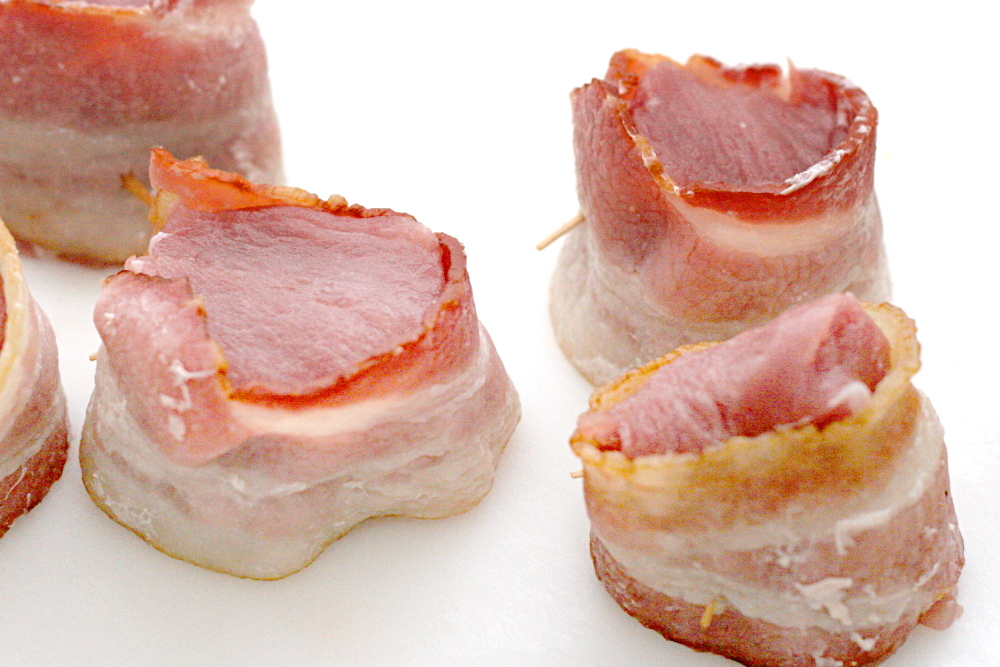
The recipe is not difficult at all. It only has a few ingredients, so it’s kept very simple. The only time consuming step was wrapping the bacon around the pork tenderloin medallions, but it takes less than a minute per medallion, and if you were serving this for guests, I don’t see any reason why that couldn’t be done ahead of time.

copy-of-img_8227

The tenderloin was, unsurprisingly as it’s wrapped in bacon, very good. However, next time I think I’ll brine it before cooking it, as maybe it was a little dry. (I might have overcooked it though – cooking big chunks of meat is probably my weakest skill in the kitchen.) The recipe is supposed to be served with a pan sauce, but somehow I missed that until too late.  I didn’t miss it.

copy-of-img_8234

Bacon-Wrapped Pork Tenderloin Medallions (from Cooks Illustrated)

CI note: We prefer natural to enhanced pork (pork that has been injected with a salt solution to increase moistness and flavor), though both will work in this recipe. Begin checking the doneness of smaller medallions 1 or 2 minutes early; they may need to be taken out of the pan a little sooner.

12-14 slices bacon (1 slice for each pork medallion)
2 pork tenderloins (1 to 1¼ pounds each), trimmed of fat and silver skin, cut crosswise into 1½-inch pieces; thinner end pieces scored and folded
Kosher salt and ground black pepper
2 tablespoons vegetable oil

1. Place bacon slices, slightly overlapping, in microwave-safe pie plate and cover with plastic wrap. Cook in microwave on high power until slices shrink and release about 1/2 cup fat but are neither browned nor crisp, 1 to 3 minutes. Transfer bacon to paper towels until cool, 2 to 3 minutes.

2. Wrap each piece of pork with 1 slice bacon and secure with 2 toothpicks where ends of bacon strip overlap, inserting toothpicks on angle and gently pushing them through to other side.

3. Season pork with pepper. Heat oil in 12-inch skillet over medium-high heat until shimmering. Add pork cut side down and cook, without moving pieces, until well-browned, 3 to 5 minutes. Turn pork and brown on second side, 3 to 5 minutes more. Reduce heat to medium. Using tongs, stand each piece on its side and cook, turning pieces as necessary, until sides are well browned and internal temperature registers 145 to 150 degrees on instant-read thermometer, 8 to 14 minutes. Transfer pork to platter and tent lightly with foil; let rest 5 minutes, then serve.

copy-of-img_8229

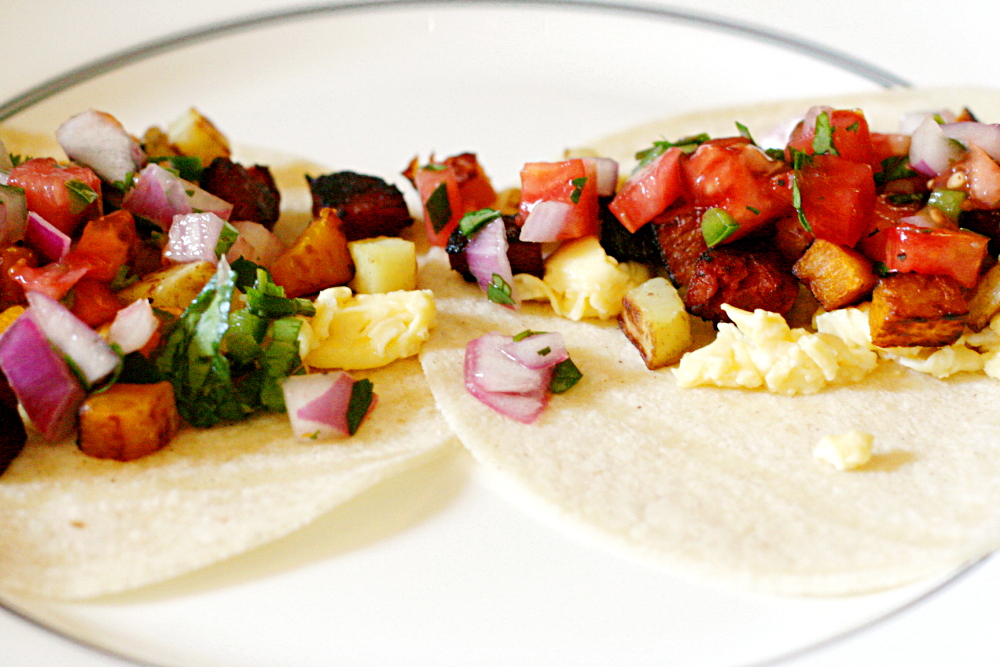
gallitos (costa rican breakfast tacos)

copy-of-img_8282

Dave lived in New Jersey for half a year while I was finishing up graduate school three hours away in upstate New York. We took turns visiting each other on the weekends, but the weekends in NJ were undoubtedly more fun, because we always took the train into Manhattan. I love Manhattan.

copy-of-img_8258

Just about every meal I’ve eaten in Manhattan has been exceptional, but one of my favorites was at Calle Ocho. We went for brunch and ordered the gallitos. I love tacos any time of the day. Dave and I don’t live as close to Manhattan anymore, so I can’t just go order gallitos whenever I want. But it took me two years to realize that there was nothing stopping me from making them myself.

copy-of-img_8267

I don’t remember the meal exactly, but the menu description helps – “Platter of Traditional Costa Rican Tacos, Scrambled Eggs, Chorizo, Calle Ocho Fries.” I could have sworn there was squash too, and pico de gallo just makes sense.

copy-of-img_8274

I will admit that this recipe is a bit of a project, and not much of it can be prepared in advance. I think it would be great for guests arriving late morning for brunch. Everyone can build their own tacos, which would be fun, and I imagine it’s not something many people have had before. Of course you should serve it with mimosas, as is fitting for any brunch, and which also accompanied my gallitos at Calle Ocho.  You can never go wrong serving champagne with breakfast.

copy-of-img_8260

The only problem I’ve had with the recipe is figuring out what to do with the tortillas. I feel like corn tortillas is more appropriate than flour, and they’re also a little lighter. However, they tend to crack instead of bend, even after being warmed and wrapped in foil. I’m not willing to fry them individually for breakfast. Unless someone has a better recommendation, I’m thinking I’ll start using flour tortillas instead. I did recently see a brand of corn tortillas that looked more flexible, so I’ll try those as well.

The gallitos are pretty great. There’s so many flavors working together – the sweet squash, salty potatoes, spicy chorizo, and fresh pico de gallo are wonderful. For me, this is definitely worth the effort involved.

copy-of-img_8284

Gallitos

Serves 4 to 6

To save time, you can cook the potatoes and squash together.

2½ tablespoons canola or vegetable oil
12 ounces (about 2 medium) Yukon Gold potatoes, diced into ¼-inch cubes
salt
16 small flour or corn tortillas
16 ounces (1 medium) butternut squash, peeled and diced into ¼-inch cubes
½ teaspoon sugar
12 ounces chorizo, diced into ½-inch cubes
4 eggs
2 tablespoons milk
Pico de gallo (recipe follows)

1. Heat oven to 200F. Wrap tortillas in foil and place in warm oven.

2. Heat 1 tablespoon oil in large nonstick skillet over medium heat. Add potatoes and ¾ teaspoon salt and stir until the potatoes are coated with oil. Cover the pan and cook, stirring occasionally, until potatoes are browned and tender, about 20 minutes. (If potatoes aren’t beginning to brown after 12 minutes, remove lid.) Pour potatoes into heatproof serving bowl and place in warm oven.

3. Meanwhile, in small nonstick skillet, cook chorizo over medium heat until evenly browned. Place chorizo in heatproof serving bowl and place in warm oven. Wipe pan with paper towels.

4. In now empty large nonstick pan (no need to clean or wipe), heat 1 tablespoon oil over medium heat. Add squash, ½ teaspoon salt, and sugar and sauté, uncovered, until browned and tender, about 20 minutes.

5. Meanwhile, heat remaining ½ tablespoon oil in small nonstick pan over medium heat. Crack eggs into a medium bowl. Add ¼ teaspoon salt, pinch black pepper, and milk. Whisk until evenly combined. Pour the egg mixture into the pan and reduce the heat to medium-low. Gently lift and stir the eggs until they form large, mostly dry curds. Pour eggs into serving bowl.

6. Serve tortillas, potatoes, squash, chorizo, eggs and pico de gallo separately, allowing each person to build their tacos as they please.

Pico de gallo: (adapted from the Pioneer Woman)
4 roma tomatoes, diced fine
1 small red onion, diced fine
1-2 jalapenos, minced
½ cup cilantro, chopped fine
juice of half a lime
salt to taste

Mix all ingredients.

copy-of-img_8287

gratin dauphinois (potatoes au gratin)

copy-of-img_67821

One advantage of screwing up a recipe is that at least you know when you don’t screw it up. The first time I made this recipe, I thought I might have overcooked it. The second time, I knew I overcooked it.

I’m a big fan of Jeffrey Steingarten, the food writer for Vogue. I have two of his books and I’ve enjoyed them both. He claims to have made a gratin once a week for the past ten years and calls this one “so fantastically good that [he has] made it every day for the past few weeks.” I’m not capable of resisting that recommendation, regardless of the half stick of butter and 1½ cups of cream. (Yikes.)

copy-of-img_67171

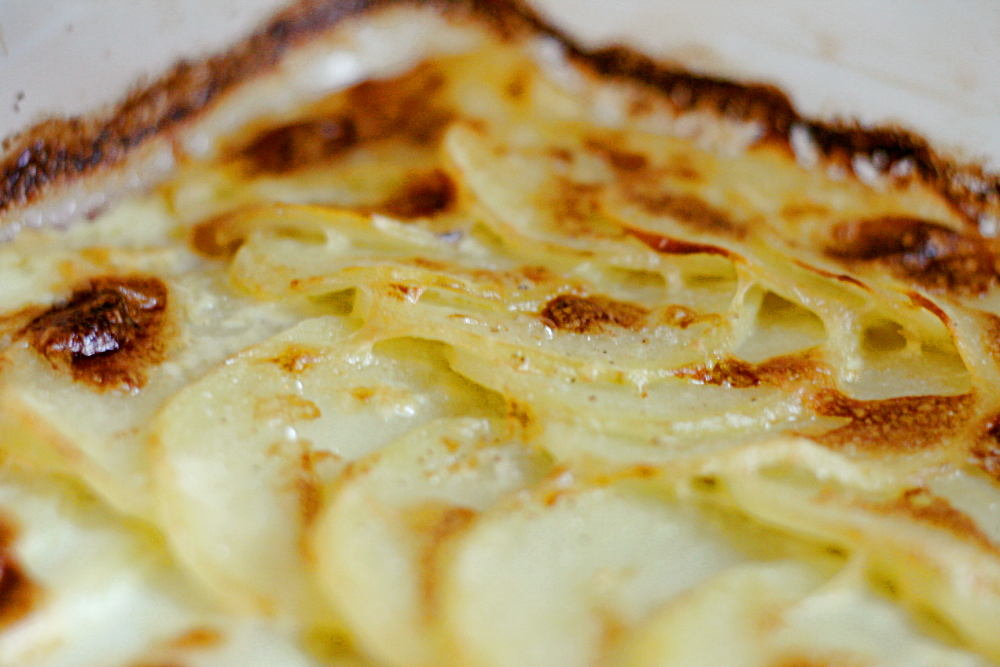
Steingarten developed his recipe to maximize the crispy parts, so the potatoes are placed in the baking pan in a single layer. Steingarten considers cheese in this type of gratin “a gross and pitiful imposture”, because the cream should reduce to a cheese-like flavor, so adding cheese is unnecessary. I have to do one more quote, because there’s no way I’ll be able to describe this as accurately and enticingly as Steingarten (which is why he is a professional and I am a blogger). “[The liquid] will coat the vegetable with an intensely flavorful concentrate…and the surface…is beautifully browned and crusty and delicious.”

copy-of-img_67291

Steingarten also says “if your gratin is truly brilliant, the bottom will become golden and crisp as well.” My gratin was not, and has never been with this recipe, truly brilliant. I’m not sure why; my only theory is that I’m using Pyrex when cast iron would be a better choice. The only cast iron cook/bakeware I have is my Dutch oven, but maybe I’ll try baking this is an All-Clan stainless steel skillet next time to see if I can get the bottom crust to form.

copy-of-img_67361

The recipe isn’t particularly difficult; it looks long due to Steingarten’s very detailed instructions. I typed out the recipe in Steingarten’s exact words because they have so much of his writing style in them, which I thought was worth keeping. However, there are aspects of the recipe that I change. A minor one is replacing the white pepper with black pepper, not only because I keep the black pepper on the counter and the white pepper requires some digging in the pantry, but because I think the flavor is better with the potatoes. Also, Steingarten calls for a pound and a half of potatoes, and says that “you will undoubtedly have some slices leftover.” With the pan size he calls for, I tend to have at least a third of the slices leftover. I’ve found that I should either increase the pan size or decrease the potatoes I slice.

copy-of-img_67471

Steingarten is also careful to instruct that the potatoes should be removed from the oven before “the cream has broken down into clear, foamy butterfat”. Oops. Good advice. Otherwise you end up with a disgusting greasy mess that makes it all too obvious that there’s a dismaying amount of fat in the recipe.

copy-of-img_67551

But, if you do it right, you have deliciously tender, creamy, crisp potatoes that don’t need cheese to taste cheesey or bread crumbs to be crispy. On the top. If you try the recipe and get a crispy bottom too, let me know!

copy-of-img_67831

Gratin Dauphinois (from Jeffrey Steingarten’s It Must’ve Been Something I Ate)

4 tablespoons (½ stick) butter
1 (scant) cup milk
1 large garlic clove, peeled and lightly crushed
½ teaspoon freshly ground white pepper
¾ teaspoon salt
1/8 teaspoon freshly grated nutmeg, about a dozen gratings
1½ pounds baking potatoes
1½ cups heavy cream

Special equipment: A large, low baking dish made of enameled iron, glass, or earthernware. The quantities in this recipe work out perfectly when baked in a dish measuring about 120 square inches on the inside bottom, where the slices of potato will lie. This translates into a rectangle 9-by-13 inches, or 10-by-12 inches; an 11-inch square; a 12-inch circle; or an oval 10-by-15 inches. An enameled iron baking dish is preferred – mine is made by Le Creuset – because it produces a delectable crust underneath the potatoes. A hand-sliced device, such as a traditional French stainless-steel mandoline or a much less expensive but excellent plastic Japanese-made device manufactures by Benriner.

Let the butter soften at room temperature for an hour or so. Meanwhile, preheat your oven to 425F.

Place the milk, garlic clove, pepper, salt, and nutmeg in a small saucepan, bring to a boil, and remove from the heat.

Meanwhile, liberally butter the bottom of the baking dish using about half the butter. Peel the potatoes, rinse them, and pat them dry. Then, slice them 1/8-inch thick, discarding the smallest slices. (This is easier with a slicing machine, inexpensive or elaborate. The quantities and cooking times given here work out best when the slices are even and close to 1/8 inch. Just keep adjusting your slicing machine until a little pile of eight slices measures an inch high.) Under no circumstances should you wash the potatoes after they have been sliced – the surface starch is absolutely indispensable.

Evenly arrange the potatoes in the buttered dish in one layer of overlapping slices. (Begin by laying out a row of slices along one narrow end of the baking dish, overlapping each one about a third of the way over the slice that came before. Repeat with a second row. Continue until the baking dish is neatly paved.) You will undoubtedly have some slices left over. Please do not try to cram them in.

Bring the milk to the boil again and pour it over the potatoes, removing the garlic. Cover the pan with a sheet of aluminum foil. Bake in the middle of the oven for about 15 minutes, until most of the milk has been absorbed. Meanwhile, bring the cream to a boil, and remove from the heat. When the potatoes are ready, remove and discard the aluminum foil. Bring the cream back to the boil and pour it over the potatoes, dotting the surface with the remaining butter.

Bake, uncovered, for another 20 to 25 minutes, until the potatoes have turned a golden brown, spotted with darker, crisp area. (Rotate the baking dish halfway through if the gratin is browning unevenly.) The underside of the gratin will also be brown and crispy in spots. But do not wait until most of the cream has broken down into clear, foamy butterfat. The potatoes should be dotted with thickened, clotted cream, especially between the slices.

Let the gratin settle for 10 minutes. (This will allow the excess butterfat to drain to the bottom of the dish.) Then eat immediately – taste and texture suffer with each passing minute. Cut into 6 or 8 rectangles with a blunt knife and serve each one with a thin, wide metal slotted spatula.

chickpea and butternut squash salad

copy-of-img_8391

Do you like squash? It seems like as soon as we were past Labor Day, everyone went squash crazy. I have reservations about squash that I think can be traced back to childhood.

copy-of-img_8381

I remember one Halloween, my mom roasted acorn squash for me and my brother, with brown sugar in the middle. We were less than pleased. I can’t remember any other squash experiences until I was cooking on my own, and I’m not the only one in my family who is inexperienced in squash. A year or two ago, my older sister called me to ask what she was supposed to do with the butternut squash she had bought.

copy-of-img_8386

I do like squash these days, but every time I eat it, I’m surprised I like it. “Wow! This is actually good!” That’s exactly how I felt about this recipe, which I heard about from Deb, but is actually from Molly. Both tend to recommend recipes that are right up my alley, so that made this recipe worth trying even with the less than familiar squash.  (This is only the third recipe I’ve ever used winter squash in.)

copy-of-img_8390

My doubts did go beyond just the squash issue. I wasn’t so sure about combining sweet squash with hummus ingredients – chickpeas and tahini, lemon juice and cilantro. And then I was worried that the sauce wouldn’t come together and be smooth (somehow it did) and that there would be too much sauce (I ended up adding it all).

copy-of-img_8383

The recipe was easy, aside from my snail-like squash peeling and cutting pace. And I was, yes, surprised by how much I liked it. The sweet squash was balanced so well by the bitter tahini and sour citrus. What a great combination.

copy-of-img_8395

Butternut and Chickpea Salad with Tahini (reworded slightly from Orangette, who adapted it from Casa Moro)

Thoughts: I’m anti raw garlic lately, so I threw the garlic in the oven with the squash for a few minutes, just to tame its sharpness a little before adding it to the sauce.

For salad:
1 medium butternut squash (about 2 to 2½ pounds, seeded, and cut into 1½-inch pieces)
1 medium garlic clove, minced or pressed
½ teaspoon ground allspice
2 tablespoons olive oil
Salt
1 (15-ounce) can chickpeas, drained and rinsed
¼ medium red onion, finely chopped
¼ cup coarsely chopped cilantro leaves

For tahini sauce:
1 medium garlic clove, finely minced with a pinch of salt (or shredded on a Microplane)
3½ tablespoons lemon juice
3 tablespoons well-stirred tahini
2 tablespoons water
2 tablespoons olive oil, plus more to taste

Preheat the oven to 425F.

In a large bowl, combine the butternut squash, garlic, allspice, olive oil, and a good pinch or two of salt. Using a large spoon or your hands, toss until the squash pieces are evenly coated. Turn them out onto a baking sheet, and bake for 15 to 25 minutes, or until soft. Remove from the oven and cool.

Meanwhile, make the tahini sauce. In a small bowl, whisk together the garlic and lemon juice. Add the tahini, and whisk to blend. Add the water and olive oil, whisk well, and taste for seasoning. The sauce should have plenty of nutty tahini flavor, but also a little kick of lemon.

To assemble the salad, combine the squash, chickpeas, onion, and cilantro in a mixing bowl. Add tahini sauce to taste, and toss carefully. (Alternatively, you can also serve the salad undressed, with the tahini sauce on the side. That way, each person can use as much or as little as they want, and the individual ingredients taste a little brighter, too.) Serve, with additional salt for sprinkling.

Note: This salad, lightly dressed, keeps beautifully in the fridge. (Hold a little of the tahini sauce on the side, for dressing at the table.) Before serving, warm slightly with quick jolt in the microwave.

copy-of-img_8391

sushi bowls

I’m so proud of this recipe. I actually came up with the idea on my own. Whoa. Not that sushi ingredients mixed up in a bowl is a groundbreaking idea, but that isn’t the point. The point is that I didn’t know there was already a recipe out there when I came up with it. I was creative! That never happens!

The inspiration behind my big idea was that Dave and I love sushi, but making it is a pain in the ass and going out to eat all the time isn’t feasible. So I figured, why bother making cute little sushi rolls – it’s the ingredients that we like, not their shape. I decided to mix up the ingredients in a bowl and call it a day.

And that makes this a pretty darn easy meal. Sushi rice takes only a little more effort than basic long-grain rice does, and that’s the only ingredient in this recipe that needs to be cooked.

I’ve made this a few times now, and once I used smoked salmon instead of raw tuna. I used smoked salmon twice when I made sushi rolls, and I thought it was good. It’s convenient, and I thought it might be a good option for people who aren’t comfortable eating raw fish. But when I used it in the sushi bowls, it was so salty that it kind of ruined the whole dish. I’m not sure if there’s a difference between brands or if all smoked salmon is so salty. I bought the cheapest brand, because that stuff always surprises me by how expensive it is.

But, every other time I’ve made this, it’s been just so good. And healthy! Look at all that green stuff. There’s no added fat in the recipe; the only fat involved is what’s naturally in avocado, sesame seeds, and the fish. That makes this a super tasty, easy, healthy, balanced meal on its own. It’s perfect.

Printer Friendly Recipe
Sushi Bowls

I’ve used raw tuna, smoked salmon, and imitation crab in this, all with very good results.  If you’re using salty smoked salmon, reduce the salt in the rice mixture slightly.

4 servings

1⅓ cups rice, rinsed well
1⅓ cups water
¼ cup soy sauce
wasabi to taste, probably at least 2 teaspoons
4 teaspoons rice vinegar
4 teaspoons sugar
½ teaspoon salt
2 (8 by 7-inch) sheets nori, cut into strips 1½ inches long and ⅛ inch wide
1 avocado, pitted, flesh scooped from skin and cut into chunks 1 inch long and ¼ inch wide
1 cucumber, peeled and cut into matchsticks 1½ inches long and ⅛ inch wide
2 green onions, halved lengthwise and cut into strips 1 inch long
8 ounces sushi-grade fish
¼ cup sesame seeds, toasted

1. Rinse the rice. Place the rice and water in a medium saucepan and bring to a boil over high heat, uncovered. Once it begins to boil, reduce the heat to the lowest setting and cover. Cook for 15 minutes. Remove from the heat and let stand, covered, for 10 minutes.

2. Meanwhile, combine the soy sauce and wasabi in a small bowl. Combine the rice vinegar, sugar and salt in a separate small bowl and heat in the microwave on high for 30 to 45 seconds, until the sugar dissolves. Transfer the rice into a large wooden or glass mixing bowl and add the vinegar mixture. Fold and cut thoroughly to combine and coat each grain of rice with the mixture. Fan until rice is near room temperature. (If you use an electric fan, this will only take about a minute.) Do not refrigerate.

3. Combine rice, wasabi mixture, and remaining ingredients. Serve.

mulled cider

I held off fall for as long as I could, mostly because I hadn’t (and still haven’t!) gotten my fill of fresh tomatoes. Plus I don’t like to be cold. But I can’t deny it anymore – there’s a chill in the air, and the trees are looking absolutely beautiful. It’s time for cider.

I looked up a few recipes for mulled cider, and they were all basically the same. But the first recipe I made, Ina Garten’s, was too sweet and not spicy enough. The next time, I eliminated all of the orange juice and just added the peel without the juice. Dave and I agreed that it was still two orangey, so I cut down the amount of peel even more. I also increased all of the spices, plus added one that wasn’t in the original recipe – allspice, which was perfect with the cider.

Ina’s recipe says to simmer for just 5 to 10 minutes, which doesn’t seem like nearly enough time to extract much flavor from whole spices. Most of the reviewers said that they simmered the mixture for far longer, and I agree with them. I generally brought the cider to a hard simmer, then turned off the heat, covered it, and forgot about it for an hour or so. Then Dave would say “didn’t you make cider?” and I’d remember and be excited and drink some and love October.

Hot Mulled Cider (adapted from Ina Garten)

Serves 4-6

8 cups (½ gallon) pure apple juice or fresh apple cider
2 (2-inch) cinnamon sticks
4 whole cloves
2 star anise
6 allspice berries
2 strips orange zest, removed with vegetable peeler, each strip about 2 inches long by ½-inch wide, cleaned of any white pith

Combine all the ingredients in a saucepan and bring to a simmer over medium-high heat. Turn off heat, cover, and let sit for 30 minutes. Pour into mugs, straining if desired, and serve.

roasted carrots

Carrots, like bananas, make a perfect snack. They’re easy, they travel well, and they’re healthy. They make such a great snack, in fact, that I’ve eaten one almost every weekday for several years. Oh my gosh, I am so sick of the daily carrot.

And I work at home three days per week. So why am I eating raw carrots day in and day out, when I could have sweet, crispy-on-the-outside, soft-on-the-inside roasted carrots with just five minutes of effort?

I know they lose nutrients (and fiber? I’m not sure) when you cook them, but for me, it’s a compromise that I have to make. If I tried to force myself to eat them raw when that doesn’t sound at all appealing, it’s a pretty safe bet that I’d end up eating cookie dough instead.

Although I tend to eat carrots as a snack, this would make a great side dish for all kinds of meals. Roasting brings out the best in carrots.

Roasted Carrots (from Ina Garten)

Bridget note: There’s quite a bit of flexibility in this recipe. I use regular table salt and just enough oil to coat the carrots. I mix those ingredients right in the pan instead of dirtying another bowl. I tend to roast the carrots at a higher temperature, simply because I forget the right temperature and am too lazy to check the recipe. I always skip the fresh herbs at the end.

12 carrots, peeled
3 tablespoons good olive oil
1¼ teaspoons kosher salt
½ teaspoons freshly ground black pepper
2 tablespoons minced fresh dill or parsley

Preheat the oven to 400 degrees F.

If the carrots are thick, cut them in half lengthwise; if not, leave whole. Slice the carrots diagonally in 1½-inch-thick slices. (The carrots will shrink while cooking so make the slices big.) Toss them in a bowl with the olive oil, salt, and pepper. Transfer to a sheet pan in 1 layer and roast in the oven for 20 minutes, until browned and tender.

Toss the carrots with minced dill or parsley, season to taste, and serve.

creme brulee (twd)

I love Dorie’s creative recipes, but I tend to turn to Cooks Illustrated for classics. So when I saw that Mari had chosen crème brulee for TWD, my first thought was to compare the two. But I’ve already compared Dorie and CI’s recipes a couple times, so instead, I decided I would play with some of the different flavors Dorie recommends.

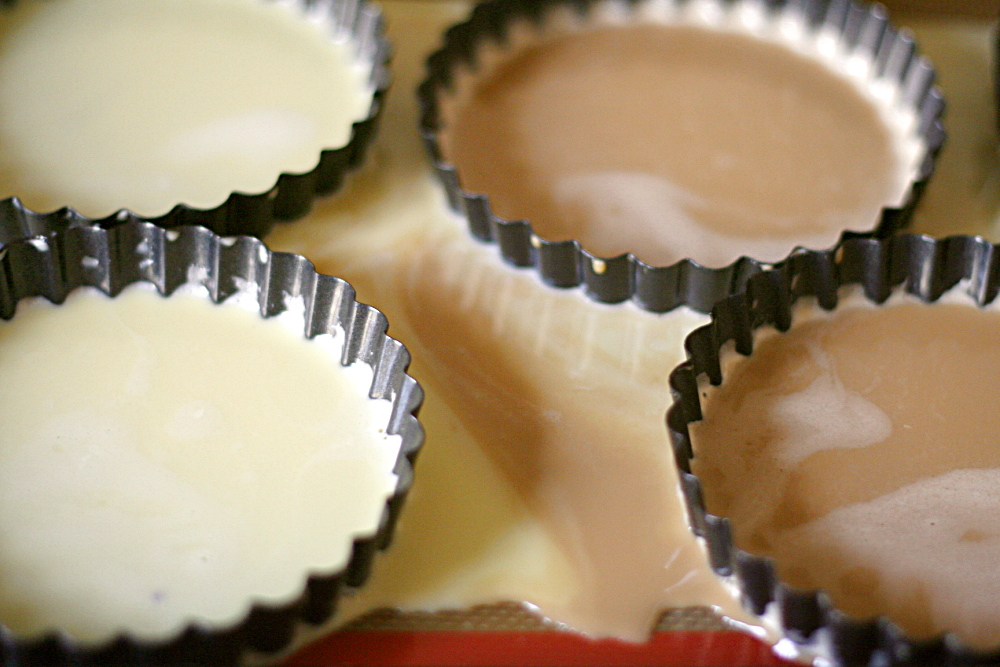
I made vanilla, Earl Grey, and ginger variations. I thought I could combine some of the steps for the variations, but that didn’t work out, so it was really like making the recipe three separate times. I didn’t have enough of the right sized ramekins, so I put the custard mixes in mini-tart pans instead. I was worried that the custard would leak because the tart pans have removable bottoms, but it worked out okay. Until I dropped the baking pan with the six full tartelette pans on it and everything spilled. Being clumsy is a pain in the ass.

Frustrated with that, I went back to my original plan to compare Dorie’s recipe to CI’s. (My freezer is full of egg whites now.) I was curious about this comparison anyway, because the recipes were significantly different. Dorie uses almost half the number of egg yolks compared to the amount of dairy, and she also uses a combination of heavy cream and milk instead of just heavy cream. That makes CI’s recipe much richer.

Whoa. Dorie’s also makes tiny servings. I wouldn’t expect that from her.

I assumed we’d like the richer crème brulee better, but Dave and I both preferred Dorie’s softer custard. However, Dave liked the flavor of CI’s better, which may be the pinch of salt added, or the lower amount of sugar used in CI’s, which could bring out the flavor of the other ingredients more. I used vanilla beans instead of vanilla extract in both recipes.

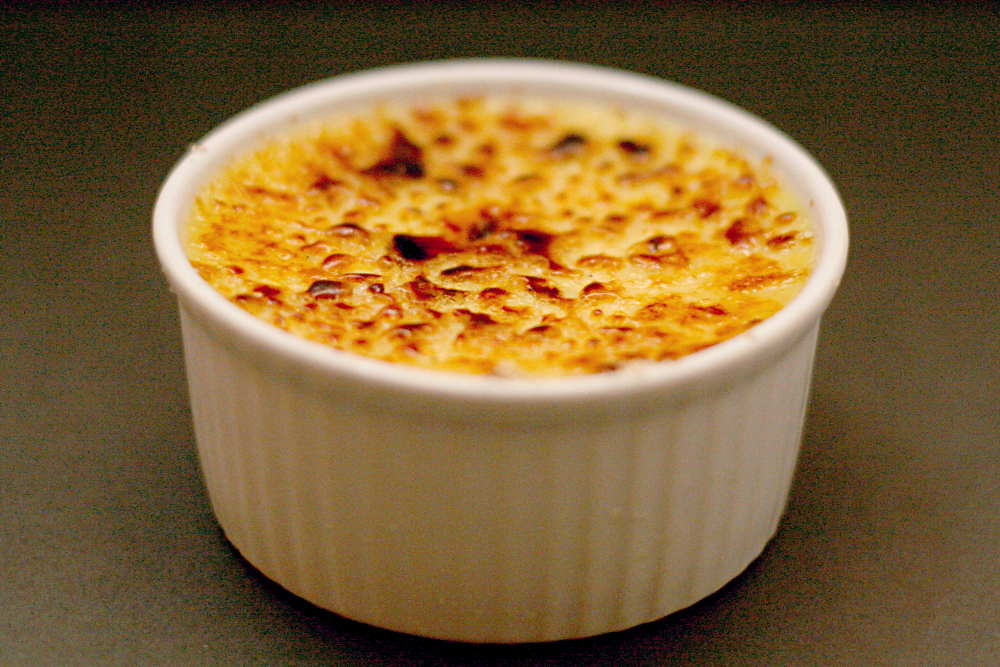
This is my most successful brulee job. (That goes for Dave too – this is the only kitchen task he’s excited about helping with.) I used a mixture of brown sugar and granulated, and in the past I used pure granulated. Apparently the mixture is more forgiving, because I used to end up with a combination of charcoaly burned areas and raw areas.

It’s crème brulee, so you really can’t go wrong. Unless you spill it all over the oven. Check Mari’s blog for Dorie’s recipe.

Classic Creme Brulee (from Cooks Illustrated)

Serves 8

CI note: Separate the eggs and whisk the yolks after the cream has finished steeping; if left to sit, the surface of the yolks will dry and form a film. A vanilla bean gives custard the deepest flavor, but 2 teaspoons of extract, whisked into the yolks in step 4, can be used instead. The best way to judge doneness is with a digital instant-read thermometer. The custards, especially if baked in shallow fluted dishes, will not be deep enough to provide an accurate reading with a dial-face thermometer. For the caramelized sugar crust, we recommend turbinado or Demerara sugar. Regular granulated sugar will work, too, but use only 1 scant teaspoon on each ramekin or 1 teaspoon on each shallow fluted dish.

4 cups heavy cream, chilled
⅔ cup granulated sugar
pinch table salt
1 vanilla bean, halved lengthwise
12 large egg yolks
8 – 12 teaspoons turbinado sugar or Demerara sugar

1. Adjust oven rack to lower-middle position and heat oven to 300 degrees.

2. Combine 2 cups cream, sugar, and salt in medium saucepan; with paring knife, scrape seeds from vanilla bean into pan, submerge pod in cream, and bring mixture to boil over medium heat, stirring occasionally to ensure that sugar dissolves. Take pan off heat and let steep 15 minutes to infuse flavors.

3. Meanwhile, place kitchen towel in bottom of large baking dish or roasting pan and arrange eight 4- to 5-ounce ramekins (or shallow fluted dishes) on towel. Bring kettle or large saucepan of water to boil over high heat.

4. After cream has steeped, stir in remaining 2 cups cream to cool down mixture. Whisk yolks in large bowl until broken up and combined. Whisk about 1 cup cream mixture into yolks until loosened and combined; repeat with another 1 cup cream. Add remaining cream and whisk until evenly colored and thoroughly combined. Strain through fine-mesh strainer into 2-quart measuring cup or pitcher (or clean medium bowl); discard solids in strainer. Pour or ladle mixture into ramekins, dividing it evenly among them.

5. Carefully place baking dish with ramekins on oven rack; pour boiling water into dish, taking care not to splash water into ramekins, until water reaches two-thirds height of ramekins. Bake until centers of custards are just barely set and are no longer sloshy and digital instant-read thermometer inserted in centers registers 170 to 175 degrees, 30 to 35 minutes (25 to 30 minutes for shallow fluted dishes). Begin checking temperature about 5 minutes before recommended time.

6. Transfer ramekins to wire rack; cool to room temperature, about 2 hours. Set ramekins on rimmed baking sheet, cover tightly with plastic wrap, and refrigerate until cold, at least 4 hours or up to 4 days.

7. Uncover ramekins; if condensation has collected on custards, place paper towel on surface to soak up moisture. Sprinkle each with about 1 teaspoon turbinado sugar (1½ teaspoons for shallow fluted dishes); tilt and tap ramekin for even coverage. Ignite torch and caramelize sugar. Refrigerate ramekins, uncovered, to re-chill, 30 to 45 minutes (but no longer); serve.

pan-seared steak with red wine pan sauce

I try not to participate in many blog events, since about a third of my entries are already committed to Tuesdays with Dorie and the Daring Bakers. But Elly’s Eat to the Beat is such a great idea, and I thought it could be a fun way to meld my favorite hobby with Dave’s, which is music.

Bustle

Dave learned to play guitar from his uncle, who plays lead guitar in this song. His best friend, Sid Faiwu, does the drums and synthesizer in this song. The three of them played together for years until Dave and Sid both moved away from their home town as well as from each other. Now they try to send around mp3’s of new songs, but that obviously doesn’t work well.

Dave wrote this song, Bustle, in grad school after a particularly stressful test. It’s one of my favorites. The song is very dark, and really not about food in any way. The only line that I could think to apply to food was “dripping red.” Because of the nature of the song, I wanted something that would look as bloody as possible. And what’s bloodier than red wine sauce dripping down animal flesh?
I know I’ve been overdoing the Cooks Illustrated recipes lately, but I can’t seem to stop myself. I turn to their recipes for classics, like this steak with pan sauce. I feel like their recipes are less mass-produced and therefore more carefully developed than a lot of those from the Food Network or epicurious. And I’m generally bad at cooking steak, so I needed as much detail as possible.

The steak came out really well. I only undercooked it a little, and at least I didn’t burn the outside like I often do. The sauce was good as well. I think next time I’ll reduce the sugar by half, but other than that, it was perfect with the steak. And it certainly looks as gory as the song sounds.

Pan-Seared Steak with Red Wine Pan Sauce for Two (from Cooks Illustrated)

Serves 2

CI note: Pan sauces cook quickly, so prepare the ingredients before you begin cooking the steaks. Use a heavy skillet with a nonreactive cooking surface.

Bridget note: I used strip steak, because it’s my favorite.

2 boneless 8-ounce rib-eye steaks or top loin steaks, 1 to 1¼ inches thick, thoroughly dried
Table salt and ground black pepper
1 small shallot, minced (about 2 tablespoons)
1 teaspoon brown sugar
¼ cup dry red wine , such as Cabernet Sauvignon
¼ cup low-sodium chicken broth
1 bay leaf
1½ teaspoons balsamic vinegar
½ teaspoon Dijon mustard
1½ tablespoons unsalted butter , cut into 3 pieces
½ teaspoon minced fresh thyme leaves

1. Heat heavy-bottomed, 10-inch skillet over high heat until very hot, about 3 minutes. Meanwhile, season both sides of steaks with salt and pepper.

2. Lay steaks in pan, leaving ¼-inch of space between each; reduce heat to medium-high, and cook without moving until well browned, about 4 minutes. Using tongs, flip steaks; cook 4 minutes more for rare, 5 minutes more for medium-rare, and 6 minutes more for medium. Transfer steaks to large plate and tent with foil to keep warm.

3. Off heat, add shallot and sugar to empty skillet; using pan’s residual heat, cook, stirring frequently, until shallots are slightly softened and browned and sugar is melted, about 45 seconds. Return skillet to high heat, add wine, broth, and bay leaf; bring to boil, scraping up browned bits on pan bottom with wooden spoon. Boil until liquid is reduced to 3 tablespoons, about 4 minutes. Stir in vinegar and mustard; cook at medium heat to blend flavors, about 1 minute longer. Off heat, whisk in butter until melted and sauce is thickened and glossy. Add thyme and season to taste with salt and pepper. Remove bay leaf, spoon sauce over steaks and serve immediately.

gazpacho

While everyone else has been getting excited about fall, publishing recipes with pumpkin and apples and cranberries, I’ve been desperately holding on to summer. Not only do I just plain like being warm, but I didn’t get my fill of summer produce this year. I only ate corn on the cob one time – just one! I’m a disgrace. And I can never get enough of flavorful seasonal tomatoes.

Gazpacho, to me, is the quintessential summer dish, putting the spotlight on tomatoes, with cucumbers and peppers singing backup. I served this gazpacho to a friend of mine from Spain, and he said that it was as good as any gazpacho he’d had over there. This is good stuff.

I’ve always been a big fan of traditional hot tomato soup, and I didn’t understand the allure of gazpacho when I was young – cold tomato soup? Yuck. But gazpacho made correctly isn’t anything like a smooth tomato soup. I like gazpacho to have more in common with salad than soup. That means that the vegetables have to be chopped by hand instead of in the food processor. It takes more time, but it’s worth it to eat real gazpacho instead of the vegetable smoothie that you’d end up with if you used the food processor.

Another great aspect of gazpacho is that it lasts for several days in the fridge. And it’s absolutely healthy, so it makes a really good snack. I love to keep some around for when I get home from work and I’m starving and dinner won’t be ready for a while.

Right after I finished dicing the vegetables for this, I inhaled deeply – it was pure summer. I felt better about letting the season go and moving into fall once I had made a batch of gazpacho. But don’t expect to see pumpkin recipes here for a while!

Gazpacho (from Cooks Illustrated)

CI note: Welch’s and Fresh Samantha’s are our favorite brands of tomato juice for this recipe — not too thick, with a bright, lively flavor. This recipe makes a large quantity because the leftovers are so good, but it can be halved if you prefer. Traditionally, diners garnish their gazpacho with more of the same diced vegetables that are in the soup, so cut some extra vegetables when you prepare those called for in the recipe. Additional garnish possibilities include simple garlic croutons, chopped pitted black olives, chopped hard-cooked eggs, and finely diced avocados. For a finishing touch, serve in chilled bowls.

Bridget note: I’ve found that the brand of tomato juice is extremely important. I’m never been able to find Welch’s or Samantha’s tomato juice, but Campbell’s works fine. And I never use ice cubes, I just add 1 cup of cold water.

Makes about 3 quarts, serving 8 to 10

3 ripe medium beefsteak tomatoes (about 1½ pounds), cored and cut into ¼-inch cubes (about 4 cups)
2 medium red bell peppers (about 1 pound), cored, seeded, and cut into slices, then into ¼-inch cubes (about 2 cups)
2 small cucumbers (about 1 pound), one peeled and the other with skin on, both seeded and cut into ¼-inch cubes (about 2 cups)
½ small sweet onion (such as Vidalia, Maui, or Walla Walla) or 2 large shallots, peeled and minced (about ½ cup)
2 medium cloves garlic, minced or pressed through a garlic press (about 2 teaspoons)
2 teaspoons table salt
⅓ cup sherry vinegar
ground black pepper
5 cups tomato juice
1 teaspoon hot pepper sauce (optional)
8 ice cubes
extra-virgin olive oil for serving

1. Combine the tomatoes, bell peppers, cucumbers, onions, garlic, salt, vinegar, and pepper in a large (at least 4-quart) nonreactive bowl. Let stand until the vegetables just begin to release their juices, about 5 minutes. Stir in the tomato juice, hot pepper sauce, if using, and ice cubes. Cover tightly and refrigerate to blend flavors, at least 4 hours and up to 2 days.

2. Adjust the seasonings with salt and pepper and remove and discard any unmelted ice cubes. Serve cold, drizzling each portion with about 1 teaspoon extra-virgin olive oil and topping with the desired garnishes, (see top note).