sausage and red pepper hash

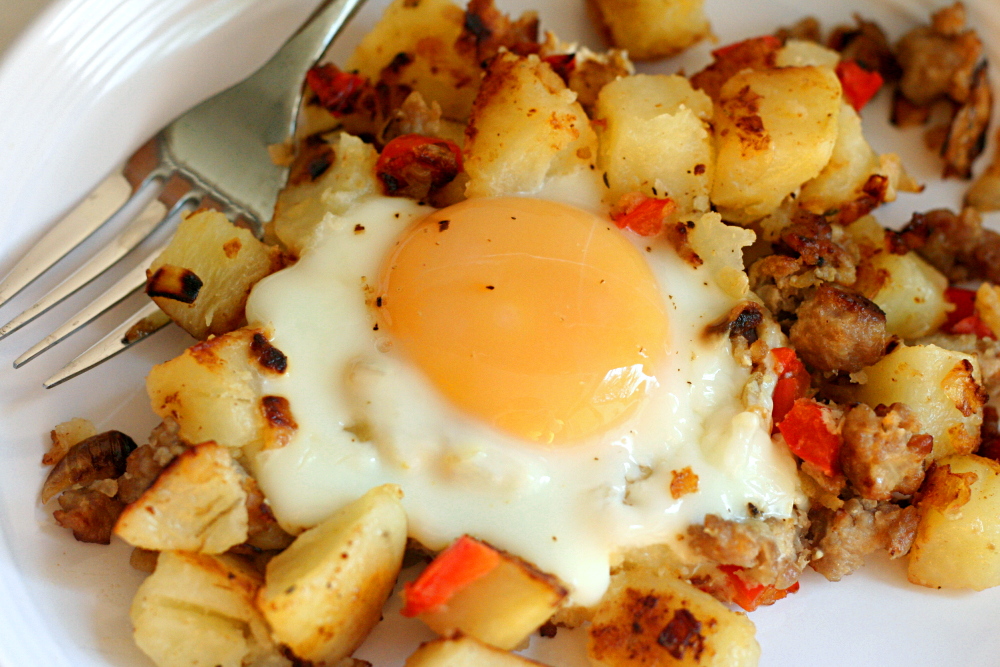
Hey, look at that, more eggs on stuff. I made this because I wanted hash, but something different from corned beef hash. I just love the idea of egg yolk dripping into browned crispy potatoes and salty breakfast meat and flavorful sautéed vegetables. Sausage and peppers sounded like a great base to go with potatoes and eggs.

Looking now at the recipe I think I was using, I apparently simplified it quite a bit. That’s the thing about making an Emeril recipe in the morning – chances are it’s going to get simplified. First I replaced chicken and apple sausage with standard breakfast sausage, and then I eliminated all of the spices and herbs that Emeril calls for, assuming that there would be enough seasoning in the sausage.

What I ended up doing was following my standard hash method of browning the meat, then cooking the vegetables in the rendered fat, then adding parboiled potatoes and cooking until they brown. Then I break eggs over the mixture and cover the pan, cooking until the whites are set and, if all goes well, the yolks are warm and viscous but not solid.

You really can’t go wrong with these ingredients combined in that method. The onions are a little caramelized, the peppers are soft, the potatoes are crispy, the sausage is peppery – everything is at its best, and then it’s taken one step further with a perfectly cooked egg on top.

Sausage and Red Pepper Hash (substantially adapted from Emeril and from Cooks Illustrated)

The potatoes can be parboiled the night before and refrigerated.

2 pounds russet potatoes, peeled and cut into ½ -inch dice
Salt
1 medium onion, diced
1 red pepper, diced
1 pound breakfast sausage
4 large eggs
Ground black pepper

1. Bring the potatoes, 5 cups water, and ½ teaspoon salt to a boil in a medium saucepan over medium-high heat. Once the water boils, cook for 4 minutes, drain, and set aside.

2. Place the sausage in a 12-inch nonstick skillet over medium-high heat and cook until the fat is partially rendered, about 2 minutes. Add the onion and pepper and cook, stirring occasionally, until the onion has softened and browned, about the edges, abut 8 minutes. Mix in the potatoes and lightly pack the mixture into the pan with a spatula. Reduce the heat to medium. Cook, undisturbed, for 4 minutes, then, with a spatula, invert the hash, a portion at a time, and fold the browned bits back into the hash. Lightly pack the hash into the pan. Repeat the process every minute or two, until the potatoes are thoroughly cooked, about 8 minutes longer.

3. Make 4 indentations (each measuring about 2 inches across) equally spaced on the surface of the hash. Crack 1 egg into each indentation and season the egg with salt and pepper to taste. Reduce the heat to medium-low, cover the pan, and cook until the eggs are just set, about 6 minutes. Cut the hash into 4 wedges, making sure each has an egg, and serve immediately.


country egg scramble

In my mind, there are basically two kinds of breakfasts – there are savory breakfasts, which are generally based around eggs, and then there are sweet breakfasts, which include pancakes and waffles and the like. The best savory breakfasts involve potatoes in addition to the eggs. And bacon of course, unless you’re saving the bacon for BLTs and have to use sausage instead.

This skillet scramble is a simple but tasty example of a savory breakfast.  I did make some changes to the recipe here and there. Like most Betty Crocker recipes, this one tries to trick you into thinking it’s easier than it is by calling for cooked bacon in the ingredient list, rather than including the instructions for cooking bacon. Like I’m going to have cooked bacon laying around, just waiting to be sprinkled over breakfast. And why would I brown the potatoes in butter when there’s bacon fat right there?

Still, this recipe for a great savory breakfast is not complicated. You pretty much cook some tasty breakfast meat, then brown some par-boiled potatoes and add beaten eggs, cooking until they set. Easy though it might be, it involves most of my favorite breakfast ingredients – eggs, meat, and potatoes – and thus makes for a delicious and classic meal.

Printer Friendly Recipe
Country Egg Scramble
(adapted from Betty Crocker)

Serves 4

1 pound (6 to 7) new red potatoes, cubed
6 slices (6 ounces) bacon (or breakfast sausage), chopped
6 eggs
2 tablespoons milk
Salt
⅛ teaspoon pepper
4 medium green onions, sliced (¼ cup)

1. Place potatoes and ¼ teaspoon salt in 2-quart saucepan. Add water until it reaches 1 inch above potatoes. Heat to boiling over medium-high heat. Once the water boils, cook for 6 minutes or until potatoes are almost tender, then drain.

2. Meanwhile, cook bacon in a medium nonstick skillet over medium heat until crisp. Using a slotted spoon, transfer to paper towel-lined plate. Drain all but 2 tablespoons fat from skillet.

3. Beat eggs, milk, ¼ teaspoon salt, the pepper, and the green onions with fork or wire whisk until it’s a uniform yellow color; set aside.

4. Cook potatoes in bacon fat over medium-high heat for 5 to 8 minutes, turning occasionally, until browned. Stir in reserved bacon.

5. Pour egg mixture into skillet. As mixture begins to set at bottom and side, gently lift cooked portions with spatula so that thin, uncooked portion can flow to bottom. Avoid constant stirring. Cover pan and cook 3 to 4 minutes or until eggs are thickened throughout but still moist.

sauteed shredded zucchini

The side I originally served with Chicken with Forty Cloves of Garlic was shredded sautéed zucchini with tomatoes and basil. While it’s a very good dish, in retrospect, I don’t think the Italian bent in the zucchini matched the flavors and French feel of the chicken. My goal for the vegetable served alongside this flavorful garlicky chicken was something that would play backup well while offering a bit of contrast in flavors. While any simply prepared vegetable would work nicely, I also wanted something that my guests probably hadn’t made for themselves.

I do like the shredded sautéed zucchini, so I didn’t want to completely alter my original meal plan. I love when vegetables get just a little crispy and browned, and something about shredded zucchini instead of slices makes me happy. All of the prep work for this dish can be completed a few hours before dinner, which means the vegetables just need a quick stay on a hot burner and a few turns before they’re ready to be served.

The problem is that it’s not a simple task getting something as watery as zucchini to caramelize. Just like cabbage, the best way to get water out of zucchini is to sprinkle some salt on it and set it aside in a strainer. Then squeeze the hell out of it. I made only two servings of this recently, and squeezed out almost half a cup of (vividly green) water.

The original recipe makes this a bit more work than I like to put into a side dish. For one, it gives instructions for shredding the zucchini by hand. That isn’t happening; that is why I have a food processor with a shredding disk. You’re also supposed to discard the watery middle of the zucchini where the seeds are, but I disregard that too, so that I can just throw the whole vegetable through the feed tube of the food processor.

Once the zucchini are shredded and squeezed, you can mix them with your flavorings and some oil and set them aside until you’re ready to cook them. For serving with the chicken, I like to use just olive oil and minced shallots with a bit of lemon juice squeezed on at the end. It’s the perfect side dish – interesting and flavorful on its own right without overpowering the star of this show, which is the chicken.

Zucchini with Shallots and Lemon (adapted from Cooks Illustrated)

Serves 4

Bridget note: Five zucchini for four servings sounds like a lot, but you lose a lot of volume with the water, so it really is the right amount. I’ve added all of the oil to the zucchini mixture and added all of that to a preheated, non-oiled pan, and that works too.

5 medium zucchini (about 8 ounces each), ends trimmed
Table salt
2 shallots, minced
1 tablespoon olive oil
1-2 teaspoons fresh lemon juice from 1 lemon
Ground black pepper

1. Shred zucchini with shredding disk of food processor or large holes of a box grater. Toss zucchini with 1½ teaspoons salt and place in colander set in medium bowl; let drain 5 to 10 minutes. Wrap zucchini in kitchen towel, in batches if necessary, and wring out excess moisture.

2. Place zucchini in medium bowl and break up any large clumps. Add shallots and 2 teaspoons oil to zucchini and toss to combine thoroughly.

3. Heat remaining 1 teaspoon oil in 12-inch nonstick skillet over high heat. Add zucchini mixture and spread evenly in pan with tongs; cook without stirring until bottom layer browns, about 2 minutes; stir well, breaking up any clumps with tongs, then cook until “new” bottom layer browns, about 2 minutes more. Off heat, stir in lemon juice and salt and pepper to taste. Serve immediately.

For the tomato-basil variation: Combine 3 cored, seeded and diced plum tomatoes, 1 clove of minced garlic, 1 teaspoon balsamic vinegar, 2 teaspoons extra-virgin olive oil, ¼ teaspoon salt, and 2 tablespoons chopped fresh basil leaves in small bowl and set aside. When the zucchini has finished cooking, remove it from the heat and stir in tomato mixture and salt and pepper to taste. Transfer to serving platter, sprinkle with ¼ cup finely grated Parmesan, and serve immediately, drizzling with additional olive oil, if desired.

Other recipes part of this recommended dinner party menu:
Salad with Herbed Baked Goat Cheese
Chicken with Forty Cloves of Garlic
Pain a l’Ancienne (baguettes)

Just about any dessert works well with this meal.
Many wines work well with this meal, but I especially like full-flavored whites such as Chardonnay, and medium-bodied reds such as Pinot Noir.

chicken with forty cloves of garlic

This chicken is the main dish of my favorite dinner party menu. But I’m not going to lie – there are good and bad aspects to making this dish for company. The advantage is that I’m pretty sure this is the best chicken I’ve ever eaten (although this comes close). It’s infused with the flavors of garlic and wine, it’s juicy, the skin is crispy, and it’s served up with a handful of roasted garlic cloves that are perfect for smearing on slices of baguette.

On the other hand, it’s fairly work-intensive. A lot of that work can be finished a few hours before dinner, but you can’t avoid some last minute cooking here. Years ago, I thought that if I had to do any cooking once my guests arrived, it meant I was being a bad host. These days, I don’t worry so much. My friends like to help, and they’re also perfectly happy to chat and drink their wine while I finish up the sauce for the chicken. I like to have a bit of a break between courses, so I’ll generally serve the salad, then finish the chicken.

But again, much of this dish can be prepared in advance. The chicken can be brined early in the day, then rinsed, dried, and refrigerated until needed. The recipe calls for a whole chicken to be cut in pieces, but I’ve used pre-cut pieces with no problem. The garlic and shallots can be roasted in advance and set aside. Of course all of the ingredients can be measured and set right where you need them. The most important thing is to relax – you fed your guests salad so they aren’t starving, they hopefully have good wine to drink, and this chicken is absolutely worth the wait.

I’m looking over the recipe right now, and I’m wondering if you could actually make everything ahead of time and just keep it in a slightly warm oven? (You’ll have to take it out to bake the goat cheese rounds if you’re making those, but that’s easy enough.) I think it would work. I’m going to try it tonight, and then I’ll update with the results.  (Update: I tried it and it was a huge failure.  Not saying it can’t be done correctly somehow, but what I did certainly didn’t work.)

Chicken with 40 Cloves of Garlic (from Cooks Illustrated)

Serves 3 to 4

CI note: Try not to purchase heads of garlic that contain enormous cloves; if unavoidable, increase the foil-covered baking time to 40 to 45 minutes so that the largest cloves soften fully. A large Dutch oven can be used in place of a skillet, if you prefer. Broiling the chicken for a few minutes at the end of cooking crisps the skin, but this step is optional. Serve the dish with slices of crusty baguette for dipping into the sauce and onto which the roasted garlic cloves can be spread.

Table salt
1 whole chicken (3½ to 4 pounds), cut into 8 pieces (4 breast pieces, 2 thighs, 2 drumsticks) and trimmed of excess fat.
Ground black pepper
3 large heads garlic (about 8 ounces), outer papery skins removed, cloves separated and unpeeled
2 medium shallots, peeled and quartered pole to pole
1 tablespoon olive oil
2 sprigs fresh thyme
1 sprig fresh rosemary
1 bay leaf
¾ cup dry vermouth or dry white wine
¾ cup low-sodium chicken broth
2 tablespoons unsalted butter

1. Adjust oven rack to middle position and heat oven to 400 degrees. Dissolve ¼-cup salt in 2 quarts cold tap water in large container or bowl; submerge chicken pieces in brine and refrigerate until fully seasoned, about 30 minutes. Rinse chicken pieces under running water and thoroughly pat dry with paper towels. Season both sides of chicken pieces with pepper.

2. Meanwhile, toss garlic and shallots with 2 teaspoons olive oil and salt and pepper to taste in 9-inch pie plate; cover tightly with foil and roast until softened and beginning to brown, about 30 minutes, shaking pan once to toss contents after 15 minutes (foil can be left on during tossing). Uncover, stir, and continue to roast, uncovered, until browned and fully tender, 10 minutes longer, stirring once or twice. Remove from oven and increase oven temperature to 450 degrees.

3. Using kitchen twine, tie together thyme, rosemary, and bay; set aside. Heat remaining 1-teaspoon oil in 12-inch heavy-bottomed ovenproof skillet over medium-high heat until beginning to smoke; swirl to coat pan with oil. Brown chicken pieces skin-side down until deep golden, about 5 minutes; using tongs, turn chicken pieces and brown until golden on second side, about 4 minutes longer. Transfer chicken to large plate and discard fat; off heat, add vermouth, chicken broth, and herbs, scraping bottom of skillet with wooden spoon to loosen browned bits. Set skillet over medium heat, add garlic/shallot mixture to pan, then return chicken, skin-side up, to pan, nestling pieces on top of and between garlic cloves.

4. Place skillet in oven and roast until instant-read thermometer inserted into thickest part of breast registers about 160 degrees, 10 to 12 minutes. If desired, increase heat to broil and broil to crisp skin, 3 to 5 minutes. Using potholders or oven mitts, remove skillet from oven and transfer chicken to serving dish. Remove 10 to 12 garlic cloves to mesh sieve and reserve; using slotted spoon, scatter remaining garlic cloves and shallots around chicken and discard herbs. With rubber spatula push reserved garlic cloves through sieve and into bowl; discard skins. Add garlic paste to skillet. Bring liquid to simmer over medium-high heat, whisking occasionally to incorporate garlic; adjust seasoning with salt and pepper to taste. Whisk in butter; pour sauce into sauceboat and serve.

Other recipes part of this recommended dinner party menu:
Salad with Herbed Baked Goat Cheese
Sauteed Shredded Zucchini
Pain a l’Ancienne (baguettes)

Just about any dessert works well with this meal.
Many wines work well with this meal, but I especially like full-flavored whites such as Chardonnay, and medium-bodied reds such as Pinot Noir.

deep dark chocolate cookies

I’m helpless in the face of recipes with names like Deep Dark Chocolate Cookies, even when I already have a deep, dark chocolate cookie recipe that I’m very happy with. I was intrigued by the lack of flour, butter, and egg yolks in this one. It seemed like that would produce a texture similar to a meringue cookie, but the recipe specifically refers to the cookies as dense and chewy.

Although the recipe was published in Bon Appetit’s fast and easy section, I’d say that the amount of work involved in on par with other cookie recipes. Chocolate is melted in one bowl, egg whites and sugar are beaten in another, and the dry ingredients – sugar and cocoa with just a bit of cornstarch and salt – are mixed in a third. The contents of the three bowls are blended together with an additional handful of chocolate chips. I considered it a good sign that the recipe contained chocolate in three forms.

The recipe states that once all of the ingredients are mixed together, the dough will become very stiff, and should then be rolled into balls and coated in powdered sugar. My dough was not “roll into balls” consistency. It was more like a really fudgy chocolate frosting than cookie dough. I simply scooped out a spoonful of dough, dropped it in powdered sugar, and pushed it around until it was evenly(ish) coated.

While the cookies were nice and chocolately, and I suppose dense and chewy, I considered the texture a bit off from what I prefer. There was indeed a similarity to meringue cookies, especially around the edges. I also thought the cookies were too sweet, which would be easily remedied by reducing the powdered sugar.

I definitely prefer my other recipe for chocolate cookies. However, these are the best gluten-free cookie I’ve ever eaten, with none of the “off” flavors that can sometimes occur in cookies based on gluten-free flour mixes. The cookies are also a bit healthier than your average cookie. The only fat in the recipe is chocolate, and once the sugar is reduced a bit (I’d say to ¾ cup in both the egg white mixture and the cocoa mixture instead of 1 cup), there’s about 100 calories per cookie, about 25% less than my favorite chocolate chip cookies.

Deep Dark Chocolate Cookies (from Bon Appetit June 2008 )

BA note: Made without butter or flour, these dense, chewy cookies will satisfy even the most intense chocolate craving.

Bridge note: I’d reduce the powdered sugar to ¾ cup (3 ounces) each in the egg white mixture and in the cocoa mixture. I also baked the cookies for 8 minutes.

Servings: Makes about 24

Nonstick vegetable oil spray
1½ cups bittersweet chocolate chips (about 9 ounces), divided
3 large egg whites, room temperature
2½ cups (10 ounces) powdered sugar, divided
½ cup (1½ ounces) unsweetened cocoa powder
1 tablespoon cornstarch
¼ teaspoon salt

Preheat oven to 400°F. Spray 2 large baking sheets with nonstick spray. Melt 1 cup chocolate chips in glass bowl in microwave, stirring twice, about 2 minutes. Cool slightly.

Using electric mixer, beat whites in large bowl to soft peaks. Gradually beat in 1 cup (4 ounces) sugar. Continue beating until mixture resembles soft marshmallow creme. Whisk 1 cup sugar (4 ounces), cocoa, cornstarch, and salt in medium bowl to blend. On low speed, beat dry ingredients into meringue. Stir in lukewarm chocolate and ½ cup chocolate chips (dough will become very stiff).

Place ½ cup (2 ounces) sugar in bowl. Roll 1 rounded tablespoon dough into ball; roll in sugar, coating thickly. Place on prepared sheet. Repeat with remaining dough, spacing 2 inches apart. Bake until puffed and tops crack, about 10 minutes. Cool on sheets on rack 10 minutes. Transfer to rack; cool.

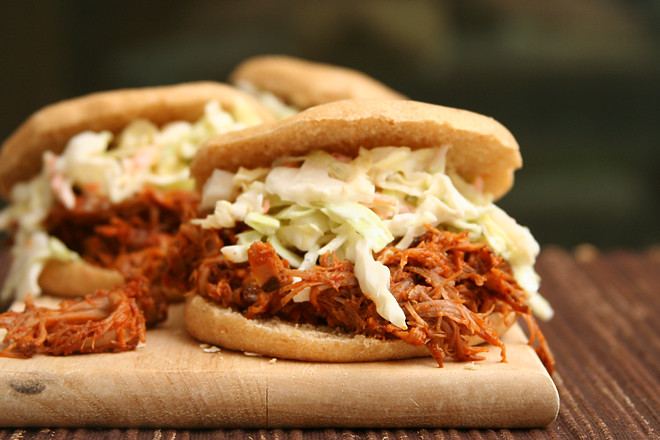
crockpot pulled pork

crockpot pulled pork new
Updated photo 5/31/12

My brother has a habit of giving out remarkably vague “recipes.” For example: “Put some pig or cow in the slow cooker with some liquid. Use a spice rub if you want. Cook until you get home from work, then give the fat to the dog and shred the meat.”

Um. Right.

I needed more information. Does the size of the roast matter? Whether it has a bone? I used pork shoulder, and Cooks Illustrated has a recipe for barbecue pulled pork, so I adapted some of their instructions – the ingredients and method for the spice rub – for this slow cooker version. I was reluctant to add liquid to the slow cooker liner with the meat, because I had some idea that it would dilute the flavor in the meat, so I added just a bit of water and some liquid smoke. I cooked it for about 10 hours, added some barbecue sauce, then cooked it for 1 hour longer.

Oh my gosh, it’s so good. I almost didn’t want to add barbecue sauce, because the meat tastes so good without it, but of course it was that much better once I added it. And it makes a ton of food. I’m going to guess that the pork shoulder I used, which was probably the smallest I could find, was about twenty servings. I froze most of it, and it reheats really well.

I learned a few things from this. For one, there’s no need to worry about liquid diluting the flavor of the meat – the meat exudes a surprising amount of liquid anyway. It’s best to add just a bit of water to help the slow cooker get the cooking started. Also, as far as cooking times go, longer seems to be better. So, as my brother said, start dinner cooking before you go to work, and when you get home 9 or 10 hours later, you’ll be just in time to shred the meat, add the barbecue sauce, and let that all cook together for a bit.

Overall, served with coleslaw, this makes for a fantastic meal. I know that crockpot pulled pork recipes are a dime a dozen, but trust me that this spice rub adds far more flavor than root beer ever could. Plus, it’s not much work at all, so with minimal effort you can stock your freezer with multiple nights’ worth of easy and tasty meals.

Update 9.21.08: Last time I made this, I used a pork shoulder that just barely fit in my crockpot; I think it was in the 7.5 pound range.  After 8.5 hours, the pork wasn’t tender enough to be pulled, at least on the inside.  So I recommend erring on the longer side of this cooking range, especially if you’re using a large roast.

Slow Cooker Pulled Pork (spice rub from Cooks Illustrated)

Spice Rub:
1 tablespoon ground black pepper
1-2 teaspoons cayenne pepper
2 tablespoons chili powder
2 tablespoons ground cumin
2 tablespoons dark brown sugar
1 tablespoon dried oregano
4 tablespoons paprika
2 tablespoons table salt
1 tablespoon granulated sugar
1 tablespoon ground white pepper

1 (6-8 pound) bone-in pork shoulder
½ teaspoon liquid smoke (optional)
2 cups barbecue sauce

1. Mix all spice rub ingredients in small bowl.

2. Massage spice rub into meat. Wrap tightly in double layer of plastic wrap; refrigerate for at least 3 hours. (For stronger flavor, the roast can be refrigerated for up to 3 days.)

3. Unwrap roast and place it in slow cooker liner. Add liquid smoke, if using, and ¼ cup water. Turn slow cooker to low and cook for 8-10 hours, until meat is fork-tender.

4. Transfer roast to cutting board; discard liquid in liner. “Pull” by tearing meat into thin shreds with two forks or your fingers. Discard fat.

5. Place shredded meat back in slow cooker liner; toss with 1 cup barbecue sauce, and heat on low for 30-60 minutes, until hot. Serve with additional barbecue sauce.

franks and beans

I can’t remember how I got it in my head to make franks and beans. I thought I had mentioned it in a blog post, but I can’t find it. Was it a comment on someone else’s blog? I thought I just idly mentioned it somewhere, and then I started thinking “yum…pork and beans…”  (Ah, Elizabeth found it for me – in my post about red beans and rice.)

Of course, god forbid I take the easy way out and buy some baked beans, add hot dogs and brown sugar and bake them for a while, like I used to do when I was a kid. (Of course, we used the cheese-filled hot dogs then. Ew!) No, I have to go all out and make beans from scratch. Glutton for punishment.

But I couldn’t find any recipes for hot dogs and beans with the beans made from scratch, so I made a Boston baked beans recipe and added cut up hot dogs to the onions while they sautéed.

I figured that if I cut the hot dogs on a diagonal, they were more elegant and I could pretend that I wasn’t eating incredibly low-class food.

But if I cut them straight across, they were more bite-sized. Ah well.

I messed up the recipe just a bit. I was cutting it in half, but I used a saucepan less than half the area of the pan called for for a full recipe, so the sauce didn’t thicken as much as I would have liked. You can see in the picture how liquidy the beans are. Also, when adding hot dogs, I might skip the salt pork next time and maybe increase the bacon by an ounce or two. Other than those minor glitches, though, this was a fun way to revisit childhood!

Boston Baked Beans (from Cooks Illustrated January 2003)

Serves 4 to 6

CI note: The beans can be made ahead. After cooking, cool them to room temperature and refrigerate in an airtight container for up to 4 days.

Bridget note: I added 2 hot dogs, cut into bite-sized pieces, to the sautéing onions.

4 ounces salt pork, trimmed of rind and cut into ½-inch cubes
2 ounces bacon (2 slices), cut into ¼ -inch pieces
1 medium onion, chopped fine
½ cup mild molasses
1 tablespoon mild molasses
1½ tablespoons brown mustard
1 pound dried small white beans (about 2 cups), rinsed and picked over
Table salt
1 teaspoon cider vinegar
Ground black pepper

Adjust oven rack to lower-middle position; heat oven to 300 degrees. Add salt pork and bacon to 8-quart Dutch oven; cook over medium heat, stirring occasionally, until lightly browned and most fat is rendered, about 7 minutes. Add onion and continue to cook, stirring occasionally, until onion is softened, about 8 minutes. Add ½ cup molasses, mustard, beans, 1¼ teaspoons salt, and 9 cups water; increase heat to medium-high and bring to boil. Cover pot and set in oven. Bake until beans are tender, about 4 hours, stirring once after 2 hours. Remove lid and continue to bake until liquid has thickened to syrupy consistency, 1 to 1½ hours longer. Remove beans from oven; stir in remaining tablespoon of molasses, vinegar, and additional salt and pepper to taste. Serve.

hash browns with sauteed vegetables and poached eggs

I’ve become enamored with poached eggs lately. They’re such a great topping for so many breakfast ideas. Besides eggs benedict, I like to serve them on toast with a bit of cheddar cheese sprinkled over. Hash browns and a bed of sautéed vegetables is my favorite poached eggs base.

The trick to great hash browns is to use starchy potatoes like russets, but to rinse some of the outside starch off of the shreds, then thoroughly dry them before starting to cook. Because I consider this breakfast one of my healthier options, I use olive oil for cooking both the vegetables and the potatoes, although vegetable oil and butter are also good choices. How often you stir the potatoes depends on how you like your hash browns. If you want a crispy base and a tender interior within a bed of potatoes, pack the shreds into a medium-size pan and leave them alone until the bottom browns, 5-6 minutes. Then flip the whole mound over and brown the second side. I tend to put the potatoes in a large skillet and stir every few minutes. After 10-15 minutes, they’re pretty evenly split between crispy browned and tender.

The vegetables you use are completely adaptable. My favorite combination is red onion, red peppers, and mushrooms. This time I used spinach instead of the red peppers, and I loved it. I like the vegetables chopped so that I can get some of each in one bite, so pretty small. (I’m particular about how vegetables are chopped anyway.)

Mound some cooked potatoes on a plate, spread the sautéed vegetables over it, and top with a poached egg – it’s a perfect combination of flavors and nutrition. Once the egg is cut into, warm yolk drips down and blends with the potatoes, and your morning is off to a terrific start.

Hash Browns, Sautéed Vegetables, and Poached Eggs (Poached Egg recipe from Cooks Illustrated)

Serves 2

1½ tablespoons olive oil
6-8 cremini or button mushrooms, halved if large and sliced thin
salt
½ small red onion, halved and sliced thin
1½ ounces spinach, cleaned and chopped very coarse
ground black pepper
1 pound russet potatoes, peeled and washed
2-4 eggs, each cracked into a small handled cup
2 tablespoons white vinegar

1. Heat oven to 200 degrees, then turn it off. Place 2 large plates in warm oven.

2. Heat ½ tablespoon of olive oil in a large nonstick skillet over medium-high heat. When shimmering but not smoking, add mushrooms and a pinch of salt. Cook, stirring occasionally, until liquid released by mushrooms has evaporated. Add onion and cook until browned at edges. Add spinach and cook, stirring constantly, until just wilted. Season with salt and pepper to taste and transfer to a bowl. Put bowl in warmed oven.

3. While vegetables cook, shred potatoes in food processor with shredding blade or on large holes of box grater. Rinse thoroughly in a strainer, then move to a clean kitchen towel and squeeze and pat dry.

4. Heat 1 tablespoon olive oil in the same skillet (no need to wash) over medium heat until shimmering but not smoking. Add potatoes and ¼ teaspoon salt and mix thoroughly. Cook potatoes, stirring every 2-3 minutes, until slightly browned and cooked throughout, a total of 15-20 minutes.

5. While potatoes cook, fill an 8- to 10-inch nonstick skillet nearly to the rim with water, add 1 teaspoon salt and the vinegar, and bring the mixture to boil over high heat. Lower the lips of each cup just into water at once; tip eggs into boiling water, cover, and remove from heat. Poach until yolks are medium-firm, exactly 4 minutes. For firmer yolks (or for extra large or jumbo eggs), poach 4 ½ minutes; for looser yolks (or for medium eggs), poach 3 minutes.

6. While eggs are cooking, divide potatoes between warmed plates. Top with sautéed vegetables. With a slotted spoon, carefully lift and drain each egg over skillet, then lay each over vegetables. Season to taste with salt and pepper and serve immediately.

caesar salad

I almost never make salads. Not because I don’t like them, but because I don’t like them as a side dish. To me, salad doesn’t coordinate well with other dinner items. I do like when it’s served before a meal, or as a meal.

I went the route of serving Caesar salad as a meal the day that I made the peanut butter torte. I figured that if I was going to eat peanut butter and cream cheese and oreos and chocolate and whipped cream for dessert, something was going to have to give.

In one of Alton Brown’s first Good Eats episodes (um, before the show was very good), he discussed the original Caesar salad recipe, which was built tableside at a restaurant by chef Cesar Cardini. The recipe starts with a thin coating of oil on the lettuce, then salt, pepper, more oil, lemon juice, and a coddled egg. I’m not all about this method. I like to at least attempt to emulsify my salad dressing ingredients, and I also think that putting oil directly on the leaves keeps the other ingredients from flavoring the lettuce. Instead, I whisked the dressing ingredients thoroughly, then dressed the leaves with the mixture.

The only ingredient in this recipe that struck me as unusual was the coddled egg. Coddled eggs are cooked in boiling water for about one minute, so, yeah, they’re still mostly raw. I didn’t tell Dave about the raw-ish egg in the salad, and I tried not to think about it myself. I’m not worried about salmonella, I’m just grossed out by eating raw egg white. But I really don’t think the salad would have been as good without it. The egg gives the dressing not only smoothness and body, but a pleasant rich, but not overwhelmingly eggy, flavor.

Alton’s croutons are really exceptional. I had my doubts that grinding the garlic into the oil and then straining the oil to toast the bread in would add enough garlic flavor, but they were extremely garlicky and delicious.

Because I’m a flake, and I forgot while planning this meal that one of the key parts of Caesar salad is the croutons, I made Deb’s pizza bianca to go with the salad. I used my pizza dough recipe instead of the one she gives (although they’re very similar) and followed the directions in the recipe for forming the dough. (Keep in mind that Deb rolled her dough out much thinner.) Also, because Peter Reinhart’s constant reminders that a slow rise is better for artisan breads has stuck with me, I made the dough the day before (with less yeast) and let it rise in the refrigerator overnight. The next day I took it out and let it come to room temperature, then shaped it and put it back in the fridge until I wanted to bake it. It was very good. The only thing I’ll change next time is to use less olive oil on the top, because “Oh my god, there’s a fire in the oven!” aren’t words Dave likes to hear from me when I’m cooking.

Hail Caesar Salad (from Alton Brown’s Good Eats)

Bridget note: I made a few changes to the recipe. I dried the bread as slices instead of cut up into bite-size pieces, because they were easier to cut once they were dried. I didn’t use kosher salt. I found 2 cups of water to be far too little to be able to cover the eggs. I probably used a bit more Worcestershire sauce and Parmesan cheese.

1 loaf day old Italian bread
3 garlic cloves, mashed
9 tablespoons extra virgin olive oil
¼ teaspoon plus 1 pinch kosher salt
2 eggs
2 heads romaine lettuce, inner leaves only
7 grinds black pepper
1 lemon, juiced
6 drops Worcestershire sauce
¼ cup grated Parmesan cheese

Heat oven to 350 degrees.

Cut ½ to ¾-inch croutons from the loaf of bread and place on a baking sheet and put into the oven until dry but not browned.

Use a mortar and pestle to mash the garlic with 4 tablespoons of oil and 1/4 teaspoon kosher salt. Strain the oil into a skillet over medium heat. Add the dried croutons and fry, tossing constantly until all of the oil is absorbed and the croutons turn gold. Set aside.

Bring 2 cups water to a boil in a small saucepan. Add the eggs and cook for 1 minute. Chill in ice water to halt cooking. Set aside.

In a very large bowl, tear lettuce and toss with 3 tablespoons of olive oil. Sprinkle with the remaining kosher salt and the black pepper. Add the remaining olive oil. Toss well. Add the lemon juice and Worcestershire sauce. Break in the eggs. Toss until a creamy dressing forms. Toss in Parmesan cheese and serve with croutons.

rice and beans

I love beans. This is a recent revelation, as the only beans I remember eating as a kid were refried or mixed with hot dogs. (And just like that, pork and beans has been added to my “To Cook” list.) I’m not sure if it’s the beans that are so good, or the type of recipes that beans tend to be in – mishmashes of various flavors and textures blended together so each bite is just a little bit different from the last, but equally delicious.

Rice and beans is beans at their simplest. I have a Puerto Rican friend who makes fantastic rice and beans, and I’m kicking myself for not getting the recipe from him before I moved away. However, I’m finding that rice and beans is completely adaptable to personal tastes and availability of ingredients. The first time I made it, I used a recipe, but I don’t find myself following it very closely these days.

The original recipe uses sausage, onions, garlic, beans, chicken broth, and some seasoning. It’s a great recipe, but the beauty of rice and beans is that you can ignore the recipe and still get something fantastic. This time I used a bit of celery, a chipotle chile, and as many tomatoes as beans. Last time I used red pepper and less tomatoes. Any number of additions would be great – green pepper, squash, maybe even sweet potatoes. The only requirement is beans, although I admit that I wouldn’t make it without onions, and now I’m loving the tomatoes. I also love the sausage, even though I prefer not to use meat in my staple weeknight meals. If you can think of a great substitute, let me know!

I’ve linked to the original recipe above, and I’ll provide a recipe for what the pictures show, but keep in mind that this is a fun meal to adapt to your own preferences.

Rice and Beans

Serves 4

8 ounces cooked sausage, such as kielbasa (I used salami this time)
1 medium onion, diced small
1 stalk celery, minced (red pepper would be great too)
4 garlic cloves, minced
1 teaspoon cumin (I’ve also used Old Bay)
2 (15-ounce) cans red kidney beans, rinsed and drained
1 (15-ounce) can diced tomatoes (I used 2 cans, but it was admittedly very tomatoey)
1 cup chicken broth (I didn’t use this, but I should have)

6 cups cooked long-grain white rice (from 1 cup uncooked rice)

In a 3- or 4-quart saucepan over medium heat, cook the sausage until it begins to brown and fat begins to render. Add the onions and celery/pepper/whatever and cook, stirring occasionally, until softened and just beginning to brown. Add the garlic and spice(s) and cook, stirring constantly, until fragrant, about 30 seconds. Add the beans, tomatoes, and broth. Bring to a simmer over medium-high heat, then cover and reduce the heat to low. Simmer, stirring occasionally, until the mixture is thick and the flavors have blended, about 45 minutes (or as long as you want actually – I’m not sure I’ve ever cooked it for the full 45 minutes). Serve over rice.