caramel peanut-topped brownie cake

I have a hard time believing that anyone who owns Dorie’s Baking book has flipped past the photo of this cake without their mouth watering at least a little. When most recipes for TWD are announced, I have to look them up to get an idea of what we’ll be making. But when Tammy chose this cake, I could picture exactly what it was. Dark chocolate cake with peanuts and dripping caramel is hard to ignore.

Although I think my 4-inch diameter springform is ridiculously cute, I wish the sides were a little higher. A 4-inch diameter circle has exactly one quarter the area of an 8-inch diameter circle, but my pan can’t fit one quarter of the batter because the sides are about an inch shorter. Plus I actually made a third of the recipe, not a quarter. The batter didn’t seem like it filled the pan very much, but it rose higher than I was expecting.

It did rise higher than the sides of the pan, but fortunately it didn’t spill over. I managed to overcook the cake part somehow, which is a bummer because a brownie-type cake had the potential to be amazing. It was still good, but definitely too dry.

The caramel portion of this recipe went smoothly for me, which was a relief because I hadn’t worked with caramel since the debacle with the filbert cake. Plus, Dorie specifically says that it’s difficult to work with less sugar than the recipe calls for, but I only made a third of the recipe anyway.

Before adding the peanut caramel topping, I carved off the top somewhat burned part of the cake. I didn’t put the cake back into the springform ring before adding the caramel – since my cake was higher than the sides anyway, I don’t think it would have made a difference. However, I can see why she recommends doing so – it gives the caramel a chance to set a little, so it doesn’t all drip down the sides and pool on the plate.

Even with overcooked cake and drippy caramel, this was a fun dessert. The ratio of caramel to peanut to cake was spot on. The cake was nice and chocolately, and the high rise made it attractively tall. For the recipe, go to Tammy’s blog.

roasted carrots

Carrots, like bananas, make a perfect snack. They’re easy, they travel well, and they’re healthy. They make such a great snack, in fact, that I’ve eaten one almost every weekday for several years. Oh my gosh, I am so sick of the daily carrot.

And I work at home three days per week. So why am I eating raw carrots day in and day out, when I could have sweet, crispy-on-the-outside, soft-on-the-inside roasted carrots with just five minutes of effort?

I know they lose nutrients (and fiber? I’m not sure) when you cook them, but for me, it’s a compromise that I have to make. If I tried to force myself to eat them raw when that doesn’t sound at all appealing, it’s a pretty safe bet that I’d end up eating cookie dough instead.

Although I tend to eat carrots as a snack, this would make a great side dish for all kinds of meals. Roasting brings out the best in carrots.

Roasted Carrots (from Ina Garten)

Bridget note: There’s quite a bit of flexibility in this recipe. I use regular table salt and just enough oil to coat the carrots. I mix those ingredients right in the pan instead of dirtying another bowl. I tend to roast the carrots at a higher temperature, simply because I forget the right temperature and am too lazy to check the recipe. I always skip the fresh herbs at the end.

12 carrots, peeled
3 tablespoons good olive oil
1¼ teaspoons kosher salt
½ teaspoons freshly ground black pepper
2 tablespoons minced fresh dill or parsley

Preheat the oven to 400 degrees F.

If the carrots are thick, cut them in half lengthwise; if not, leave whole. Slice the carrots diagonally in 1½-inch-thick slices. (The carrots will shrink while cooking so make the slices big.) Toss them in a bowl with the olive oil, salt, and pepper. Transfer to a sheet pan in 1 layer and roast in the oven for 20 minutes, until browned and tender.

Toss the carrots with minced dill or parsley, season to taste, and serve.

pain ordinaire

I like all kinds of breads. I keep a loaf of sweet tender country crust bread in my freezer to use for sandwiches and toast (with cheddar and Marmite, yum), and of course I love a really great loaf of artisanal French or Italian bread. This bread is neither of those. It’s just a very simple loaf of regular bread – no added flavoring ingredients like sugar or butter, and no overnight pre-ferment to coax the natural sweetness out of the flour. It’s exactly what the name implies – ordinary bread.

And that’s okay. Because ordinary bread, eaten fresh from the oven or toasted and made into panzanella, can certainly be extraordinary.

This bread is as flavorful as a rustic bread that’s ready in just a few hours can be. Although there is no overnight pre-ferment, there is a 20-minute “sponge” rest that improves flavor and texture. Other than that step, this is a very standard bread recipe – mix, knead, rise, shape, rise, bake, cool.

While I love Eric Treuille and Ursula Ferrigno’s Ultimate Bread, especially for the beautiful photos that inspire me to get baking, their methods differ from what I’m used to, and frankly, I like my normal method better. For example, Treuille and Ferrigno usually recommend adding all of the flour and then adding small amounts of liquid to get the correct consistency. Most recipes instruct the reverse – add all of the liquid and then add flour until the right consistency is achieved. I prefer the latter method because I find that flour is easier to incorporate into the dough than liquid is.

If you want some very good bread with dinner and you don’t want to think about it days in advance, this recipe is perfect. I think it is also a great recipe for an inexperienced bread baker. There’s nothing complicated here, but the end result shows how great homemade bread can be.

Update 3/16/10: I’ve successfully used this method to make this bread whole wheat.  Complete instructions for adapting this recipe are included in that post.

Pain Ordinaire (adapted from Ultimate Bread, by Eric Treuille and Ursula Ferrigno)

Feel free to play with the recipe. Either bread flour (which I think is what I used) or all-purpose will work, and you can substitute about a quarter of that with whole wheat or even rye flour. You can replace half of the water with buttermilk or milk. You can make the loaf any shape you want. It fits in a loaf pan and it can be made into rolls.

3½ cups (17½ ounces) unbleached flour
2 teaspoons instant yeast
1⅓ cup water, room temperature
1½ teaspoon salt

1. Stir the yeast into 1¾ cup (8¾ ounces) of the flour in the bowl of a stand mixer. Add all of the water, stirring until it forms a smooth, sticky batter (like pancake batter). Cover the bowl with plastic wrap and leave at room temperature for approximately 20 minutes, or until the mixture becomes frothy, loose, and slightly expanded.

2. Add the remaining flour and the salt to the mixture. Stir (or mix on medium-low speed with the hook attachment) for 1 minute, or until the ingredients form a ball.

3. Lightly dust the counter with flour, transfer the dough to the counter, and begin kneading (or mix on medium speed with the dough hook). Knead for about 10 minutes (6 minutes by machine), adding flour, if needed, to make a dough that is smooth, shiny, and elastic.

4. Lightly oil a large bowl and transfer the dough to the bowl, rolling it to coat with the oil. Cover the bowl with plastic wrap. Let rise until doubled in size, about 1½ to 2 hours. Press to deflate, then let rest for 10 minutes.

5. Gently pat the dough into a rough rectangle. Fold the bottom third of dough, letter style, up to the center and press to seal, creasing surface tension on the outer edge. Fold the remaining dough over the top and use the edge of your hand to seal the seam closed and to increase the surface tension all over. Press evenly with the palms of both hands and roll the dough backward and forward until it is 14 inches in length. Line a sheet pan with baking parchment. Place the loaf on the pan and lightly dust with flour. Cover loosely with plastic wrap.

6. Proof at room temperature for about 1 hour, or until the loaves have grown to about twice their original size.

7. About half an hour into the second rise, place a baking stone* on the bottom rack of the oven and preheat the oven to 500 degrees.

8. Using a very sharp knife or a serrated bread knife, cut 5 diagonal slashes, each about ¼ to ½-inch deep, across the top of the loaf. (Alternatively, cut one long slash that extends for the length of the loaf.)

9. Transfer the dough on the parchment paper to a peel or the back of a sheet pan. Transfer the dough to the baking stone. Close the oven and reduce the temperature to 450 degrees. Bake until golden brown and the temperature is at least 200 degrees** at the center.

10. Transfer the loaves to a cooling rack and cool for at least 1 hour before slicing and serving.

*If you don’t have a baking stone, simply bake the loaf on a baking sheet at 425 degrees for 45 minutes.
**If you don’t have an instant-read thermometer, tap the bottom of the hot baked loaf. It should sound hollow when the bread is done baking.

creme brulee (twd)

I love Dorie’s creative recipes, but I tend to turn to Cooks Illustrated for classics. So when I saw that Mari had chosen crème brulee for TWD, my first thought was to compare the two. But I’ve already compared Dorie and CI’s recipes a couple times, so instead, I decided I would play with some of the different flavors Dorie recommends.

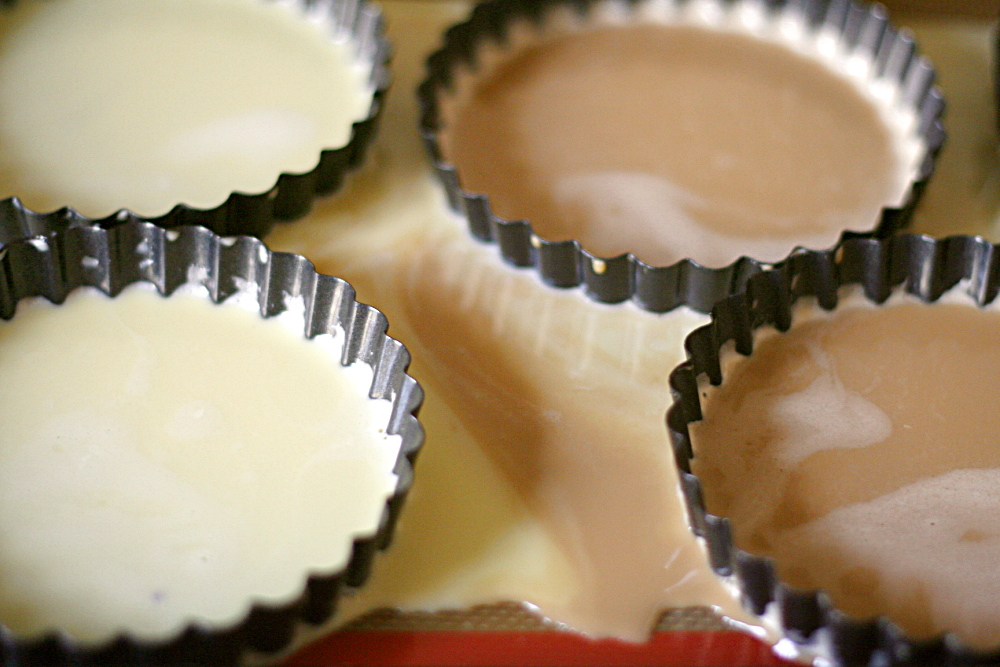
I made vanilla, Earl Grey, and ginger variations. I thought I could combine some of the steps for the variations, but that didn’t work out, so it was really like making the recipe three separate times. I didn’t have enough of the right sized ramekins, so I put the custard mixes in mini-tart pans instead. I was worried that the custard would leak because the tart pans have removable bottoms, but it worked out okay. Until I dropped the baking pan with the six full tartelette pans on it and everything spilled. Being clumsy is a pain in the ass.

Frustrated with that, I went back to my original plan to compare Dorie’s recipe to CI’s. (My freezer is full of egg whites now.) I was curious about this comparison anyway, because the recipes were significantly different. Dorie uses almost half the number of egg yolks compared to the amount of dairy, and she also uses a combination of heavy cream and milk instead of just heavy cream. That makes CI’s recipe much richer.

Whoa. Dorie’s also makes tiny servings. I wouldn’t expect that from her.

I assumed we’d like the richer crème brulee better, but Dave and I both preferred Dorie’s softer custard. However, Dave liked the flavor of CI’s better, which may be the pinch of salt added, or the lower amount of sugar used in CI’s, which could bring out the flavor of the other ingredients more. I used vanilla beans instead of vanilla extract in both recipes.

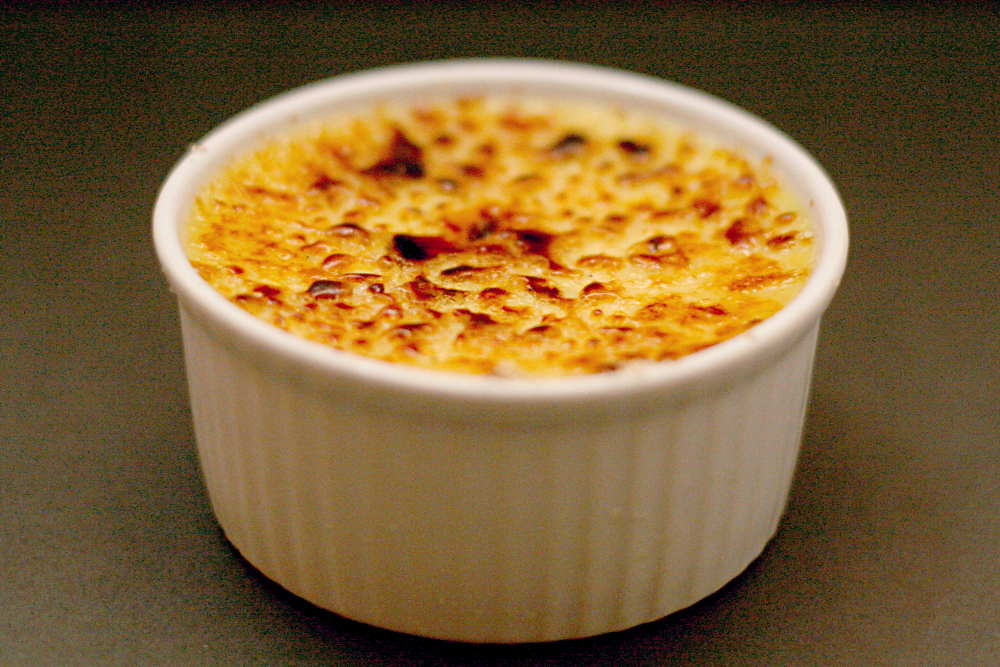
This is my most successful brulee job. (That goes for Dave too – this is the only kitchen task he’s excited about helping with.) I used a mixture of brown sugar and granulated, and in the past I used pure granulated. Apparently the mixture is more forgiving, because I used to end up with a combination of charcoaly burned areas and raw areas.

It’s crème brulee, so you really can’t go wrong. Unless you spill it all over the oven. Check Mari’s blog for Dorie’s recipe.

Classic Creme Brulee (from Cooks Illustrated)

Serves 8

CI note: Separate the eggs and whisk the yolks after the cream has finished steeping; if left to sit, the surface of the yolks will dry and form a film. A vanilla bean gives custard the deepest flavor, but 2 teaspoons of extract, whisked into the yolks in step 4, can be used instead. The best way to judge doneness is with a digital instant-read thermometer. The custards, especially if baked in shallow fluted dishes, will not be deep enough to provide an accurate reading with a dial-face thermometer. For the caramelized sugar crust, we recommend turbinado or Demerara sugar. Regular granulated sugar will work, too, but use only 1 scant teaspoon on each ramekin or 1 teaspoon on each shallow fluted dish.

4 cups heavy cream, chilled
⅔ cup granulated sugar
pinch table salt
1 vanilla bean, halved lengthwise
12 large egg yolks
8 – 12 teaspoons turbinado sugar or Demerara sugar

1. Adjust oven rack to lower-middle position and heat oven to 300 degrees.

2. Combine 2 cups cream, sugar, and salt in medium saucepan; with paring knife, scrape seeds from vanilla bean into pan, submerge pod in cream, and bring mixture to boil over medium heat, stirring occasionally to ensure that sugar dissolves. Take pan off heat and let steep 15 minutes to infuse flavors.

3. Meanwhile, place kitchen towel in bottom of large baking dish or roasting pan and arrange eight 4- to 5-ounce ramekins (or shallow fluted dishes) on towel. Bring kettle or large saucepan of water to boil over high heat.

4. After cream has steeped, stir in remaining 2 cups cream to cool down mixture. Whisk yolks in large bowl until broken up and combined. Whisk about 1 cup cream mixture into yolks until loosened and combined; repeat with another 1 cup cream. Add remaining cream and whisk until evenly colored and thoroughly combined. Strain through fine-mesh strainer into 2-quart measuring cup or pitcher (or clean medium bowl); discard solids in strainer. Pour or ladle mixture into ramekins, dividing it evenly among them.

5. Carefully place baking dish with ramekins on oven rack; pour boiling water into dish, taking care not to splash water into ramekins, until water reaches two-thirds height of ramekins. Bake until centers of custards are just barely set and are no longer sloshy and digital instant-read thermometer inserted in centers registers 170 to 175 degrees, 30 to 35 minutes (25 to 30 minutes for shallow fluted dishes). Begin checking temperature about 5 minutes before recommended time.

6. Transfer ramekins to wire rack; cool to room temperature, about 2 hours. Set ramekins on rimmed baking sheet, cover tightly with plastic wrap, and refrigerate until cold, at least 4 hours or up to 4 days.

7. Uncover ramekins; if condensation has collected on custards, place paper towel on surface to soak up moisture. Sprinkle each with about 1 teaspoon turbinado sugar (1½ teaspoons for shallow fluted dishes); tilt and tap ramekin for even coverage. Ignite torch and caramelize sugar. Refrigerate ramekins, uncovered, to re-chill, 30 to 45 minutes (but no longer); serve.

lavash crackers (daring bakers)

This is the first Daring Baker recipe that has not only been from a cookbook I own, but was a recipe that I had planned to make soon anyway. Since football season started a few weeks ago, I’ve made Sunday into a snack day instead of serving an actual meal, which gives me a chance to play around with appetizer and dip recipes that I normally can’t (healthily) work into our routine.

The recipe itself was pretty simple. This is a rare recipe for Peter Reinhart in that it doesn’t require a pre-ferment, so the recipe can be completed in one day. The dough was easy to work with. I rolled it out right on my silicone baking mat, and then just moved the mat to a baking pan to bake it, so I never had to transfer just the sheet of dough.

I think Reinhart’s directions on rolling out the dough are off. I rolled the dough out to exactly the dimensions he recommends, but my “crackers” ended up far too thick. Reinhart refers to the rolled-out dough as “paper-thin” at one point, and mine certainly wasn’t. In the future, I’ll roll the dough out possibly twice as thin, so they’re more like crackers and less like little toasts.

I cheated on the dip. After I made it, I saw in the rules that we were supposed to make something that was gluten-free and vegan, but my pesto dip is based on goat cheese. But it’s so good! I have no regrets on breaking the rules if I get something so tasty out of it.

This challenge was a fun one – I always enjoy making yeast breads, and as I said, I’d been interested in this recipe for a while. The hosts this month, Natalie and Shel, also give directions for a gluten-free version, which I may try for my gluten-intolerant grandmother next time I see her. I’m always on the lookout for good gluten-free recipes.

Lavash Crackers (from Peter Reinhart’s The Bread Baker’s Apprentice)

Makes 1 sheet pan of crackers

1½ cups (6.75 ounces) unbleached bread flour
½ tsp salt
½ tsp instant yeast
1 tablespoons sugar
1 tablespoon vegetable oil
⅓ to ½ cup + 2 tablespoons (3 to 4 ounces) water, at room temperature
Poppy seeds, sesame seeds, paprika, cumin seeds, caraway seeds, or kosher salt for toppings

1. In a mixing bowl, stir together the flour, salt yeast, sugar, oil, and just enough water to bring everything together into a ball. You may not need the full ½ cup + 2 tablespoons of water, but be prepared to use it all if needed.

2. Sprinkle some flour on the counter and transfer the dough to the counter. Knead for about 10 minutes, or until the ingredients are evenly distributed. The dough should pass the windowpane test and register 77 degrees to 81 degrees Fahrenheit. The dough should be firmer than French bread dough, but not quite as firm as bagel dough (what I call medium-firm dough), satiny to the touch, not tacky, and supple enough to stretch when pulled. Lightly oil a bowl and transfer the dough to the bowl, rolling it around to coat it with oil. Cover the bowl with plastic wrap.

3. Ferment at room temperature for 90 minutes, or until the dough doubles in size. (You can also retard the dough overnight in the refrigerator immediately after kneading or mixing).

4. Mist the counter lightly with spray oil and transfer the dough to the counter. Press the dough into a square with your hand and dust the top of the dough lightly with flour. Roll it out with a rolling pin into a paper thin sheet about 15 inches by 12 inches. You may have to stop from time to time so that the gluten can relax. At these times, lift the dough from the counter and wave it a little, and then lay it back down. Cover it with a towel or plastic wrap while it relaxes. When it is the desired thinness, let the dough relax for 5 minutes. Line a sheet pan with baking parchment. Carefully lift the sheet of dough and lay it on the parchment. If it overlaps the edge of the pan, snip off the excess with scissors.

5. Preheat the oven to 350 degrees Fahrenheit with the oven rack on the middle shelf. Mist the top of the dough with water and sprinkle a covering of seeds or spices on the dough (such as alternating rows of poppy seeds, sesame seeds, paprika, cumin seeds, caraway seeds, kosher or pretzel salt, etc.) Be careful with spices and salt – a little goes a long way. If you want to precut the cracker, use a pizza cutter (rolling blade) and cut diamonds or rectangles in the dough. You do not need to separate the pieces, as they will snap apart after baking. If you want to make shards, bake the sheet of dough without cutting it first.

5. Bake for 15 to 20 minutes, or until the crackers begin to brown evenly across the top (the time will depend on how thinly and evenly you rolled the dough).

6. When the crackers are baked, remove the pan from the oven and let them cool in the pan for about 10 minutes. You can then snap them apart or snap off shards and serve.

Pesto Goat Cheese Spread (from Gourmet September 2002, but really epicurious.com)

4 ounces soft mild goat cheese at room temperature
2 ounces cream cheese at room temperature
¼ cup pesto

Stir together all ingredients with salt and pepper to taste until smooth.

pan-seared steak with red wine pan sauce

I try not to participate in many blog events, since about a third of my entries are already committed to Tuesdays with Dorie and the Daring Bakers. But Elly’s Eat to the Beat is such a great idea, and I thought it could be a fun way to meld my favorite hobby with Dave’s, which is music.

Bustle

Dave learned to play guitar from his uncle, who plays lead guitar in this song. His best friend, Sid Faiwu, does the drums and synthesizer in this song. The three of them played together for years until Dave and Sid both moved away from their home town as well as from each other. Now they try to send around mp3’s of new songs, but that obviously doesn’t work well.

Dave wrote this song, Bustle, in grad school after a particularly stressful test. It’s one of my favorites. The song is very dark, and really not about food in any way. The only line that I could think to apply to food was “dripping red.” Because of the nature of the song, I wanted something that would look as bloody as possible. And what’s bloodier than red wine sauce dripping down animal flesh?

I know I’ve been overdoing the Cooks Illustrated recipes lately, but I can’t seem to stop myself. I turn to their recipes for classics, like this steak with pan sauce. I feel like their recipes are less mass-produced and therefore more carefully developed than a lot of those from the Food Network or epicurious. And I’m generally bad at cooking steak, so I needed as much detail as possible.

The steak came out really well. I only undercooked it a little, and at least I didn’t burn the outside like I often do. The sauce was good as well. I think next time I’ll reduce the sugar by half, but other than that, it was perfect with the steak. And it certainly looks as gory as the song sounds.

Pan-Seared Steak with Red Wine Pan Sauce for Two (from Cooks Illustrated)

Serves 2

CI note: Pan sauces cook quickly, so prepare the ingredients before you begin cooking the steaks. Use a heavy skillet with a nonreactive cooking surface.

Bridget note: I used strip steak, because it’s my favorite.

2 boneless 8-ounce rib-eye steaks or top loin steaks, 1 to 1¼ inches thick, thoroughly dried
Table salt and ground black pepper
1 small shallot, minced (about 2 tablespoons)
1 teaspoon brown sugar
¼ cup dry red wine , such as Cabernet Sauvignon
¼ cup low-sodium chicken broth
1 bay leaf
1½ teaspoons balsamic vinegar
½ teaspoon Dijon mustard
1½ tablespoons unsalted butter , cut into 3 pieces
½ teaspoon minced fresh thyme leaves

1. Heat heavy-bottomed, 10-inch skillet over high heat until very hot, about 3 minutes. Meanwhile, season both sides of steaks with salt and pepper.

2. Lay steaks in pan, leaving ¼-inch of space between each; reduce heat to medium-high, and cook without moving until well browned, about 4 minutes. Using tongs, flip steaks; cook 4 minutes more for rare, 5 minutes more for medium-rare, and 6 minutes more for medium. Transfer steaks to large plate and tent with foil to keep warm.

3. Off heat, add shallot and sugar to empty skillet; using pan’s residual heat, cook, stirring frequently, until shallots are slightly softened and browned and sugar is melted, about 45 seconds. Return skillet to high heat, add wine, broth, and bay leaf; bring to boil, scraping up browned bits on pan bottom with wooden spoon. Boil until liquid is reduced to 3 tablespoons, about 4 minutes. Stir in vinegar and mustard; cook at medium heat to blend flavors, about 1 minute longer. Off heat, whisk in butter until melted and sauce is thickened and glossy. Add thyme and season to taste with salt and pepper. Remove bay leaf, spoon sauce over steaks and serve immediately.

dimply plum cake (twd)

Deb from Smitten Kitchen recently recommended the cake that Michelle chose for TWD this week, and since I’m a Smitten Kitchen junkie, I’d been wanting to make it since then. I didn’t even realize it was Dorie Greenspan’s recipe at first, so I was excited when I saw that it was the assigned recipe. Plus, I just happened to have all of the ingredients the day it was chosen for TWD, including a bunch of plums. That never happens.

I baked the recipe in a muffin pan because muffins are more convenient to store in the freezer and grab before going to work. And I overfilled the muffin cups because I have an annoying lazy tendency. I put what seemed like an appropriate amount of batter in each cup, but I could tell after I pushed the first plum into the batter that the cups were overfilled. How hard would it have been, really, to re-portion the dough into extra muffin cups, especially considering that I only used 10 sections of the 12-cup muffin pan, and I had extra plums. And then I would have avoided making a mess of some of the muffins/cupcakes.

Not that I minded those broken bits. They gave me a great excuse to snack on cake while I finished making breakfast. I thought the cake was really good. I used lemon zest and cinnamon, but I think orange zest would be a lot better. I’m still fighting fall, but this was a good compromise between late summer and fall flavors.

Michelle has posted the recipe.

banana and peanut butter stuffed french toast

Up until very recently, whenever someone mentioned Elvis’ favorite sandwich, I thought to myself “well, no wonder he died young!” Once I actually took a moment to consider it though, the sandwich really isn’t so bad. The basic Elvis sandwich is just bananas and peanut butter, fried like a classic grilled cheese. I’d say that the grilled cheese sandwich is far worse for you. Oh, except sometimes Elvis liked to add bacon, which, okay, is a little over the top.

I realized a few months ago that I like bananas a lot more if they’re served with a bit of peanut butter (or Nutella). That reminded me of Elvis’s favorite sandwich, but I wasn’t interested in pan-frying it. Instead, I thought it would be great as French toast.

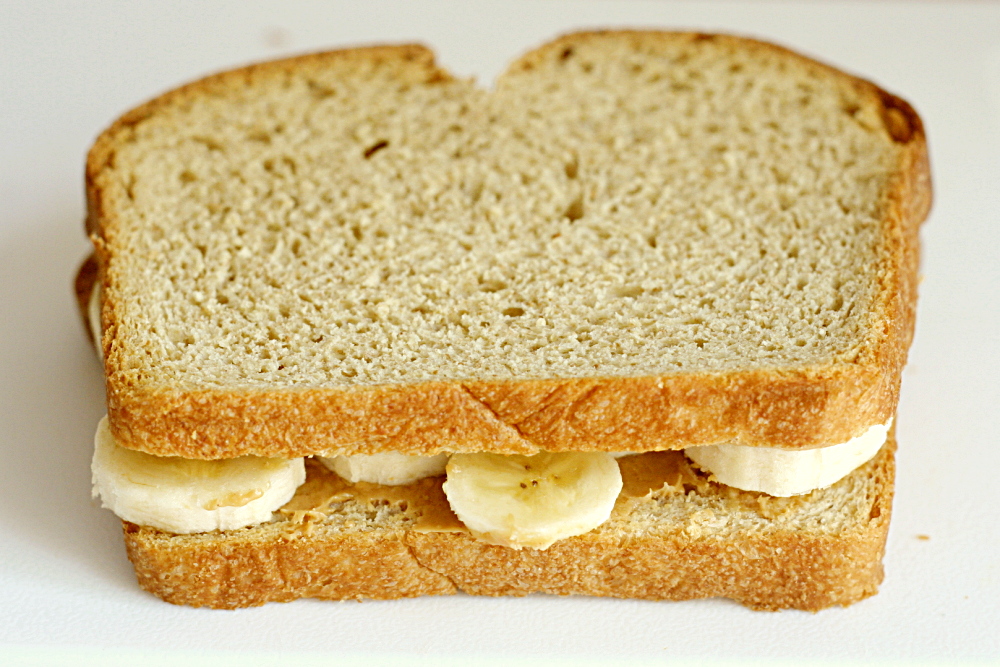
I had never made stuffed French toast, but there are plenty of recipes for different versions of it, so I was confident that it would work. First I made the basic sandwich by smearing one side of each bread slice with a thin layer of peanut butter. I wanted peanut butter on both slices so it would glue the bananas to the bread, keeping the sandwich together. I recommend a very thin layer because peanut butter can be overpowering, as well as sticky in your mouth. I used my favorite French toast recipe for the batter, but made it a little thinner because it would only be absorbed through the non-peanut butter side of the bread slices.

It worked out pretty well. I should have let the sandwich soak in the batter a little longer, and I should have cooked them on higher heat, but the flavors were really good. And there’s really nothing unhealthy about it except for a bit of butter to fry the sandwiches. I’m guessing the drug dependency was a bigger influence on Elvis’ early demise than banana sandwiches.

Elvis French Toast (adapted from Cooks Illustrated’s French Toast recipe)

4 slices sandwiches bread (I used Country Crust Bread)
2 tablespoons peanut butter (approximately)
1-2 bananas, sliced ¼-inch thick
1 large egg
1 cup milk
2 teaspoons vanilla extract
2 tablespoons granulated sugar
¼ teaspoon table salt
1 tablespoon butter

1. Spread a thin layer of peanut butter on one side of each slice of bread. Place slices of banana in a single layeron peanut butter-covered sides of two bread slices. Top with the remaining bread, peanut butter side down.

2. Heat medium nonstick skillet over medium heat for 5 minutes. Meanwhile, beat egg lightly in shallow pan or pie plate; whisk in milk, vanilla, sugar, and salt and salt, continuing to whisk until smooth. Soak sandwiches without oversaturating, about 1 minute per side. Pick up bread and allow excess batter to drip off; repeat with remaining sandwiches.

3. Swirl 1 tablespoon butter in hot skillet. Transfer prepared sandwiches to skillet; cook until golden brown, about 2 minutes on first side and 1 minute 15 seconds on the second. Serve immediately, dusting with powdered sugar.

chocolate chunkers

Just about every week, I’m reminded of why I enjoy being a member of TWD so much. The Chocolate Chunkers Claudia chose this week are no exception. I am always impressed by Dorie’s creativity.

That being said, Dorie and I do often differ on taste preferences. For example, what is with all the raisins? She puts them in everything. I do not approve. Also, peanuts. I like them, but I rarely want them in dessert. Also, this phrase: “You’ll have more crunchies than dough.” But…I love dough. Even more than crunchies.

This recipe is far more involved than my normal cookie recipes. It has quite the substantial ingredient list, and a good number of those ingredients need to be prepped in some way. At least I was able to use up my little-bits-of-leftover-chocolate stash.

She doesn’t call these “chunkers” for nothing. More crunchies than dough indeed. There’s just enough of the brownie-like batter to hold the mix-ins together. But – it works. Yes, I’d rather have a plain, rich, moist, perfect brownie, but for something super-fun and different, I like these cookies.

Claudia has the recipe posted. I substituted dried cherries (which I chopped up a bit) for the raisins and walnuts (not toasted, but they should have been) for the peanuts.

gazpacho

While everyone else has been getting excited about fall, publishing recipes with pumpkin and apples and cranberries, I’ve been desperately holding on to summer. Not only do I just plain like being warm, but I didn’t get my fill of summer produce this year. I only ate corn on the cob one time – just one! I’m a disgrace. And I can never get enough of flavorful seasonal tomatoes.

Gazpacho, to me, is the quintessential summer dish, putting the spotlight on tomatoes, with cucumbers and peppers singing backup. I served this gazpacho to a friend of mine from Spain, and he said that it was as good as any gazpacho he’d had over there. This is good stuff.

I’ve always been a big fan of traditional hot tomato soup, and I didn’t understand the allure of gazpacho when I was young – cold tomato soup? Yuck. But gazpacho made correctly isn’t anything like a smooth tomato soup. I like gazpacho to have more in common with salad than soup. That means that the vegetables have to be chopped by hand instead of in the food processor. It takes more time, but it’s worth it to eat real gazpacho instead of the vegetable smoothie that you’d end up with if you used the food processor.

Another great aspect of gazpacho is that it lasts for several days in the fridge. And it’s absolutely healthy, so it makes a really good snack. I love to keep some around for when I get home from work and I’m starving and dinner won’t be ready for a while.

Right after I finished dicing the vegetables for this, I inhaled deeply – it was pure summer. I felt better about letting the season go and moving into fall once I had made a batch of gazpacho. But don’t expect to see pumpkin recipes here for a while!

Gazpacho (from Cooks Illustrated)

CI note: Welch’s and Fresh Samantha’s are our favorite brands of tomato juice for this recipe — not too thick, with a bright, lively flavor. This recipe makes a large quantity because the leftovers are so good, but it can be halved if you prefer. Traditionally, diners garnish their gazpacho with more of the same diced vegetables that are in the soup, so cut some extra vegetables when you prepare those called for in the recipe. Additional garnish possibilities include simple garlic croutons, chopped pitted black olives, chopped hard-cooked eggs, and finely diced avocados. For a finishing touch, serve in chilled bowls.

Bridget note: I’ve found that the brand of tomato juice is extremely important. I’m never been able to find Welch’s or Samantha’s tomato juice, but Campbell’s works fine. And I never use ice cubes, I just add 1 cup of cold water.

Makes about 3 quarts, serving 8 to 10

3 ripe medium beefsteak tomatoes (about 1½ pounds), cored and cut into ¼-inch cubes (about 4 cups)
2 medium red bell peppers (about 1 pound), cored, seeded, and cut into slices, then into ¼-inch cubes (about 2 cups)
2 small cucumbers (about 1 pound), one peeled and the other with skin on, both seeded and cut into ¼-inch cubes (about 2 cups)
½ small sweet onion (such as Vidalia, Maui, or Walla Walla) or 2 large shallots, peeled and minced (about ½ cup)
2 medium cloves garlic, minced or pressed through a garlic press (about 2 teaspoons)
2 teaspoons table salt
⅓ cup sherry vinegar
ground black pepper
5 cups tomato juice
1 teaspoon hot pepper sauce (optional)
8 ice cubes
extra-virgin olive oil for serving

1. Combine the tomatoes, bell peppers, cucumbers, onions, garlic, salt, vinegar, and pepper in a large (at least 4-quart) nonreactive bowl. Let stand until the vegetables just begin to release their juices, about 5 minutes. Stir in the tomato juice, hot pepper sauce, if using, and ice cubes. Cover tightly and refrigerate to blend flavors, at least 4 hours and up to 2 days.

2. Adjust the seasonings with salt and pepper and remove and discard any unmelted ice cubes. Serve cold, drizzling each portion with about 1 teaspoon extra-virgin olive oil and topping with the desired garnishes, (see top note).