granola grabbers (twd)

No classic cookie recipes have been chosen for TWD since I joined. I like making cookies, so I was looking forward to Michelle’s choice for this week.

With all of the ingredients in this recipe, I thought at first that they’d be similar to Magic Cookie Bars. And then I looked closer at the recipe – 3 cups of granola and almost 3 more cups of other healthy-ish stuff compared to only 1 cup of flour. These were some sort of melding of granola bars and cookies. Hmm…that sounds…healthy.

And it tasted healthy. Too much granola! Too many raisins (any raisins in cookies is too many), too many nuts. I added 1 cup of chocolate chips to the recipe, and it was the saving grace. It also might have caused some problems – the cookies were a little crumbly, I think because there was just too many add-ins, and not enough dough to hold them together.

Dave and some other friends are going backpacking this weekend, so I baked (most of) the cookies as bar cookies, which hold up better with being squashed at the bottom of a pack. Unfortunately, in a rare move for me, I made the whole recipe. I was only able to pawn about half of that off on the backpackers, so I threw the rest in the freezer until further notice. I have a feeling they’re going to get sent to Iraq, which I feel kind of bad about, but I just don’t know what else to do with them. They’re not bad, they’re not good enough to bother eating. Plus, they’re not healthy – they just taste like it.

If you’d like to check out the recipe, Michelle has posted it.

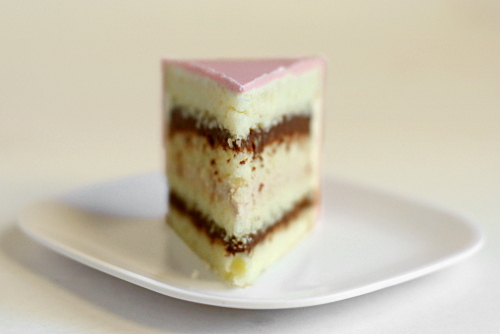
black (and pink) and white chocolate cake

I thought long and hard about what to make for my birthday cake. The thing about this obsessed-with-baking phase that I’m going through is that the eating of the cake is almost secondary to the fun of making it. I had a fairly long list of desserts I was considering, split almost evenly between cheesecakes and somewhat-elaborate layer cakes. I settled on Dorie Greenspan’s Black and White Chocolate Cake because it seemed like a good balance between fancy and not so much work that I’d spend all day (the day before my birthday) baking. Or so I had hoped.

The cake consists of a straightforward buttermilk-vanilla cake, layered with chocolate pastry cream and vanilla cream. The chocolate pastry cream was easy and delicious, and the cake itself came together without any problems.

The white chocolate cream, unfortunately, was not so smooth (literally). This was one of the first TWD recipes, back when there were only a handful of members, so I had scanned a few of their entries and seen that the white chocolate cream might be a problem. I knew enough to use high quality white chocolate, which is less prone to problems in baking than cheaper versions. Valrhona and Guittard are recommended most often, but both require a special, out-of-my-way trip to either Whole Foods or Williams-Sonoma, and I’ve had good experiences with Green and Black’s White Chocolate, which is available at my regular grocery store.

The white chocolate cream is made by melting white chocolate with cream, then adding that mixture to cream that’s been whipped to very soft peaks and continuing to beat until firm peaks are achieved. Firm peaks. Not stiff peaks. I guess I should have considered the difference between those two more carefully. I knew, knew, that there was the potential to overbeat the mixture and cause curdling, and I was so careful, only beating for about a second at a time, then checking the consistency. I was waiting until the peaks could hold their shape.

But the mixture curdled first. I tried to save it, the same way I’ve saved curdled buttercream in the past, and I thought for a while that it might work, but it didn’t. I kicked myself over and over for not stopping whipping the cream mixture early enough. Then I mentally berated Dorie for not being more specific. She gives such wonderful detailed instructions sometimes, describing exactly what the food processor should sound like when tart dough is ready, but she can’t add a warning about this “firm peaks” issue. Bleah.

Even if I’d had the right ingredients, which I didn’t, I wasn’t enthusiastic about trying the white chocolate cream again. Instead, I made a white chocolate buttercream. But I accidentally only made enough to give the cake the thinnest of coatings. I was tired of dealing with fussy white chocolate, and I’d already incorporated raspberries into the cake, so then I made another buttercream, this time flavored with raspberries. But I was frustrated and bored by this time, so I screwed up the buttercream, twice (cooked the egg whites), because of I was inattentive.

So much for my relatively straightforward cake. To assemble, I mixed a portion of the white chocolate buttercream with some raspberry pastry cream I had leftover from another project, and used that as the white chocolate layer in the cake. I used the white chocolate buttercream as a crumb coat and the raspberry buttercream as a final layer.

I wasn’t disappointed in the final product. For one thing, it was really pretty. The cake itself was tasty, although it probably could have used a quick brush with a simple syrup. The dark chocolate pastry cream was fantastic. I wasn’t totally happy with either the white chocolate or the raspberry buttercream, but neither detracted from the final product, even if they didn’t add much. All in all, a satisfactory birthday cake.

Black and White Chocolate Cake (from Dorie Greenspan’s Baking: From My Home to Yours)

Makes 10 servings

For the Cake
2 cups cake flour
2 teaspoons baking powder
⅛ teaspoon baking soda
¼ teaspoon salt
1¼ sticks (10 tablespoons) unsalted butter, at room temperature
1 cup sugar
3 large eggs
1 large egg yolk
1 teaspoon pure vanilla extract
¾ cup buttermilk

For the Dark Chocolate Cream
2 cups whole milk
4 large egg yolks
6 tablespoons sugar
3 tablespoons cornstarch, sifted
¼ teaspoon salt
7 ounces bittersweet chocolate, melted
2½ tablespoons unsalted butter, cut into 5 pieces, at room temperature

For the White Chocolate Whipped Cream
6 ounces premium-quality white chocolate (such as Valrhona Ivoire or Guittard), finely chopped
1½ cups heavy cream

Chocolate shavings or curls, dark or white or a combination, for decoration (optional)

Getting Ready:
Center a rack in the oven and preheat the oven to 350 degrees F. Butter two 9-x-2-inch round cake pans, dust the insides with flour, tap out the excess and line the bottoms of the pans with parchment or wax paper. Put the pans on a baking sheet.

To Make the Cake:
Sift together the cake flour, baking powder, baking soda, and salt.

Working with a stand mixer, preferably fitted with a paddle attachment, or with a hand mixer in a large bowl, beat the butter on medium speed until soft and creamy. Add the sugar and beat for another 3 minutes. Add the eggs one by one, and then the yolk, beating for 1 minute after each addition. Beat in the vanilla; don’t be concerned if the mixture looks curdled. Reduce the mixer speed to low and add the dry ingredients alternately with the buttermilk, adding the dry ingredients in 3 additions and the milk in 2 (begin and end with the dry ingredients); scrape down the sides of the bowl as needed and mix only until the ingredients disappear into the batter. Divide the batter evenly between the two pans and smooth the tops with a rubber spatula.

Bake for 28 to 30 minutes, rotating the pans at the midway point. When fully baked, the cakes will be golden and springy to the touch and a thin knife inserted into the centers will come out clean. Transfer the cakes to a rack and cool for about 5 minutes, then unmold, remove the paper and invert to cool to room temperature right side up on the rack.

To Make the Dark Chocolate Cream:
Bring the milk to a boil.

Meanwhile, in a large heavy-bottomed saucepan, whisk the egg yolks with the sugar, cornstarch and salt until thick and well blended. Whisking without stopping, drizzle in about ¼ cup of the hot milk – this will temper, or warm, the yolks so they won’t curdle – then, still whisking, add the remainder of the milk in a steady stream. Put the pan over medium heat and, whisking vigorously, constantly and thoroughly (make sure to get into the edges of the pan), bring the mixture to a boil. Keep at a boil, still whisking, for 1 to 2 minutes. Remove the pan from the heat.

Whisk in the melted chocolate, and let stand for 5 minutes. Then whisk in the pieces of butter, stirring until they are fully incorporated and the chocolate cream is smooth and silky. Press a piece of plastic wrap against the surface of the cream to create an airtight seal and refrigerate the cream until chilled, or for up to 3 days. Or, if you want to cool the cream quickly, put the bowl with the cream into a large bowl filled with ice cubes and cold water and stir the cream occasionally until it is thoroughly chilled, about 20 minutes.

To Make the White Chocolate Whipped Cream:
Put the white chocolate in a heatproof bowl and put the bowl over a saucepan of gently simmering water. Stir frequently to melt the chocolate evenly. Meanwhile, bring ½ cup of the heavy cream to a boil.

When the white chocolate is melted, remove the bowl from the pan. Pour the hot cream into the melted chocolate and let it sit for a minute. Using a small spatula, stir the chocolate gently until it is smooth. Let it sit on the counter until it reaches room temperature – it can’t be the least bit warm when you add it to the whipped cream.

Working with the stand mixer with the whisk attachment or with a hand mixer in a large bowl, beat the remaining 1 cup heavy cream only until it holds the softest peaks. Turn the machine to high, add the cooled white chocolate all at once and continue to beat until the whipped cream holds firm peaks. Turn the whipped cream into a bowl, press a piece of plastic wrap gently against the surface to create an airtight seal and refrigerate for at least 2 hours, or up to 6 hours.

To Assemble the Cake:
If the tops of the cake layers have crowned, use a long serrated knife and a gentle sawing motion to even them. Slice each layer horizontally in half. Place one layer cut side down on a cardboard cake round or on a cake plate protected by strips of wax or parchment paper.

Remove the dark and white chocolate creams from the refrigerator and whisk each of them vigorously to loosen and smooth them. With a long metal icing spatula, spread enough dark chocolate cream (about 1 cup) over the cake layer to cover it completely. Top the cream with another cake layer, cut side up, and cover this layer with white chocolate whipped cream, making the white layer about the same thickness as the dark layer. Cover with a third layer, cut side up, and cover with another cup or so of the dark chocolate cream. (You’ll have some dark chocolate cream left over – use it as a dip for madeleines or sables.) Top with the final layer of cake, cut side down, and frost the sides and top with the remaining white chocolate whipped cream. If you’d like to decorate the top with chocolate shavings or curls, do it now.

Refrigerate for at least 3 hours, or overnight.

Serving: Remove the cake from the fridge about 20 minutes before serving. Use a serrated knife and a gentle sawing motion to cut it. Though the cake is particularly good with coffee or tea, it also goes well with a sweet or sparkling dessert wine.

Storing: While both the dark chocolate cream and white chocolate cream can be made ahead and kept tightly covered in the refrigerator, once assembled, the cake is best after about 3 hours in the fridge. However, it can be refrigerated overnight – just cover it loosely and keep it away from foods with strong odors.

The Raspberry Buttercream is the same recipe used for Dorie’s Perfect Party Cake, with raspberry puree substituting for the lemon juice. The White Chocolate Buttercream is the ingredients in this recipe using the method for Dorie’s buttercream.

fruit bruschetta

Lately I’ve been on a major breakfast kick. It seems like I want to try something different every weekend morning. This fruit bruschetta is definitely different – it doesn’t even fit into my simple sweet versus savory categorization of breakfasts. (Obviously it’s a sweet option, but it isn’t the standard pancakes/waffles/French toast offering.)

The bruschetta are easy to make. Toast and butter bread, sprinkle with cinnamon sugar and broil until the sugar caramelizes, top with fruit and yogurt. And except for the bit of sugar and butter, it’s actually healthy. As much as Dave loves the croque-madame, I think if it was up to him, we’d eat breakfasts like this far more often.

I used the last loaf of pain a l’ancienne for the brushetta. I noted when I made the pain a l’ancienne that the crust was too thick, and that, combined with maybe overtoasting it a bit, caused my bruschetta to be way too crispy. That’s an understatement – I worried for my teeth, eating this. But if you’re using normal bread, I’m sure you won’t have the same problem.

I think these would be perfect for a brunch. They can sit at room temperature for a while without a problem, and they’re easy finger food. They’re simple, they’re fairly healthy, and they’re certainly an original option.

Peach, Strawberry, and Banana Bruschetta (from Gourmet August 1994, but really epicurious.com)

Bridget note: I used vanilla yogurt to drizzle over the toasts instead of plain yogurt, so I skipped the honey and sprinkled lemon zest over the yogurt instead.

Makes 16 bruschetta

16 ½-inch-thick slices crusty Italian or French bread
2 tablespoons melted unsalted butter
1½ tablespoons sugar
1½ tablespoons cinnamon, or to taste
1 peach, peeled, pitted, and cut into fine dice
½ banana, cut into fine dice
8 large strawberries, cut into fine dice
3 to 4 tablespoons plain yogurt
honey for drizzling

Preheat oven to 375°F.

Arrange bread slices in one layer in a shallow baking pan and bake in middle of oven until golden, about 10 minutes. Brush toasts with butter on one side. Toasts may be made 1 week ahead and kept in an airtight container.

In a small bowl stir together 1 tablespoon sugar and cinnamon and sprinkle evenly over buttered side of each toast. Broil toast about 5 inches from heat under preheated broiler 30 seconds, or until tops are bubbling, and cool.

In a bowl stir together fruit and remaining ½ tablespoon sugar and mound about 1 tablespoon on each toast. Top each toast with about 1 teaspoon yogurt and drizzle with honey.

blueberry sour cream ice cream (twd)

The blueberry sour cream ice cream that Dolores chose for TWD this week sounded interesting, and I wasn’t really sure how I’d feel about it. I had never tried sour cream in ice cream, or even really heard of it being used. I remember mixing sour cream into whipped cream for the cream puff filling and being surprised by how much I liked it, so I had high hopes for this ice cream.

The recipe itself was very simple. Bring sugar, berries, and lemon to a simmer, blend it with heavy cream and sour cream, chill, and churn. No one seemed to have any problems putting the recipe together this week, so that’s something. A few people even went ahead and made it without an ice cream maker.

I really liked it. Dave thought it was too sour creamy, but that might be my fault – I told him it was blueberry ice cream, and he said that the sour cream detracted from the blueberry flavor. But this is definitely blueberry sour cream ice cream – the sour cream gets equal billing with the blueberries.

The texture was smooth, not grainy at all. Some other TWD members have complained that the ice cream was too rich and left an unpleasant coating behind each bite, but I don’t really agree.

The ice cream admittedly isn’t a classic choice; the sour cream flavor definitely stands out. But I thought it was really good, and I enjoyed trying something different. Plus, it’s super easy.

Check out the recipe on Dolores’ site.

country egg scramble

In my mind, there are basically two kinds of breakfasts – there are savory breakfasts, which are generally based around eggs, and then there are sweet breakfasts, which include pancakes and waffles and the like. The best savory breakfasts involve potatoes in addition to the eggs. And bacon of course, unless you’re saving the bacon for BLTs and have to use sausage instead.

This skillet scramble is a simple but tasty example of a savory breakfast.  I did make some changes to the recipe here and there. Like most Betty Crocker recipes, this one tries to trick you into thinking it’s easier than it is by calling for cooked bacon in the ingredient list, rather than including the instructions for cooking bacon. Like I’m going to have cooked bacon laying around, just waiting to be sprinkled over breakfast. And why would I brown the potatoes in butter when there’s bacon fat right there?

Still, this recipe for a great savory breakfast is not complicated. You pretty much cook some tasty breakfast meat, then brown some par-boiled potatoes and add beaten eggs, cooking until they set. Easy though it might be, it involves most of my favorite breakfast ingredients – eggs, meat, and potatoes – and thus makes for a delicious and classic meal.

Printer Friendly Recipe
Country Egg Scramble
(adapted from Betty Crocker)

Serves 4

1 pound (6 to 7) new red potatoes, cubed
6 slices (6 ounces) bacon (or breakfast sausage), chopped
6 eggs
2 tablespoons milk
Salt
⅛ teaspoon pepper
4 medium green onions, sliced (¼ cup)

1. Place potatoes and ¼ teaspoon salt in 2-quart saucepan. Add water until it reaches 1 inch above potatoes. Heat to boiling over medium-high heat. Once the water boils, cook for 6 minutes or until potatoes are almost tender, then drain.

2. Meanwhile, cook bacon in a medium nonstick skillet over medium heat until crisp. Using a slotted spoon, transfer to paper towel-lined plate. Drain all but 2 tablespoons fat from skillet.

3. Beat eggs, milk, ¼ teaspoon salt, the pepper, and the green onions with fork or wire whisk until it’s a uniform yellow color; set aside.

4. Cook potatoes in bacon fat over medium-high heat for 5 to 8 minutes, turning occasionally, until browned. Stir in reserved bacon.

5. Pour egg mixture into skillet. As mixture begins to set at bottom and side, gently lift cooked portions with spatula so that thin, uncooked portion can flow to bottom. Avoid constant stirring. Cover pan and cook 3 to 4 minutes or until eggs are thickened throughout but still moist.

banana coconut muffins

Dave’s been eating muffins everyday, which is good for me because it gives me an actual reason to bake. Plus, I buy enough bananas for Dave and I to each eat one per day, but I’m so freakin’ bored of bananas that I never eat mine. I eat batter or dough instead. Did I mention that I bake a lot?

If I’m going to be making banana muffins constantly, I figure I might as well make some interesting ones. The recipe for these banana coconut muffins has a lot of great reviews on epicurious, which is always a good sign. Also, Dave likes coconut more than I do, and since I do all of the cooking for us, I don’t think he gets to eat it as often as he’d like.

I was really happy with the muffins. I can never resist eating one after I bake them, even though I’m making them for Dave to bring to work. They were light and tender and flavorful, with a good balance of banana and coconut flavor. Some of the coconut shreds on top of the muffin fell off, so next time I’ll pat those into the batter a bit. Other than that detail, these were perfect.

Banana Coconut Muffins (from epicurious.com)

Makes 8

1¼ cups (6.25 ounces) all-purpose flour
1 teaspoon baking powder
¼ teaspoon salt
2 very ripe bananas, mashed (¾ cup)
1 stick (½ cup) unsalted butter, melted
⅔ cup (4.65 ounces) sugar
1 large egg
½ teaspoon vanilla
¾ cup sweetened flaked coconut

Put oven rack in middle position and preheat oven to 375°F. Line muffin cups with liners.

Whisk together flour, baking powder, and salt in a bowl. Whisk together bananas, butter, sugar, egg, vanilla, and ½ cup coconut in a large bowl until combined well, then fold in flour mixture until flour is just moistened.

Divide batter among lined muffin cups and sprinkle with remaining ¼ cup coconut. Bake until muffins are puffed and golden, about 25 minutes. Transfer muffins to a rack and cool slightly.

grits, cheese and onion souffles

Opinions vary among food bloggers on whether it’s worth publishing the recipes we didn’t like. Some people feel that the point of their blog is to share recipes, and there’s no point offering one to your readers that you don’t recommend. Others have a blog simply to keep a log of what they’ve cooked, good or bad. For the most part, I feel that as long as I’m offering some useful information, it’s worth having in my blog. This recipe was in a recent issue of Bon Appetit, so people may be planning on making it, and my review could be useful to them.

Also, I made grits soufflés. Something as unusual as grits soufflé deserves a blog entry, even if it didn’t knock my socks off.

It was just too…eggy. It’s probably my fault; I think I was expecting the grits to give the soufflés more structure. I always think cheese soufflé is too eggy too, so maybe I just don’t really like soufflé. Except that I have no problem with the chocolate soufflés that I’ve made.

The reviews for this recipe are much more positive than I would expect based on my experience. It seems like a lot of the reviewers added more cheese, some almost doubling the original amount. In general, more cheese = good, so maybe that would have helped. I don’t know. I haven’t given up on savory soufflés yet, but I’m starting to have my doubts about them.

Grits, Cheese, and Onion Soufflés (from Bon Appétit June 2008)

Makes 4 main-course servings

2 tablespoons (¼ stick) butter
¾ cup chopped onion
¾ cup chopped leek
1½ cups whole milk, divided
½ teaspoon salt
⅓ cup quick-cooking grits
4 large eggs, separated
3 green onions, chopped
1 cup (packed) grated hot pepper Monterey Jack cheese (about 4 ounces), divided

Preheat oven to 425°F. Butter four 1¼-cup soufflé dishes. Melt 2 tablespoons butter in large saucepan over medium heat. Add onion and leek; sauté 3 minutes. Mix in 1¼ cups whole milk and ½ teaspoon salt, then grits; bring to simmer. Reduce heat to low, cover, and cook until thick, stirring occasionally, about 5 minutes.

Meanwhile, whisk remaining ¼ cup milk and yolks in small bowl to blend.

Remove grits from heat. Stir in yolk mixture, then green onions and ¾ cup cheese. Beat whites in medium bowl until stiff but not dry. Fold into grits in 3 additions. Divide mixture among prepared dishes (mixture will come all the way to top of dishes). Sprinkle with ¼ cup cheese.

Bake soufflés until puffed and brown on top, about 18 minutes. Serve immediately.

black and white banana loaf (twd)

I couldn’t figure out at first whether the banana loaf Ashlee chose for TWD this week was supposed to be a cake or a quick bread. Eventually I realized that it’s in the cake section of the book, only a few pages after the pound cake recipe. But that didn’t stop me from baking it in a muffin pan.

Other TWD members had a lot of problems with this recipe, claiming that the batter was too liquidy. I didn’t really have any issues, although the batter was curdled at the end and looked really gross. Also – for something that I thought would be pretty straightforward, this used a surprising amount of dishes.

My correctly-sized loaf pan is in the freezer full of mushroom lasagna, so I had to bake the recipe in smaller dishes. That meant I could play around with some different methods of combining the batters. I was eager to try polka-dots.  It was fairly successful; I think they’d work better in a larger pan, but this was a good learning experience.

But I thought it was really good. Dave said that it was good but not something that he’d ever really ask me make, so I must have liked it more than he did. I thought the little cakes had a nice texture – they’re really moist, but also nice and firm. The banana flavor is pretty subtle, which I don’t prefer in banana bread, but I liked in this cake.

The recipe can be found on Ashlee’s blog.

fried egg and sausage ciabbata breakfast pizzas

By now it must be obvious that I like eggs on top of stuff. Poached are my favorite, but fried is fine too. With some potatoes or bread to soak up the creamy yolk and any number of other additions, a lot of my favorite breakfasts are based around eggs on stuff.

I’m not completely sure that this particular breakfast deserves its own recipe, although I apparently needed one to give me the idea. All it really is some crusty bread, halved horizontally, brushed with oil and topped with green onions, cheese, and cooked sausage. The pizzas are cooked until the cheese melts, then topped with a fried egg and more green onions.

I kept the basic structure of the recipe the same, but varied the details. I used some extra pain a l’ancienne that I had in the freezer, plus cheddar instead of pepper jack and breakfast sausage instead of Italian. The recipe instructs that chopped green onions should be mixed with a half cup of olive oil, which is rubbed on the bread and then drizzled over the egg at the end. I’m sure I don’t have to tell you that is a heck of a lot of oil (even for eight servings). I used just enough to coat the bread before adding the other toppings, and I (meant to but forgot to) sprinkled more chopped green onions over the egg, leaving the oil behind.

Dave and I couldn’t quite figure out if we should eat these with silverware or hands. Dave tried using silverware, and it seemed like sort of a disaster. I ended up picking mine up to eat it with my hands, and it worked pretty well. I was thinking that the yolk might be a drippy mess, but it mostly soaked into the bread below. So disregard the silverware in the pictures – I’m pretty sure silverware is not the way to go here. It is pizza, after all.

You can vary the ingredients to use whatever seems good to you. Any crusty chewy bread will work, and any cheese or cooked meat. Any way you go about it, this should be an easy and fun breakfast to put together and eat.

Fried Egg and Sausage Ciabatta Breakfast Pizzas (from Bon Appétit January 2008, but really epicurious.com)

BA note: Make this recipe your own by using different sausages and cheeses. For a Middle Eastern spin, sub in lamb sausage and feta. Serve pizzas with hot sauce.

Bridget note: I used breakfast sausage, cheddar cheese, pane a l’ancienne, and far less oil.

Makes 8 servings

1 loaf ciabatta bread (about 1 pound)
1 cup chopped green onions
8 tablespoons olive oil, divided
8 ounces sliced hot pepper Monterey Jack cheese
1 pound spicy or sweet Italian sausages, casings removed
8 large eggs

Preheat oven to 450°F. Cut bread horizontally in half. Place bread halves, cut side up, on separate baking sheets. Mix onions and 6 tablespoons oil in small bowl. Season with salt and pepper. Reserve 2 tablespoons onion oil and spread remaining onion oil over bread. Top with cheese.

Sauté Italian sausages in large nonstick skillet over medium-high heat until cooked through, breaking up with spoon, about 7 minutes. Divide sausage among bread halves. Bake pizzas until cheese melts and bread begins to crisp, about 10 minutes.

Meanwhile, heat 1 tablespoon oil in each of 2 large skillets over medium-high heat. Crack 4 eggs into each skillet. Sprinkle with salt and pepper. Cook 2 minutes. Remove from heat and let eggs stand in skillets while pizzas bake.

Arrange 4 eggs atop each pizza. Spoon reserved onion oil over eggs. Cut each pizza between eggs into 4 pieces.

tuscan-style couscous salad


Food generally tastes better outside. Even more so after you’ve hiked eight miles while carrying a 25-pound pack. Since Dave and I almost always eat this couscous salad while we’re backpacking, it’s no wonder we like it so much. But last time we went camping, we got driven home early by, um, we’ll just say fear of Lyme disease and spare you the creepy details. We ate this salad when we got home that night, and it tasted just as good while sitting on the couch watching a movie as it does when we’re eating it out of zip-top bags in the woods.

What’s so great about this salad is that it’s a perfectly balanced complete meal – a couscous base, both beans and nuts, and plenty of tomatoes, onions, and basil. There’s no real cooking involved and not much chopping.

I have tweaked the original recipe slightly – while it’s basically the same list of ingredients, I’ve doubled the amount of pine nuts, tomatoes, basil, and onion. I’ve also reduced to the olive oil in the dressing, which I do with most vinaigrettes recipes.

One final change I make to the original recipe is to toast the unpeeled garlic cloves before adding them to the dressing. Lately I’ve been unhappy with the sharpness of raw garlic, and toasting it mellows its flavor a bit. It’s still garlicky and good, but it won’t burn your tongue. And since the pine nuts are already being toasted, it’s no problem to add the garlic cloves to the skillet as well.

Between the vivid colors of this dish, its healthfulness, the ease with which it comes together, and of course, its flavorful mix of ingredients, this salad is well worth eating at home and in the woods.

Tuscan-Style Couscous Salad (adapted from Vegetarian Classics, by Jeanne Lemlin)

Serves 4 as a main course

1½ cups couscous
½ teaspoon turmeric
2 cups boiling water
½ cup pine nuts
1 (15-ounce) can small white beans such as navy or Great Northern, rinsed well and drained
1 pint cherry tomatoes, halved
¾ cup shredded fresh basil
1 small red onion, slivered

The dressing:
3 garlic cloves, unpeeled
⅓ cup lemon juice
½ teaspoon salt
Generous seasoning freshly ground pepper
3 tablespoon extra virgin olive oil

1. Place the couscous and turmeric in a large bowl and mix. Pour on the boiling water, stir, and immediately cover the bowl with a large plate. Let sit for 10 minutes. Remove the cover and fluff the couscous with a fork. Let cool.

2. Place the pine nuts and unpeeled garlic cloves in a small skillet and toast over medium heat, tossing often, until golden, about 5 minutes. Watch them carefully because they can easily burn. Let the pine nuts cool, then mix them into the couscous along with the beans, tomatoes, basil, and red onion.

3. Mince the garlic. Place the dressing ingredients in a jar with a tight-fitting lid and shake vigorously. Pour over the couscous mixture and toss well. Let marinate at least 30 minutes before serving. Cover and chill if longer than 30 minutes. Serve at room temperature.