bagels

15.jpg

I absolutely love bagels. If it made nutritional sense, I would eat them several times each day – with butter, with cream cheese, with jam, as a breakfast sandwich with egg and cheese, as a lunch sandwich with turkey and mayonnaise. As it is, I eat one every day, half with butter, the other half with cream cheese. It’s one of my favorite meals of the day, and it never gets old.

23.jpg

I’ve been making my own for years. The first recipes I tried were fairly standard bread recipes with the added step of boiling the bagels between the second rise and baking. Once I discovered retarding the bagels – replacing the second rise with an overnight stay in the refrigerator – my bagels improved dramatically. They became even better when I started using a pre-ferment.

33.jpg

Unfortunately, all of these steps make homemade bagels a fair bit of effort. I had to take a break from making my own when my wedding became imminent, and I was moving and finishing my PhD and starting a new job. After eating perfectly good grocery store bagels for the past several months, I had to ask myself why I had bothered to make my own.

44.jpg

52.jpg

Now I remember – because mine are better. And not only are they very tasty, I can add whole wheat flour to my heart’s desire and better control the portion size. I also get to enjoy one fresh from the oven, and nothing beats that.

62.jpg

Bagels (adapted from Peter Reinhart’s The Bread Baker’s Apprentice and Cooks Illustrated)

Make 12 small or 8 large bagels

Bridget notes: I’ve found that I get the best bagels when I use Cooks Illustrated’s ingredient list and Peter Reinhart’s methods. The recipes are similar; the biggest difference is that Cook’s Illustrated uses a firmer dough (i.e., more flour).

Both recipes call for high-gluten flour, which is difficult to find. You can make your own by adding some gluten flour to bread flour. Sometimes I do that. This time, I simply used about half white bread flour and half whole wheat flour.

Update 4.14.08 – I reduced the flour in the recipe to reflect more accurately how much I’m usually able to mix in before the dough gets too dry (from 11 ounces in the dough to 8 ounces).

Sponge:
½ teaspoon instant yeast
1¾ cup (9 ounces) bread flour
1¼ cup (10 ounces) water, room temperature

Dough:
¼ teaspoon instant yeast
1 3/4 cup (8 ounces) bread flour (approximately)
1 1/2 teaspoons salt
1 tablespoon barley malt syrup
1 tablespoon cornmeal

1. To make sponge, stir the yeast into the flour in the bowl of a stand mixer. Add the water, stirring only until it forms a smooth, sticky batter (like pancake batter). Cover the bowl with plastic wrap and leave at room temperature for approximately 2 hours, or until the mixture becomes very foamy and bubbly. It should swell to nearly double in size and collapse when the bowl is tapped on the countertop.

2. To make the dough, add the additional yeast to the sponge and stir. Then add most of the remaining flour and all of the salt and malt. Mix on low speed with the dough hook until the ingredients form a ball, slowly working in the remaining flour to stiffen the dough.

3. Knead at low speed for 6 minutes. The dough should be firm and stiff, but still pliable and smooth. There should be no raw flour – all the ingredients should be hydrated. If the dough seems too dry and rips, add a few drops of water and continue kneading. If the dough seems tacky or sticky, add more flour to achieve the stiffness required. The kneaded dough should feel satiny and pliable but not be tacky.

4. Immediately divide the dough into 8-12 equal pieces. Form the pieces into smooth balls.

5. Cover the balls with plastic wrap and allow them to rest for 20 minutes. Dust a baking sheet with the cornmeal.

6. Form each dough ball into a rope 9 inches long by rolling it under your outstretched palms. Do not taper the ends of the rope. Overlap the ends of the rope about 1 inch and pinch the entire overlapped area firmly together. If the ends of the rope do not want to stick together, you can dampen them slightly. Place the loop of dough around the base of your fingers and, with the overlap under your palm, roll the rope several times, applying firm pressure to seal the seam. The bagel should be roughly the same thickness all the way around.

7. Place each of the shaped pieces about an inch apart on the prepared pan. Cover loosely with plastic wrap. Let the pan sit at room temperature for about 20 minutes.

8. Check to see if the bagels are ready to be retarded in the refrigerator by using the ‘float test.” Fill a small bowl with cool or room-temperature water. The bagels are ready to be retarded when they float within 10 seconds of being dropped into the water. Take one bagel and test it. If it floats immediately return the tester bagel to the pan, pat it dry, cover the pan, and place it in the refrigerator overnight (it can stay in the refrigerator for up to 2 days). If the bagel does not float, return it to the pan and continue to proof the dough at room temperature, checking back every 10 to 20 minutes or so until a tester floats. The time needed to accomplish the float will vary, depending on the ambient temperature and the stiffness of the dough.

9. The following day (or when you are ready to bake the bagels), adjust the rack to the middle position and preheat the oven to 450 degrees. Bring a large pot of water to a boil (the wider the pot the better). Have a slotted spoon or skimmer nearby. Line a baking sheet with parchment paper.

10. Remove the bagels from the refrigerator and gently drop them into the water, boiling only as many as comfortably fit (they should float within 10 seconds). Stir and submerge bagels with Chinese skimmer or slotted spoon until very slightly puffed, 30 to 35 seconds. Remove rings from water; transfer to wire rack, bottom side down, to drain.

11. Transfer boiled rings, rough side down, to parchment paper-lined baking sheet. Bake until deep golden brown and crisp, about 12 minutes.

12. Remove the pans from the oven and let the bagels cool on a rack for 10-15 minutes before serving.

72.jpg

whole wheat pasta with greens, beans, tomatoes, and garlic chips

copy-of-dscn4711.jpg

Dave recently told me that he’d prefer to eat less meat. Because I do all of the meal planning and cooking, we generally have an understanding that I get control over what we eat. On the other hand, Dave is so open-minded about what we eat that it’s fair for him to offer up some opinions.

And our meat intake has increased in the last few months. We used to eat meat around 1-3 times per week, and lately we’ve been eating vegetarian around 1-3 times per week. Because I have more free time lately, I’ve been more adventurous with my cooking, and because I don’t have as much experience cooking with meat, it’s more challenging for me. (In other words, I’m not very good at it.)

But Dave’s right, we should eat less meat. For our health, for our budget, for the environment.

This recipe for whole wheat pasta with greens, beans, tomatoes, and garlic chips is definitely Dave’s type of meal.

copy-of-dscn4709.jpg

This is only a quarter of the kale the recipe calls for, or just under one serving. (I cut the recipe in half, and accidentally only bought half as much kale as I needed.) Hey, he asked for more vegetables…

The pasta, wholesome though it is, is surprisingly flavorful. A dish like this lends itself well to personalization. I left out the olives, because they’re one of Dave’s few food hang-ups. Because I only made half the recipe for the two of us, I’m left with half a can of beans and half a can of tomatoes leftover. I plan on doubling those ingredients in the future so I can use the whole can. I only used half the amount of kale the recipe calls for, which was convenient because it was one bunch. I could see how more would be good, although I don’t know if I’d want twice as much.

The recipe did take longer to prepare than I prefer for a weeknight pasta dish. Using bags of pre-washed spinach would cut down on prep time and cooking time. The garlic chips are a nice addition, but could also be skipped to save time.

All in all, this was a great tasting dish with lots of vegetables and no meat, as per Dave’s request.

copy-of-dscn4716.jpg

Whole Wheat Pasta with Greens, Beans, Tomatoes, and Garlic Chips (from Cooks Illustrated November 2005)

Serves 4 to 6

CI note: If you can’t find a 13.25-ounce package of Ronzoni, the winner of our tasting, use ¾ pound of a whole wheat pasta of your choice. If you like, pass extra-virgin olive oil for drizzling over the finished pasta. For a vegetarian dish, substitute vegetable broth for chicken broth.

Variation: Spinach can be substituted for the greens. Replace kale or collards with two 10-ounce bags of crinkly-leaf spinach, trimmed, chopped into 1-inch pieces, and rinsed, water still clinging to leaves (about 16 cups), and reducing chicken broth to ¾ cup. After adding second half of spinach to pan, cook for 2 minutes, until spinach is completely wilted. Continue with recipe as directed.

3 tablespoons olive oil
8 cloves garlic, 5 cloves sliced thin lengthwise, 3 cloves minced or pressed through garlic press (1 tablespoon)
Table salt
1 medium onion, diced small (about 1 cup)
½ teaspoon hot red pepper flakes
14 cups kale (loosely packed) or collard greens (1 to 1½ pounds), thick stems trimmed, leaves chopped into 1-inch pieces and rinsed, water still clinging to leaves
1½ cups low-sodium chicken broth
1 can (14½ ounces) diced tomatoes, drained
1 can (15 ounces) cannellini beans, drained and rinsed
¾ cup pitted kalamata olives, roughly chopped
13¼ ounces whole wheat spaghetti
2 ounces Parmesan cheese, finely grated (about 1 cup), plus additional for serving
Ground black pepper

1. Heat oil and sliced garlic in 12-inch straight-sided sauté pan over medium-high heat. Cook, stirring and turning frequently, until light golden brown, about 3 minutes. Using slotted spoon, transfer garlic to plate lined with paper towels. Sprinkle lightly with salt.

2. Add onion to pan; cook until starting to brown, about 5 minutes. Add minced garlic and red pepper flakes; cook, stirring constantly, until garlic is fragrant, about 30 seconds.

3. Add half of greens to pan; using tongs, toss occasionally, until starting to wilt, about 2 minutes. Add remaining greens, broth, and ¾ teaspoon salt; cover (pan will be very full); increase heat to high and bring to strong simmer. Reduce heat to medium and cook, covered, tossing occasionally, until greens are tender, about 15 minutes (mixture will be somewhat soupy). Stir in beans and olives.

4. Meanwhile, bring 4 quarts water to boil in Dutch oven over high heat. Add spaghetti and 1 tablespoon salt; cook until pasta is just shy of al dente. Drain pasta and return to pot. Add greens mixture to pasta, set over medium-high heat, and toss to combine. Cook until pasta absorbs most of liquid, about 2 minutes. Stir in 1 cup Parmesan; adjust seasoning with salt and pepper. Serve immediately, passing garlic chips, extra-virgin olive oil, and Parmesan separately.

chocolate sandwich cookies

copy-of-dscn4429.jpg

I made these cookies without knowing what I was getting into. Based on the picture, I thought they’d be a rich, soft chocolate cookie topped with sweet vanilla icing. I didn’t bother reading the part of the description specifically referring to them as “crisp” until it was too late and I was committed.

So, they’re crisp cocoa-flavored cookies with vanilla icing. They’re Oreos. I don’t dislike Oreos, but I don’t think they’re worth making at home.

Especially with Martha Stewart’s recipe. She’s nitpicky. The recipe instructs that the dough should be flattened, chilled, rolled out, chilled, cut, chilled, and finally baked. Wow. I skipped all that. I rolled the dough into a cylinder and put it in the freezer until I was ready to bake it (which was two months later). Then I cut off slices.

Martha’s method would definitely produce more perfectly-shaped cookies. Mine weren’t nearly as uniformly round. But I’m happy with the easier method.

copy-of-dscn4432.jpg

I underbaked the cookies slightly in the hopes that they’d end up more chewy than crisp. They were softer, which was nice, but they were overwhelmingly cocoa-flavored. My kitchen smelled like a nice cup of hot cocoa when the cookies came out of the oven. Not a bad smell, but I was hoping for a deeper chocolate flavor.

So what do I do with a batch of cookies that I’m not impressed with? I make an oreo-cookie crust.

copy-of-dscn4439.jpg

Mmm…chocolate pie…I definitely enjoyed these cookies, in their proper place!

Chocolate Wafer Sandwich Cookies (from Martha Stewart’s Baking Handbook)

Makes about 2 dozen sandwich cookies

MS note: These crisp cookies can be sandwiched with Vanilla Cream Filling, freshly whipped cream, or your favorite ice cream.

Bridget note: If you’re not picky about your cookies being perfectly round, you can skip the rolling, chilling, and cutting, and simply roll the dough into a cylinder of 1½ inch diameter, wrap it in parchment paper, and freeze until firm, about 30 minutes. When you’re ready to bake, remove dough log from wrapping and, using sharp chef’s knife, slice dough into rounds 1/8 inch thick.

1¼ cups (6¼ ounces) all-purpose flour, plus more for dusting
¼ cup plus 2 (1 1/8 ounces) tablespoons Dutch-process cocoa powder
½ teaspoon baking powder
½ teaspoon baking soda
¼ teaspoon salt
1 stick (½ cup) unsalted butter, room temperature
2/3 cup (4 2/3 ounces) packed light-brown sugar
1/3 cup (2 1/3 ounces) granulated sugar
1 large egg
1 teaspoon pure vanilla extract
Vanilla Cream Filling (recipe follows)

Line two large baking sheets with parchment paper; set aside. In a large bowl, whisk together flour, cocoa, baking powder, baking soda, and salt; set aside. In the bowl of an electric mixer fitted with the paddle attachment, beat the butter and both sugars on medium sped until light and fluffy, 2 to 3 minutes. Add the egg and vanilla; beat to combine. With mixer on low speed, add flour mixture, and beat to combine, scraping down the sides of the bowl as needed.

Turn out the dough onto a piece of plastic wrap, and divide in half. With floured hands, shape each piece into a flattened rectangle, wrap with plastic wrap, and refrigerate until firm, about 30 minutes.

Place one rectangle of dough on a lightly floured work surface. Roll out dough to a scant 1/8-inch thickness, stopping every so often to release the dough by running an offset spatula underneath. You should end up with a rectangle that’s about 14 by 11 inches. Transfer dough to a prepared baking sheet, and freeze until very firm, about 30 minutes. Repeat with remaining dough.

Preheat the oven to 350 degrees. Place one rectangle of dough on a clean work surface. Working quickly, cut out rounds using a 2-inch cookie cutter. (If the dough begins to soften too much, return to the freezer for a few minutes.) Using a wide metal spatula, transfer rounds to a parchment-lined baking sheets, about 1½ inches apart. Gather together remaining scraps, reroll, and cut out more rounds. Freeze until firm, about 15 minutes. Repeat with the remaining rectangle of dough.

Bake, rotating sheets halfway through, until the centers of the cookies feel firm when lightly pressed, 12 to 14 minutes. Transfer to a wire rack to cool completely.

Using an offset spatula, spread 1 tablespoon desired filling onto the flat sides of half the cookies. Sandwich with remaining cookies, keeping the flat sides down. Unfilled cookies can be kept in an airtight container at room temperature for up to 1 week. Once filled, cookies are best eaten the day they are made, but they can be kept in an airtight container in the refrigerator for up to 3 days.

Vanilla Cream Filling

Makes enough to fill 2 dozen sandwich cookies

Bridget note: I used all butter in my filling, because butter is good.

1 1/3 (5 1/3 ounces) confectioners’ sugar
1/3 cup vegetable shortening
1/3 cup (5 1/3 tablespoons) unsalted butter, room temperature
½ teaspoon pure vanilla extract
pinch of salt

In the bowl of an electric mixer fitted with the paddle attachment, combine all ingredients. Beat on medium-high speed until fluffy and light, 3 to 4 minutes. Use immediately or refrigerate in an airtight container for up to 3 days. Let soften at room temperature before using.

copy-of-dscn4417.jpg

chocolate cream pie

copy-of-dscn4482.jpg

After weeks of pound cakes, I’d had enough of vanilla-flavored desserts. I was in the mood for chocolate! And I wanted to make a chocolate pie, which I had never done before. I wanted something rich and intensely chocolately. I had 6 ounces of unsweetened chocolate, 4 ounces of bittersweet chocolate, and cocoa. (Fun fact: so far, about 10% of the words in this blog post are “chocolate.”) My dairy options were also limited.

Chocolate Mousse Pie is exactly what I was in the mood for, but it didn’t fit my ingredient limitations. (I’m stubborn about extra trips to the grocery store.) I had to settle for Chocolate Cream Pie.

Chocolate cream pie is just pudding in a pie crust. I was starting to get disappointed that I wasn’t going to end up with a dessert as rich as I had originally intended.

copy-of-dscn4459.jpg

I needn’t have worried. This chocolate pie was plenty rich and chocolatey and delicious. See how I’ve nicely spread the filling into the pie shell here? Okay, now look at the edges, and you can see where I took a spoon around the edge of the pie to scoop up some filling. Just to taste, you know? I had to make sure it was edible. I needed several spoonfuls to really make sure.

Oh, it was edible all right. Topped with whipped cream and dusted with cocoa, this definitely fulfilled my chocolate craving.

Chocolate Cream Pie (adapted from epicurious.com and Cooks Illustrated)

8 to 10 servings

Epicurious note: Pie (without topping) can be chilled up to 1 day.

Bridget note: I made the pie on Friday and we finished it on Tuesday, and I didn’t notice any loss of quality over time. I topped each piece with whipped cream as it was served rather than spreading it on the pie. Also, I used 4 ounces semisweet chocolate and 3 ounces unsweetened chocolate, plus 2 teaspoons extra sugar.

Chocolate Cookie Crumb Crust
16 Oreo cookies (with filling), broken into rough pieces, about 2½ cups
2 tablespoons unsalted butter, melted and cooled

Chocolate Cream Filling
2/3 cup sugar
¼ cup cornstarch
½ teaspoon salt
4 large egg yolks
3 cups whole milk
5 oz fine-quality bittersweet chocolate (not unsweetened), melted
2 oz unsweetened chocolate, melted
2 tablespoons unsalted butter, softened
1 teaspoon vanilla

Whipped Cream Topping
1 cups heavy cream (cold)
1 tablespoons granulated sugar
½ teaspoon vanilla extract

1. For the Crust: Adjust oven rack to middle position and heat oven to 350 degrees. In bowl of food processor fitted with steel blade, process cookies with 15 one-second pulses, then let machine run until crumbs are uniformly fine, about 15 seconds. (Alternatively, place cookies in large zipper-lock plastic bag and crush with rolling pin.) Transfer crumbs to medium bowl, drizzle with butter, and use fingers to combine until butter is evenly distributed.

2. Pour crumbs into 9-inch Pyrex pie plate. Following illustration below, press crumbs evenly onto bottom and up sides of pie plate. Refrigerate lined pie plate 20 minutes to firm crumbs, then bake until crumbs are fragrant and set, about 10 minutes. Cool on wire rack while preparing filling.

3. For the filling: Whisk together sugar, cornstarch, salt, and yolks in a 3-quart heavy saucepan until combined well, then add milk in a stream, whisking. Bring to a boil over moderate heat, whisking, then reduce heat and simmer, whisking, 1 minute (filling will be thick).

4. Force filling through a fine-mesh sieve into a bowl, then whisk in chocolates, butter, and vanilla. Cover surface of filling with a plastic wrap and cool completely, about 2 hours.

5. Spoon filling into crust and chill pie, loosely covered, at least 6 hours.

6. For the topping: Just before serving, beat cream, sugar, and vanilla in bowl of standing mixer on low speed until small bubbles form, about 30 seconds. Increase speed to medium; continue beating until beaters leave a trail, about 30 seconds more. Increase speed to high; continue beating until cream is smooth, thick, and nearly doubled in volume and forms soft peaks, about 20 seconds. Spread or pipe whipped cream over chilled pie filling. Cut pie into wedges and serve.

copy-of-dscn4439.jpg

lemon poppy seed muffins

copy-of-dscn4303.jpg

Soon after I started dating Dave, we spent the weekend in his hometown, staying with his best friends (who are now also my best friends). Our hostess made lemon poppy seed muffins one morning for breakfast, and they were fantastic. A few months later, I asked my friend for the recipe, and she couldn’t find it. How does someone lose a recipe? I don’t get it. I have a number of recipe sources (cookbooks and websites), and if I can’t remember which one a recipe came from, I can generally figure it out with a few minutes of searching. Maybe my friend made the muffins from a mix and didn’t want to tell me. I don’t know.

Since then, I’ve tried a number of lemon poppy seed muffin recipes, looking for one that lived up to that memory. I won’t complain about any of them, because it’s an unbeatable combination of flavors, but none were as good as I was hoping for, until this recipe. These are light and tender and lemony without being sour, with a satisfying crunch from the poppy seeds. I’ll be sure not to lose this recipe.

copy-of-dscn4305.jpg

Lemon Poppy Seed Muffins (from Cooks Illustrated January 1997)

Makes 1 dozen large muffins

CI note: Remember, if you’re short on time, you can melt the butter, mix it with the eggs, and stir it into the dry ingredients. When thoroughly mixed, beat in the yogurt and proceed with the recipe.

3 cups unbleached all-purpose flour
1 tablespoon baking powder
½ teaspoon baking soda
3 tablespoons poppy seeds
½ teaspoon table salt
10 tablespoons unsalted butter, softened
1 cup granulated sugar, less 1 tablespoon
1 tablespoon grated lemon zest
2 large eggs
1½ cups plain low-fat yogurt
Vegetable cooking spray or additional unsalted butter for muffin tins
¼ cup granulated sugar
¼ cup lemon juice

1. Adjust oven rack to lower middle position and heat oven to 375 degrees. Mix flour, baking powder, baking soda, poppy seeds, and salt in medium bowl; set aside.

2. Beat butter and sugar with electric mixer on medium-high speed until light and fluffy, about 2 minutes. Add lemon zest to butter-sugar mixture. Add eggs, one at a time, beating well after each addition. Beat in one-half of dry ingredients. Beat in one-third of yogurt. Beat in remaining dry ingredients in two batches, alternating with yogurt, until incorporated.

3. Spray twelve-cup muffin tin with vegetable cooking spray or coat lightly with butter. Use large ice cream scoop to divide batter evenly among cups. Bake until muffins are golden brown, 25 to 30 minutes. Set on wire rack to cool slightly, about 5 minutes. Remove muffins from tin and glaze.

4. For Glaze: While muffins are baking, heat 1/4 cup granulated sugar and lemon juice in small saucepan until sugar dissolves and mixture forms light syrup, 3 to 4 minutes. Brush warm syrup over warm muffins and serve.

sushi

14.jpg

Sometimes I don’t know what gets into me. Last week, I became determined to make my own sushi. But what possible good could this serve? I certainly wasn’t expecting to exceed the quality of the sushi restaurants I’ve been to. I couldn’t, or at least didn’t want to, make it any healthier. And with the specialized tools and ingredients I’d need to buy, homemade sushi promised to be similar in price to eating out. Finally I realized that I wanted to make sushi for the simplest of reasons – for fun.

But I was intimidated. I had difficulty finding precise recipes for sushi rolls. I also wanted to make a variety of rolls with a minimum of ingredients. Not being a spontaneous cook, I did a lot of research and took notes on exactly what I’d need to buy and prepare.

I decided to stick to one fish type (tuna, this time) for four different rolls. I made adapted versions of Philadelphia rolls (fish, cream cheese, cucumber), California rolls (fish, cucumber, avocado), spicy tuna rolls (tuna, avocado, scallion, spicy mayonnaise), and sort of a spider roll (tuna, tempura bits, cucumber), plus a few nigiri.

I settled on Alton Brown’s sushi rice recipe. The rice is cooked similar to standard long-grain rice, except without salt, and then a mixture of rice vinegar, salt, and sugar is poured over the cooked rice and folded in. The rice must be fanned while it cools so that the starches on the surface…something. I can’t remember. Just fan it until it’s near room temperature, and be gentle with stirring. I used a paper plate to fan the rice. If you have an electric fan nearby, that would work great.

2b.jpg

Obviously the fillings must be prepared before any rolling starts. I’m not usually great at mise en place, but I didn’t have a choice this time. This picture shows, clockwise from the upper left, mayonnaise mixed with ancho chile powder, toasted sesame seeds, tempura bits, cucumber, scallion, cream cheese, and avocado. I never did mix in enough chile powder to make the mayonnaise spicy enough, plus I should have used more mayonnaise. For the tempura, I simply mixed up a bit of batter and fried it. I peeled one strip of cucumber and not the other two, and I do prefer it peeled. The avocado I brushed with lemon juice so that it wouldn’t brown.

43.jpg

Alton’s California roll recipe recommends cutting the nori (seaweed) sheets in half. At first I didn’t, which is what this picture shows. However, they should be smaller. You don’t want to spiral your fillings, you just want to enclose them. I found half a sheet to be a little too small for the amount of filling I used, but a full sheet was far too big.

51.jpg

The relatively more simple method of rolling is shown above, where everything, including the rice, is inside the nori. Slightly more complicated is the inside-out roll, where the rice is on the outside.

61.jpg

Except that, it didn’t actually end up being more complicated. I was pleasantly surprised when it actually…worked.

71.jpg

Look at that, a sushi burrito. Mmm…sushi burrito. Unfortunately, sushi isn’t, in fact, eaten in burrito form. It is cut into “bite-size” pieces. Except I don’t know whose bite-size, because sushi rolls are always way too big for me. Anyway, cutting the rolls was the only part of the process that was really frustrating, and I recognize that the problem is my dull knives, but I don’t have an immediate solution. I found that a serrated knife worked better on the inside-out rolls.

8.jpg

…My display needs some work. By this point, I was frustrated with the cutting and worried about the raw fish sitting at room temperature while I figured out how the hell to make sushi. Plus sushi rice? Is sticky. Moving around individual pieces inevitably resulted in rice stuck to my hands and the plate. I decided aesthetics be damned, it was time to eat.

Overall, it was good. Probably as tasty as a restaurant’s, although obviously not nearly as pretty. I’m sure I can improve on that with time, even though I don’t plan on buying any special platters for sushi. I’ll make it again, at least until I use up the ingredients I had to buy. As far as a cost comparison goes, Dave and I generally spend $30-40 on a sushi dinner, and including the special equipment and ingredients that I won’t need to buy again for a while, this meal was $25. Next time I’ll use a cheaper fish, and I can probably make sushi for under $10. The preparation should also be far easier now that I’ve done it once. But I don’t see this becoming a regular thing for me. I think I’ll leave sushi-making to the professionals.

Sushi recipes/method

Serves 2

Sushi rice (adapted from Alton Brown)

1 cup sushi or short grain rice
1 cup water
1 tablespoons rice vinegar
1 tablespoons sugar
½ teaspoon salt

Rinse rice.

Place the rice and water into a medium saucepan and place over high heat. Bring to a boil, uncovered. Once it begins to boil, reduce the heat to the lowest setting and cover. Cook for 15 minutes. Remove from the heat and let stand, covered, for 10 minutes.

Combine the rice vinegar, sugar and salt in a small bowl and heat in the microwave on high for 30 to 45 seconds. Transfer the rice into a large wooden or glass mixing bowl and add the vinegar mixture. Fold and cut thoroughly to combine and coat each grain of rice with the mixture. Fan until rice is near room temperature. Do not refrigerate.

Ingredient preparation

Mix ¼ teaspoon of ancho chile powder into 1 tablespoon mayonnaise
Toast and cool 2 teaspoons sesame seeds
Tempura-mix 1 tablespoon flour, 1 tablespoon ice water, 1 teaspoon egg – cook in hot oil
Seed and peel cucumber and cut 3 ¼-square strips
Cut green part of green onion
Shape ¾ ounce cream cheese into strip
Cut nori in half crosswise (or not…see text)
Peel and pit avocado, cut into 2 strips, brush with lemon juice to prevent browning
Cut fish into strips

Rolling

Fill medium-sized bowl with cold water. Cover bamboo mat with plastic wrap.

Regular rolls:
Lay 1 sheet of nori, shiny side down, on the plastic covered mat. Wet your fingers with water and spread ½ cup of the rice evenly onto the nori, leaving 1 inch of far side bare. Lay filling near edge of mat closest to you. Grab the edge of the mat closest to you, keeping the fillings in place with your fingers, and roll it into a tight cylinder, using the mat to shape the cylinder. Lay it seam side down while you form the other rolls. Cut into 6-8 pieces.

Inside-out rolls:
Lay 1 sheet of nori, shiny side down, on the plastic covered mat. Wet your fingers with water and spread ½ cup of the rice evenly onto the nori. Sprinkle the rice with sesame seeds (optional). Turn the sheet of nori over so that the rice side is down. Lay filling near edge of mat closest to you. Grab the edge of the mat closest to you, keeping the fillings in place with your fingers, and roll it into a tight cylinder, using the mat to shape the cylinder. Lay it seam side down while you form the other rolls. Cut into 6-8 pieces.

Fillings:
“Philadelphia”: cream cheese, fish, cucumber
“California”: fish, avocado, cucumber, sesame seeds
“Spicy tuna”: avocado, fish, mayonnaise (1 tbsp), green onion (1 stalk, green parts only)
“Spider”: fish, cucumber, tempura

(almost) no-knead bread

32.jpg

If it weren’t for Smitten Kitchen, I wouldn’t have known what Cooks Illustrated was referring to in their article about Mark Bittman’s No-Knead Bread recipe that “instantly won over legions of followers”, including Deb. I’ve never made the original recipe, so I can’t attest to Cooks Illustrated’s claim that it sometimes produces “flat, irregular blobs” with a flat-tasting crumb. Their Almost No-Knead Bread recipe aims to solve any problems that were encountered with the original.

I made Cooks Illustrated’s updated version, and I thought it was great. This might be the most attractive loaf of bread I have ever baked. I loved the flavor as well. I thought it had a bit of a sourdough flavor to it, but without the work involved with real sourdough. I also like the open structure of the crumb – I love breads with lots of air bubbles. Another great thing – I estimate that all of the work for the recipe, from getting out ingredients to cleaning up, took a total of about 20 minutes.

22.jpg

One thing I don’t understand about both recipes is why we need a no-knead bread recipe? I don’t know anyone who kneads bread by hand. Most people who are interested enough in food to know about this recipe own Kitchenaid mixers or bread machines that do their bread-kneading for them. I actually mixed up this dough in my Kitchenaid’s mixer bowl and considered letting the mixer stir the dough for me. Leaving the machine on for another 8 minutes while it kneads wouldn’t have been any more work. The No-Knead bread fad would make more sense to me if the bread could be mixed the night before and immediately baked upon getting home from work the next day, but both the original and CI’s revised recipe require about the same amount of babysitting on the day they’re baked as a traditional bread recipe.

On the other hand, if this recipe is popular not for its lack of kneading, but simply because it produces a lovely and tasty loaf of bread, well then I can understand.

13.jpg

Almost No-Knead Bread (from Cooks Illustrated January 2008)

Makes 1 large round loaf

CI note: An enameled cast-iron Dutch oven with a tight-fitting lid yields best results, but the recipe also works in a regular cast-iron Dutch oven or heavy stockpot. (See the related information in “Making Your Dutch Oven Safe for High-Heat Baking” for information on converting Dutch oven handles to work safely in a hot oven.) Use a mild-flavored lager, such as Budweiser (mild non-alcoholic lager also works). The bread is best eaten the day it is baked but can be wrapped in aluminum foil and stored in a cool, dry place for up to 2 days.

3 cups unbleached all-purpose flour (15 ounces), plus additional for dusting work surface
¼ teaspoon instant or rapid-rise yeast
1½ teaspoons table salt
¾ cup plus 2 tablespoons water (7 ounces), at room temperature
¼ cup plus 2 tablespoons mild-flavored lager (3 ounces)
1 tablespoon white vinegar

1. Whisk flour, yeast, and salt in large bowl. Add water, beer, and vinegar. Using rubber spatula, fold mixture, scraping up dry flour from bottom of bowl until shaggy ball forms. Cover bowl with plastic wrap and let sit at room temperature for 8 to 18 hours.

2. Lay 12- by 18-inch sheet of parchment paper inside 10-inch skillet and spray with nonstick cooking spray. Transfer dough to lightly floured work surface and knead 10 to 15 times. Shape dough into ball by pulling edges into middle. Transfer dough, seam-side down, to parchment-lined skillet and spray surface of dough with nonstick cooking spray. Cover loosely with plastic wrap and let rise at room temperature until dough has doubled in size and does not readily spring back when poked with finger, about 2 hours.

3. About 30 minutes before baking, adjust oven rack to lowest position, place 6- to 8-quart heavy-bottomed Dutch oven (with lid) on rack, and heat oven to 500 degrees. Lightly flour top of dough and, using razor blade or sharp knife, make one 6-inch-long, ½-inch-deep slit along top of dough. Carefully remove pot from oven and remove lid. Pick up dough by lifting parchment overhang and lower into pot (let any excess parchment hang over pot edge). Cover pot and place in oven. Reduce oven temperature to 425 degrees and bake covered for 30 minutes. Remove lid and continue to bake until loaf is deep brown and instant-read thermometer inserted into center registers 210 degrees, 20 to 30 minutes longer. Carefully remove bread from pot; transfer to wire rack and cool to room temperature, about 2 hours.

42.jpg

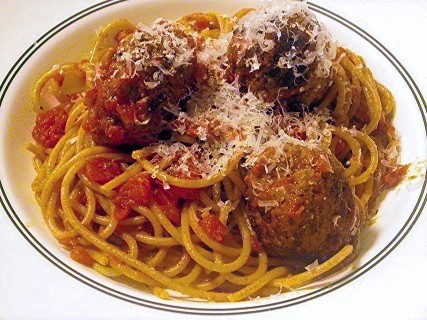
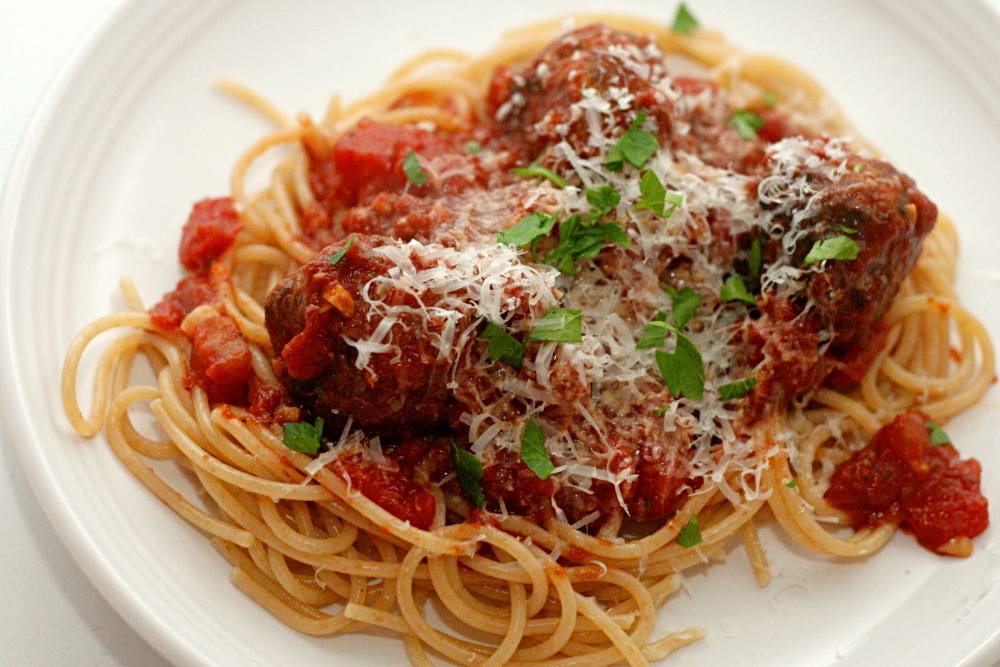
spaghetti and meatballs

I actually made this dish a couple of months ago, but never got around to putting it in my blog. There’s not much to say about it, other than that spaghetti and meatballs are delicious. What’s not to love about pasta, sauce, and dressed-up meat?

copy-of-img_8364Updated photo 11.08.08

Of course, not all spaghetti and meatballs are created equal. But I’ve had my share of meatballs, and I’ve never had any better than these. This dish is a classic that will always please.

Classic Spaghetti and Meatballs (from Cooks Illustrated January 1998)

Serves 4 to 6

CI note: This streamlined recipe can be on the table in under an hour.

Bridget note: I find that recipes almost always call for more pasta per sauce than I prefer. Therefore, I would serve this with 12 ounces pasta instead of the 1 pound that the recipe calls for.

Meatballs
2 slices white sandwich bread (crusts discarded), torn into small cubes
½ cup buttermilk or 6 tablespoons plain yogurt thinned with 2 tablespoons sweet milk
¾ pound ground beef chuck (or 1 pound if omitting ground pork below)
¼ pound ground pork (to be mixed with ground chuck)
¼ cup grated Parmesan cheese
2 tablespoons minced fresh parsley leaves
1 large egg yolk
1 small clove garlic, minced (1 teaspoon)
¾ teaspoon table salt
Ground black pepper
vegetable oil for pan-frying (about 1¼ cups)

Simple Tomato Sauce
2 tablespoons extra-virgin olive oil
1 teaspoon minced garlic
1 can (28 ounces) crushed tomatoes
1 tablespoon minced fresh basil leaves
Table salt and ground black pepper
1 pound spaghetti
grated Parmesan cheese
1. For the meatballs: Combine bread and buttermilk in small bowl, mashing occasionally with fork, until smooth paste forms, about 10 minutes.

2. Mix all meatball ingredients, including bread mixture and pepper to taste in medium bowl. Lightly form 3 tablespoons of mixture into 1½-inch round meatballs; repeat with remaining mixture to form approximately 14 meatballs. (Compacting them can make the meatballs dense and hard. Can be placed on large plate, covered loosely with plastic wrap, and refrigerated for several hours.)

3. Bring 4 quarts of water to boil in large pot for cooking pasta.

4. Meanwhile, heat ¼-inch vegetable oil over medium-high heat in 10- or 11-inch sauté pan. When edge of meatball dipped in oil sizzles, add meatballs in single layer. Fry, turning several times, until nicely browned on all sides, about 10 minutes, regulating heat as needed to keep oil sizzling but not smoking. Transfer browned meatballs to paper towel–lined plate; set aside. Repeat, if necessary, with remaining meatballs.

5. For the sauce, discard oil in pan, leaving behind any browned bits. Add olive oil along with garlic; sauté, scraping up any browned bits, just until garlic is golden, about 30 seconds. Add tomatoes, bring to boil, and simmer gently until sauce thickens, about 10 minutes. Stir in basil; add salt and pepper to taste. Add meatballs and simmer, turning them occasionally, until heated through, about 5 minutes. Keep warm over low flame.

6. Meanwhile, add 1 tablespoon salt and pasta to boiling water. Cook until al dente, drain, and return to pot. Ladle several large spoonfuls of tomato sauce (without meatballs) over spaghetti and toss until noodles are well coated. Divide pasta among individual bowls and top each with a little more tomato sauce and 2 to 3 meatballs. Serve immediately with grated cheese passed separately.

cook’s illustrated classic pound cake

12.jpg

Over the course of this blog, I’ve made no secret that I love Cooks Illustrated. An embarrassing number of the recipes I’ve discussed come from their magazine and cookbooks. When I want to try a new dish, I check the CI recipe first. Why not? Even if it isn’t exactly what I’m looking for, they discuss the goals for each recipe so clearly that at least I’ll know that their recipe isn’t right for me. But often it is. I’ve made hundreds of their recipes, and about half of those have been the best version of that dish that I’ve ever eaten. Most of the rest have still been great. There’s a very few recipes that I haven’t cared for, but even most of those can be attributed to personal taste. Their Northern Cornbread wasn’t near sweet enough for me (or Dave), but they made up for it with their All-Purpose Cornbread, which is the best I’ve had.

41.jpg

But there’s no excuse for this pound cake. I made it the first time a couple of years ago, and it didn’t turn out quite right. I had such faith in CI and I was so used my oven overbrowning things that I was convinced the problem wasn’t with the recipe. I tried the same recipe (different oven) recently, but it didn’t rise much at all. I was exceedingly careful with the recipe – I tested the temperature of the butter before starting, and checked the temperature of the oven with an oven thermometer. Still, I decided that the error must have been mine, especially because the recipe was designed specifically to be foolproof. So I tried again. Same result.

21.jpg

See this picture from their website?

31.jpg

This flat (they call it “bad”) cake is exactly what mine looked like. CI states that a “flat and dense” pound cake will result if the butter is too warm and the batter is overbeaten. But I took the temperature of the butter before starting! And I followed the mixing times and cues in the recipe!

And, by the way, I’m a good baker. And I was careful. I’m blaming the recipe.

It’s missing an ingredient which is in most other pound cake recipes that I’ve seen – baking powder. However, I’ve seen a few blog entries with reviews for these pound cakes which have called the cakes dry. I did not want a dry pound cake. I wanted a rich and tender and buttery and moist pound cake.

And I already had a rich and buttery and dense pound cake. So I didn’t want to start with a whole new recipe. And there was another thing holding me to this recipe – the batter is possibly the best I’ve ever eaten. Ever. And this is from someone who makes chocolate chip cookies just for the dough. I think this batter may be better than cookie dough. I didn’t want to lose that.

5.jpg

So I tweaked the recipe I’d been using. I simply added ½ teaspoon of baking powder with the flour.

And, oh my gosh, if this isn’t now a completely fantastic dessert. Every bite I took of this adapted pound cake was delightful. It’s buttery, it’s tender, it’s not a bit dry, and it’s not a brick of cake. The best part was the top crust, which was all of those things plus caramelized. I’m considering adding an additional ¼ teaspoon baking powder next time, but it’s not really necessary. I’m perfectly happy with this cake as it is. Just don’t trust the original recipe.

6.jpg

Classic Pound Cake (from Cooks Illustrated January 2007)

Makes one 9 by 5-inch loaf

CI note: As directed in the recipe, the butter and eggs should be the first ingredients prepared so they have a chance to stand at room temperature and lose their chill while the oven heats, the loaf pan is greased and floured, and the other ingredients are measured. Leftover cake will keep reasonably well for up to 3 days if wrapped tightly in plastic wrap and stored at room temperature.

Bridget note: Add baking powder with the flour! ½ to ¾ teaspoon of it. I also added the seeds of one Tahitian vanilla bean with the eggs and vanilla extract.

16 tablespoons unsalted butter (2 sticks), cold, plus extra for greasing pan
3 large eggs
3 large egg yolks
2 teaspoons vanilla extract
1¾ cups cake flour (7 ounces), plus extra for dusting pan
½ teaspoon table salt
1¼ cups sugar (8 3/4 ounces)

1. Cut butter into 1-tablespoon pieces and place in bowl of standing mixer; let stand at room temperature 20 to 30 minutes to soften slightly (butter should reach no more than 60 degrees). Using dinner fork, beat eggs, egg yolks, and vanilla in liquid measuring cup until combined. Let egg mixture stand at room temperature until ready to use.

2. Adjust oven rack to middle position and heat oven to 325 degrees. Generously butter 9 by 5-inch loaf pan; dust pan liberally with flour and knock out excess.

3. In standing mixer fitted with flat beater, beat butter and salt at medium-high speed until shiny, smooth, and creamy, 2 to 3 minutes, scraping bottom and sides of bowl once with rubber spatula. Reduce speed to medium; with mixer running, gradually pour in sugar (this should take about 60 seconds). Once all sugar is added, increase speed to medium-high and beat until mixture is fluffy and almost white in color, 5 to 8 minutes, scraping bottom and sides of bowl once. With mixer running at medium speed, gradually add egg mixture in slow, steady stream; this should take 60 to 90 seconds. Scrape bottom and sides of bowl; beat mixture at medium-high speed until light and fluffy, 3 to 4 minutes (mixture may look slightly broken). Remove bowl from mixer; scrape bottom and sides.

4. In 3 additions, sift flour over butter/egg mixture; after each addition, fold gently with rubber spatula until combined. Scrape along bottom of bowl to ensure that batter is homogenous.

5. Transfer batter to prepared loaf pan and smooth surface with rubber spatula. Bake until golden brown and wooden skewer inserted into center of cake comes out clean, about 70 to 80 minutes. Cool cake in pan on wire rack for 15 minutes; invert cake onto wire rack, then turn cake right side up. Cool cake on rack to room temperature, about 2 hours. Slice and serve.

7.jpg

rice pudding

copy-of-dscn4349.jpg

While I was visiting my family in New Mexico last week, I came across a recipe for rice pudding. My mom and grandmother said that they liked it, but sister said she’s never cared for it, because it’s…rice. For dessert. I had never tried it, but I wanted to make a dessert (without guar gum or anything else weird) that my gluten-intolerant grandmother could eat, so I gave rice pudding a try.

And it was good, but it was definitely…rice. For dessert. That ain’t right. My mom and grandmother liked it. My dad was unsure at first, so he scooped out just a few spoonfuls for himself and then came back for more after he established that it was good. I seemed to be the only one unconvinced on the rice pudding. It had a lot of good traits – sweet, creamy, a bit nutty. But you know what else it had? Grains of rice floating in it. That ain’t right.

copy-of-dscn4347.jpg

Simple Stovetop Rice Pudding (from Cooks Illustrated September 1996)

Serves 6 to 8

CI note: We prefer pudding made from medium-grain rice, but long-grain is perfectly acceptable if that’s what you happen to have on hand.

Bridget note: I used long-grained rice.

¼ teaspoon table salt
1 cup medium-grain rice (white), or long grain white rice
2½ cups whole milk
2½ cups half-and-half
2/3 cup granulated sugar
1¼ teaspoons vanilla extract

1. Bring 2 cups water to boil in large, heavy-bottomed pot (at least 3 quarts) or small soup kettle (4 to 5 quarts). Stir in salt and rice; cover and simmer over low heat, stirring once or twice until water is almost fully absorbed, 15 to 20 minutes.

2. Add milk, half-and-half and sugar. Increase heat to medium-high to bring to simmer, then reduce heat to maintain simmer. Cook uncovered, stirring frequently, until mixture starts to thicken, about 30 minutes. Reduce heat to low and continue to cook, stirring every couple of minutes to prevent sticking and scorching, until a spoon is just able to stand up in the pudding, about 15 minutes longer.

3. Remove from heat and stir in vanilla extract. Cool and serve at room temperature or chilled. (Can be covered with plastic wrap on surface of pudding and then refrigerated up to 2 days.)