more fish from cans (deviled eggs with tuna)

copy-of-dscn2968.jpg

I know, I know, deviled eggs? Does anyone really need a recipe for deviled eggs, or a blog entry about them?

But, these have an extra ingredient that I assure you, makes a blog entry just for them worthwhile. (Plus, look how cute they are in pictures! They look like little boats from the side!)

copy-of-dscn2966.jpg

That ingredient is tuna. That’s right, we’re talking about good ol’ canned tuna. I recently heard a few people say that they don’t eat canned tuna, and, what?! Not eat canned tuna?! I looove canned tuna!

The first time a really remember eating it was a few years ago, when a friend brought me some fancy canned tuna from Spain. I wasn’t sure what to do with it, but my friend encouraged me to just mix it up into tuna salad. (In retrospect, I should have just eaten it from the can.) I decided that an experiment was in order. Was expensive Spanish tuna worth the difference in price? So Dave and I did a side-by-side comparison of tuna salads made with the Spanish tuna and with StarKirst Solid White Albacore. (This is the brand recommended by Cooks Illustrated.)

In tuna salad, at least, the difference was minor. And since that test, I have become enamored with tuna salad sandwiches. It’s something that, for me, is best eaten at home, because I’ve gotten so picky about how it’s made. No celery or pickles, but enough minced red onion and parsley to make up for it.

There are a few tricks to getting the most from your tuna. First, drain the heck out of it. Then add salt, pepper, and lemon juice, and let that set while you prepare the other ingredients. This gives the tuna time to soak up those flavor-enhancers.

I made the filling for these deviled eggs very similar to how I make tuna salad, just leaving out minced red onion and of course adding the egg yolks. Best deviled eggs ever, I assure you!

One more thing – while I agree that a sprinkle of paprika adds some color to a deviled egg, I think a little minced something makes them just so cute. I used tomato in this case, but I think a purple olive like kalamata would look, and taste, great as well. (My husband does not agree that olives improve anything, hence the tomatoes in January.)

Deviled Eggs
Make 16 appetizers

1 6-ounce can tuna, preferably StarKist Solid White Albacore in Water
1/8 teaspoon salt
pinch ground black pepper
1 teaspoon lemon juice
2 tablespoons minced parsley
½ teaspoon Dijon mustard
8 hard-boiled eggs, peeled
3 tablespoons mayonnaise
¼ plum tomato, minced (optional)
4 kalamata olives, minced (optional)

1. Drain the tuna very well. Using a fork or your fingers, break up any large pieces. Add salt, pepper, parsley and mustard.

2. Cut each egg in half from pole to pole. Use a spoon to remove the yolk. Using a fork, mash the yolks well. Add to tuna mixture, then stir in mayonnaise.

3. Either spoon mixture into egg whites, or transfer mixture to a decorators bag or zip-top bag. If using a zip-top bag, cut out a corner. Squeeze mixture into egg whites. Garnish with tomatoes or olives, if desired.

copy-of-dscn2958.jpg

salty little fish (pissaladiere)

copy-of-dscn2900.jpg

Like many people I know, I worked at a pizza joint as a teenager. One night, as another employee handed a pizza to a customer, I caught a whiff of an awful odor – like rotting fish, ruining a perfectly good pizza. This was my first firsthand experience with anchovies. Yuck.

It took Cooks Illustrated (of course) and their recipe for pasta e fagioli to convince to me give the little fishies another chance. In this soup, the anchovies are used much like garlic, first minced and then used to flavor the sauce. When I opened the can, I expected to be confronted with the rotted smell that I still remembered from ten years before. Instead, I smelled…nothing. Nothing rotted, nothing even the least bit fishy. I took a hesitant nibble of one.

Whoa!!! Careful eating anchovies straight from the can! It’s like eating a fillet of salt.

dscn2850.jpg

These days, I love anchovies. My husband, unfortunately, does not. One too many anchovy pizza deliveries as he worked his way through college, I suspect. I don’t know what those pizza places do to their anchovies to make them smell so horrid; my theory is incorrect storage. Also, to me, slabs of fish on tomato sauce and cheese seems inconsistent.

Not that I don’t like anchovies on pizza, mind you. But I like to skip the tomatoes and cheese and lay the little fishes on a pile of caramelized onions, dotted with nicoise olives and sprinkled with parsley. Ah, pissaladiere. This was one of my favorite dinners for myself before I married an anchovy-hater.

And now it’s my entry for Hay Hay It’s Donna Day, hosted this month by Joey of 80 breakfasts. I certainly encourage you to give anchovies a chance if you’ve always been convinced that they’re nothing but a foul pizza topping. They are far more than that – subtly meaty and a bit salty even after being rinsed. I admit, however, that this is probably not a good recipe for the anchovy un-initiated.

But for the rest of us, what a treat of contrasting flavors that play so well together!

copy-of-dscn2906.jpg

Pissaladiere – Provencal Pizza (from Cooks Illustrated)

Instant yeast is almost always sold under a marketing name; look for “rapid rise,” “perfect rise,” or “quick rise.” If your food processor includes a plastic dough blade attachment, use it; its short blades and dull edges make kneading easier on the motor. If not, the regular metal blade works almost as well. For best flavor, use high-quality oil-packed anchovies; in a recent tasting, Ortiz were our favorite. The dough in this recipe rises for 1 to 1 ½ hours. If a longer or overnight rise is more convenient, make the dough with ½ teaspoon of instant yeast and let it rise in the refrigerator for 16 to 24 hours. The caramelized onions can also be made a day ahead and refrigerated.

Makes 2 tarts, 8 to 10 first course servings

Dough:
2 cups bread flour (11 ounces), plus extra for dusting work surface
1 teaspoon instant yeast
1 teaspoon table salt
1 tablespoon olive oil, plus additional oil for brushing dough and greasing hands
1 cup water (8 ounces), warm (about 110 degrees)

Caramelized Onions:
2 tablespoons olive oil
2 pounds yellow onions, sliced 1/4 inch thick
½ teaspoon table salt
1 teaspoon brown sugar
1 tablespoon water

Olives, Anchovies, and Garnishes:
olive oil
½ teaspoon ground black pepper
½ cup niçoise olives, pitted and chopped coarse
8 anchovy fillets, rinsed, patted dry, and chopped coarse (about 2 tablespoons)
12 anchovy fillets, rinsed and patted dry for (optional) garnish
2 teaspoons minced fresh thyme leaves
1 teaspoon fennel seeds (optional)
1 tablespoon minced fresh parsley leaves (optional)

1. For the dough: In workbowl of food processor fitted with plastic dough blade (see note), pulse flour, yeast, and salt to combine, about five 1-second pulses. With machine running, slowly add oil, then water, through feed tube; continue to process until dough forms ball, about 15 seconds. Generously dust work surface with flour; using floured hands, transfer dough to work surface and knead lightly, shaping dough into ball. Lightly oil 1-quart measuring cup or small bowl, place dough in measuring cup, cover tightly with plastic wrap, and set aside in draft-free spot until doubled in volume, 1 to 1 1/2 hours.

2. For the caramelized onions: While dough is rising, heat oil in 12-inch nonstick skillet over high heat until shimmering but not smoking; stir in onions, salt, and brown sugar and cook, stirring frequently, until moisture released by onions has evaporated and onions begin to brown, about 10 minutes. Reduce heat to medium-low and cook, stirring frequently, until onions have softened and are medium golden brown, about 20 minutes longer. Off heat, stir in water; transfer to bowl and set aside. Adjust oven rack to lowest position, set baking stone on rack, and heat oven to 500 degrees.

3. To shape, top, and bake the dough: When dough has doubled, remove from measuring cup and divide into 2 equal pieces using dough scraper. Working with one piece at a time, form each piece into rough ball by gently pulling edges of dough together and pinching to seal. With floured hands, turn dough ball seam-side down. Cupping dough with both hands, gently push dough in circular motion to form taut ball. Repeat with second piece. Brush each lightly with oil, cover with plastic wrap, and let rest 10 minutes. Meanwhile, cut two 20-inch lengths parchment paper and set aside.

4. Coat fingers and palms of hands generously with oil. Using dough scraper, loosen 1 piece of dough from work surface. With well-oiled hands, hold dough aloft and gently stretch to 12-inch length. Place on parchment sheet and gently dimple surface of dough with fingertips. Using oiled palms, push and flatten dough into 14- by 8-inch oval. Brush dough with oil and sprinkle with 1/4 teaspoon pepper. Leaving ½-inch border around edge, sprinkle ¼ cup olives, 1 tablespoon chopped anchovies, and 1 teaspoon thyme evenly over dough, then evenly scatter with half of onions. Arrange 6 whole anchovy fillets, if using, on tart and sprinkle with fennel seeds, if using. Slip parchment with tart onto pizza peel (or inverted rimless baking sheet), then slide onto hot baking stone. Bake until deep golden brown, 13 to 15 minutes. While first tart bakes, shape and top second tart.

5. Remove tart from oven with peel or pull parchment onto baking sheet; transfer tart to cutting board and slide parchment out from under tart. Cool 5 minutes; sprinkle with 1½ teaspoons parsley, if using. Cut tart in half lengthwise, then cut crosswise to form 8 pieces; serve immediately. While first tart cools, bake second tart.

copy-of-dscn2903.jpg

not a chinese burrito (moo shu pancakes)

dscn2770-copy.jpg

I haven’t been reading food blogs long – only about a week longer than I’ve had my own, in fact – but I’m already playing favorites. One of the blogs that first caught my attention and held it is Jen’s use real butter. Jen’s blog has what I consider the three requisite aspects of a good food blog: beautiful pictures, entertaining writing, and recipes I actually want to make. Something else I love about Jen’s blog is that some of those recipes are authentic Chinese food. At least, I’m assuming they’re authentic. As an all-American mutt, I’m not exactly an expert on spotting traditional ethnic cuisine.

The latest such recipe is moo shu pork. I’d heard of moo shu before – the term seems to get tossed around a lot just because it sounds cute and is fun to say. Moo shu. Moooooo shu. But I actually had no idea what it was until Jen’s post about it. Turns out, it’s a bunch of stir-fried goodness all wrapped up in flatbread. Sounds delicious!

The recipe is fairly simple, but it did involve some ingredients that weren’t familiar to me. The first is hoisin sauce. Jen says that she prefers to buy hoisin sauce with more Chinese on the label that English. That sounds reasonable. My grocery store has a well-stocked ethnic section, so I was pretty confident that I’d be able to find something that fit the bill. I ended up with a bottle with about 50% English, 50% Chinese on the label. Close enough.

The moo shu shells were a bigger problem. Even Wegman’s ethnic section can only go so far. I had a bit of hope when I saw an “asian” sign in the freezer section, but there was no luck to be had there. I had two options at this point: find an asian grocery store or make my own moo shu shells. I just moved to Philadelphia a week ago and didn’t relish the idea of driving around looking for an asian grocery store, so homemade it was.

Okay, let’s be honest. I could have found an asian grocery store – I know how to use the internet, after all. The truth is, I’m just not very comfortable in them. The merchandise is unfamiliar to me, I don’t know how anything is arranged, and most of the labels are in Chinese. Last time I went to one, I wandered up and down the aisles looking for dried shrimp. When I gave up and asked the cashier for help, she yelled, “in the cooler!” The cooler encompassed an entire aisle of this store. I wandered over there and searched around, all the while with her yelling from the cash register which direction I needed to be looking. Why she didn’t just walk the 10 steps over to the cooler and grab the damn shrimp off the shelf for me is a mystery. Then, as I was checking out, she asked if I was making pad thai. Apparently little white girls have one use for dried shrimp and one use only. I said I was, and she told me I needed Thai basil. I know Thai basil is a traditional pad thai ingredient, but I’m assuming that it has the same shelf life of regular basil – so about 3 hours. My pad thai had always been damn good without it, so I declined, admitting that my pad thai must not be that authentic. So there you go – my desire to make traditional ethnic food lies somewhere between dried shrimp and Thai basil.

So, homemade moo shu shells it was. Turns out making moo shu shells is even easier than finding a recipe for them on the internet. (Hint: Don’t google “moo shu shells”, regardless of how you spell the “moo.” You need to look up “mandarin pancakes.”) The process is a little strange, but it worked out beautifully in the end. Flour is mixed with boiling water, then the dough is allowed to rest. It’s rolled into a rope, then cut into pieces. Each piece is flattened, brushed with oil, and then stacked on another piece with the oiled sides together. Each pair of dough segments is rolled out together, then cooked in an ungreased skillet. The only tricky part is tearing the two pieces apart after they cook, and the only difficulty there stems from the fact that it’s hot!

dscn2752-copy.jpg

dscn2762-copy.jpg

So, in the end, moo shu pork is good. Really good, in fact. I can’t wait to make it again. And hoisin sauce? Also really good. All salty and sweet and just altogether tasty.

Now, Jen insists that these shouldn’t be called Chinese burritos. I can understand this I suppose – after all, I’ve never heard of a burrito referred to as Mexican moo shu. But I’m sure you can see the resemblance. In fact, when I handed Dave his plate, guess what he said? “Oh, cool. It’s a Chinese burrito.”

dscn2763-copy.jpg

Mandarin Pancakes (from Fine Cooking)

The only change I’ll probably make in the future is to add a pinch of salt to the dough.

Makes 12

1¾ cups (8 ounces) unbleached flour
¾ cup boiling water
1 tablespoon toasted sesame oil

In a bowl, mix the flour and the boiling water with chopsticks or a wooden spoon to combine. Turn the shaggy dough onto a lightly floured board, gather it into a heap, and knead it until smooth, about 3 minutes. Cover with a towel and let it rest for about 1/2 hour.

With your hands, shape the dough into an even cylinder about 12 inches long. With a sharp knife, preferably serrated, cut the roll into 1-inch pieces. If the cutting squashes any of the pieces, stand them on end and shape them back into rounds.

Lightly flour your palms and use them to flatten the pieces into 2-inch rounds. Brush the top of each round generously with sesame oil. Lay one round on top of another, oiled sides together. Flatten the pair together with the heel of your hand. Continue until you have 6 pairs.

With a floured rolling pin, roll each pair into a thin pancake about 7 inches in diameter, flipping the pancake over now and again to roll evenly on both sides. Stack the pancakes as you finish rolling them.

In an ungreased cast-iron skillet or nonstick pan over medium-high heat, cook the pancakes one at a time. Heat one side until it becomes less opaque and starts to bubble slightly, and just a few brown spots appear, about 1 min. Flip it over and cook it until a few light brown spots appear on the other side, about 30 seconds.

While the pancake is still hot, pick it up, look for a seam to grab, and separate it into two very thin pancakes. Stack them on a plate as you go and wrap them in foil to keep them warm and prevent drying. If not using right away, refrigerate until ready to use.

For Jen’s mu-shu pork filling, check out her blog.

martha martha martha (maple walnut cupcakes)

dscn2685.jpg

For someone who’s been very interested in food and cooking for a large part of her life, I was late catching onto Martha Stewart fanhood. I just didn’t know much about her, for whatever reason. I didn’t watch her show, I didn’t read her magazine, and I hadn’t made any of her recipes. But then last Christmas, my mother-in-law gave me Martha Stewart’s Baking Handbook.

This is a really great book. For one thing, every recipe has a beautiful picture accompanying it. Also, many of the recipes include garnishes. What a relief for someone like me, who is new to caring about garnishes! But more important, of course, are the recipes themselves. There’s a great mix of classics, like chocolate chip cookies and buttermilk biscuits, to more advanced but still familiar recipes, like a wedding cake and croissants, plus a good peppering of more original ideas, like grapefruit cookies and rum-raisin pie. I’m especially excited to make my way through some of the cookie recipes. Whoever heard of grapefruit in cookies? Yum!

I’ve been craving cupcakes for quite some time now, and I wanted something a little bit more…interesting that your standard old chocolate or vanilla. These were perfect! I’m especially happy with the maple buttercream frosting. I had my doubts going in, because I haven’t had the most successful history of working with buttercream. Also, I was only making a third of the recipe. I know buttercream is very temperature sensitive, and this much smaller amount was going to change temperatures a lot faster than the recipe indicates. And, I was worried about the method of combining the maple syrup and the egg yolk. The syrup is heated to 240 degrees (my probe thermometer tops out at 212 degrees, so I guessed and hoped for the best), then drizzled into the egg yolk. 240 degrees is…hot, especially for egg. But, it all seemed to work out! The buttercream did show signs of breaking, but I tried beating it more, and it actually came together very nicely!

The only change I would make to the recipe is to toast the walnuts before mixing them with the batter. Oh, and I wouldn’t spill a quarter of the dry ingredient mixture on the counter and then not notice until the cupcakes were in the oven. All in all, they were really good.  And cute!

dscn2680.jpg

Maple-Walnut Cupcakes (from Martha Stewart’s Baking Handbook)
Makes 2 dozen

2¾ cups (13.75 ounces) unbleached flour
1 tablespoon baking powder
¼ teaspoon salt
1 teaspoon ground cinnamon
16 tablespoons (2 sticks) unsalted butter, room temperature
1 ½ cups (10.5 ounces) granulated sugar
3 large eggs
1 teaspoon vanilla extract
1 cup milk
1½ cups (5.5 ounces) walnuts, toasted, chopped medium-fine
Maple Buttercream

Preheat the oven to 350 degrees. Line two standard 12-up muffin pans with paper liners. Into a large bowl, sift together flour, baking powder, salt, and cinnamon; set aside.

In the bowl of an electric mixer fitted with the paddle attachment, beat the butter and sugar on medium speed until creamy, about 3 minutes. Add the eggs and vanilla, and beat until combined. With the mixer still on medium speed, add the flour mixture in two parts, alternating with the milk and beginning and ended with the flour. Fold in the walnuts.

Divide the batter evenly among he muffin cups, adding about 1/3 cup to each. Bake, rotating the pans halfway through, until cupcakes are golden and a cake tester inserted into the center of a cupcake comes out clean, 18-20 minutes. Transfer the pans to a wire rack to cool slightly. Invert the cupcakes onto the rack; then reinvert and let them cool completely, top sides up. Frost tops with Maple Buttercream. Cupcakes can be refrigerated in an airtight container for up to 3 days.

Maple Buttercream
Makes enough for 2 dozen cupcakes (about 2 cups)

This frosting can be refrigerated in an airtight container for up to three days. Bring to room temperature before using.

3 large eggs yolks
1 cup pure maple syrup
16 tablespoons (2 sticks) unsalted butter, cold, cut into small pieces

In the bowl of an electric mixer fitting with the whisk attachment, beat the egg yolks on high speed until light and fluffy, about 5 minutes; set aside. In a small saucepan set over medium-high heat, bring the maple syrup to a boil, and cook until it registers 240 degrees on a candy thermometer, about 15 minutes. Remove from heat.

With the mixer running, slowly pour syrup down the side of the bowl in a slow, steady stream, until completely incorporated, about 1 minute. Continue beating until bowl is just slightly warm to the touch, 4 to 5 minutes. Add butter, one piece at a time, until thoroughly incorporated and the frosting is fluffy, about 4 minutes more.

dscn2688.jpg

farming fungus (country crust bread)

dscn2603.jpg

Recently, I’ve noticed a lot of people trying out homemade bread for the first time. I remember my first time making yeast bread. I was nervous about everything – the amount of flour I was kneading into the dough, the rising time, the baking temperature. There’s so much uncertainty involved with bread baking, and I’m not sure why. Bread isn’t any different from a recipe for anything else – just follow the directions and everything should go smoothly. There are a few more variables to take into account – the freshness of the yeast and the temperature of the room can affect the rate of rising, but as long as you follow the visual clues, everything should come out okay. Plus, I’ve found bread to be relatively forgiving. You can add some extra flour, knead too long, let it rise a bit longer (or less) than ideal, but the effect on the final product will be minor. No worries!

dscn2572.jpg

One thing about bread though, is that I always feel like kind of a jerk when I make it. It all starts with these little fungal yeasties. So you give them some food, and a nice warm place to the live. Give them plenty of time to grow and start a little community. Then you cook them and eat them. Poor little dudes. (Yes, yes, I eat meat, I know it’s considerably worse. I’m a bad person.)

dscn2588.jpg

This is one of my favorite breads. It’s just a nice, simple sandwich bread, but it has plenty of flavor. My mom serves it at holiday meals, and it’s one of my favorite foods on the table. For this particular loaf, we snacked on it a few hours after it came out of the oven in between doing chores, and then I made French toast with it the next day. Both were really satisfying.

Update 3/16/10: I’ve successfully used this method to make this bread whole wheat.  Complete instructions for adapting this recipe are included in that post.

Country Crust Bread (called Rich Egg Bread in recent additions of Betty Crocker cookbooks)
Adapted from Betty Crocker and Cooks Illustrated

Makes one 9-inch loaf

I used honey and butter, and I substituted about 1/3 of the white flour for whole wheat flour. You can increase that to half the total flour without any detrimental affects to the bread, although the rising time will probably need to be increased.

To braid the loaf instead of baking it in a loaf pan, divide the dough into three equal portions. Gently roll each portion into a 16-inch length. Braid the pieces together, then pinch the ends together and tuck them under the loaf. Reduce the baking time by 15 minutes.

3 – 3½ cups (15 – 17½ ounces) unbleached flour, plus extra for work surface
1½ teaspoons table salt
1 cup water, warm (110 degrees)
1 egg
2 tablespoons vegetable oil or unsalted butter, melted
¼ cup (1.75 ounces) granulated sugar or 3 tablespoons honey
1 package (2 1/4 teaspoons) rapid-rise yeast (also called instant)

1. Adjust oven rack to low position and heat oven to 200 degrees. Once oven temperature reaches 200 degrees, maintain heat 10 minutes, then turn off oven heat.

2. Mix flour, salt, and yeast in bowl of standing mixer fitted with dough hook. Mix water, egg, butter, and honey in 1-quart Pyrex liquid measuring cup. Turn machine to low and slowly add liquid. When dough comes together, increase speed to medium (setting number 4 on a KitchenAid mixer) and mix until dough is smooth and satiny, stopping machine two or three times to scrape dough from hook if necessary, about 10 minutes. Turn dough onto lightly floured work surface; knead to form smooth, round ball, about 15 seconds.

3. Place dough in very lightly oiled bowl, rubbing dough around bowl to lightly coat. Cover bowl with plastic wrap; place in warm oven until dough doubles in size, 40 to 50 minutes.

4. Form dough into loaf by gently pressing the dough into a rectangle, one inch thick and no wider than the length of the loaf pan. Next, roll the dough firmly into a cylinder, pressing with your fingers to make sure the dough sticks to itself. Turn the dough seam side up and pinch it closed.  Finally, place dough in greased 9-by-5-by-3-inch loaf pan and press it gently so it touches all four sides of the pan.

5. Cover with plastic wrap; set aside in warm spot until dough almost doubles in size, 20 to 30 minutes. Heat oven to 350 degrees, placing empty loaf pan on bottom rack. Bring 2 cups water to boil.

6. Remove plastic wrap from loaf pan. Place pan in oven, immediately pouring heated water into empty loaf pan; close oven door. Bake until instant-read thermometer inserted at angle from short end just above pan rim into center of loaf reads 195 degrees, about 40 to 50 minutes. Remove bread from pan, transfer to a wire rack, and cool to room temperature. Slice and serve.

dscn2625.jpg

the real deal (marcella hazan’s lasagne bolognese)

dscn2543.jpg

I’ve been kept away from cooking for too long. Between holiday traveling and moving, it’s been at least a month since I did any serious cooking or baking. Every time I have a cooking dry spell like this, I end up thinking of food constantly. I start to make lists of what I want to make. And it seems like the dish that occupies the most of my thoughts is always lasagna.

I love lasagna in all of its forms – meat, mushroom, spinach, artichoke, tomato, béchamel. This time I wanted to make a classic meat lasagna. I keep trying new recipes because I haven’t yet found one that I love. I decided it was high time to try Marcella Hazan’s recipe. I coveted Hazan’s Essentials of Classic Italian Cooking for several years before receiving it as a wedding gift from my sister-in-law. Yay! This is the first recipe I’ve made from it.

I’ve often heard about those lasagna recipes that take all day. Most modern recipes are trying to simplify and shorten the process, but I’ve always been curious about the original. If someone spends all day on a recipe, it must be worth it, right?

I was about to find out. Reading Hazan’s recipe for Baked Green Lasagne with Meat Sauce, Bolognese Style, was like the Choose Your Own Adventure books I read as a kid. Turn to page 129 for pasta made with the machine method, or page 143 for the hand-rolled method. On page 129, I was directed to page 89 for instructions on cooking the spinach. Yeesh. I took the recipe(s) one step at a time, and everything really did go without a hitch.

The recipe involves a lot of patience. Hazan is not much into modern tools that make life easier; she’s all about doing things the hard way. I’ve made béchamel sauce many times, always by melting butter, stirring in flour, whisking in cold milk, stirring until it boils. Hazan instructs this all to be done over low heat, and the milk is pre-heated, then added to the butter-flour mixture 2 tablespoons at a time. Then this mixture is stirred, of course constantly, over low heat until it thickens. Over low heat, it takes a long time to thicken. But once it does, it makes the smoothest béchamel sauce I’ve ever made, albeit one that tastes somewhat of raw flour.

The bolognese sauce is similar in that there’s a lot of “gentle simmering.” Hazan is very specific that the sauce must simmer for at least 3 hours after the tomatoes are added. What she fails to mention is that the recipe takes about an hour even before that point. One cup of milk takes quite some time to completely bubble away at a gentle simmer.

dscn2482.jpg

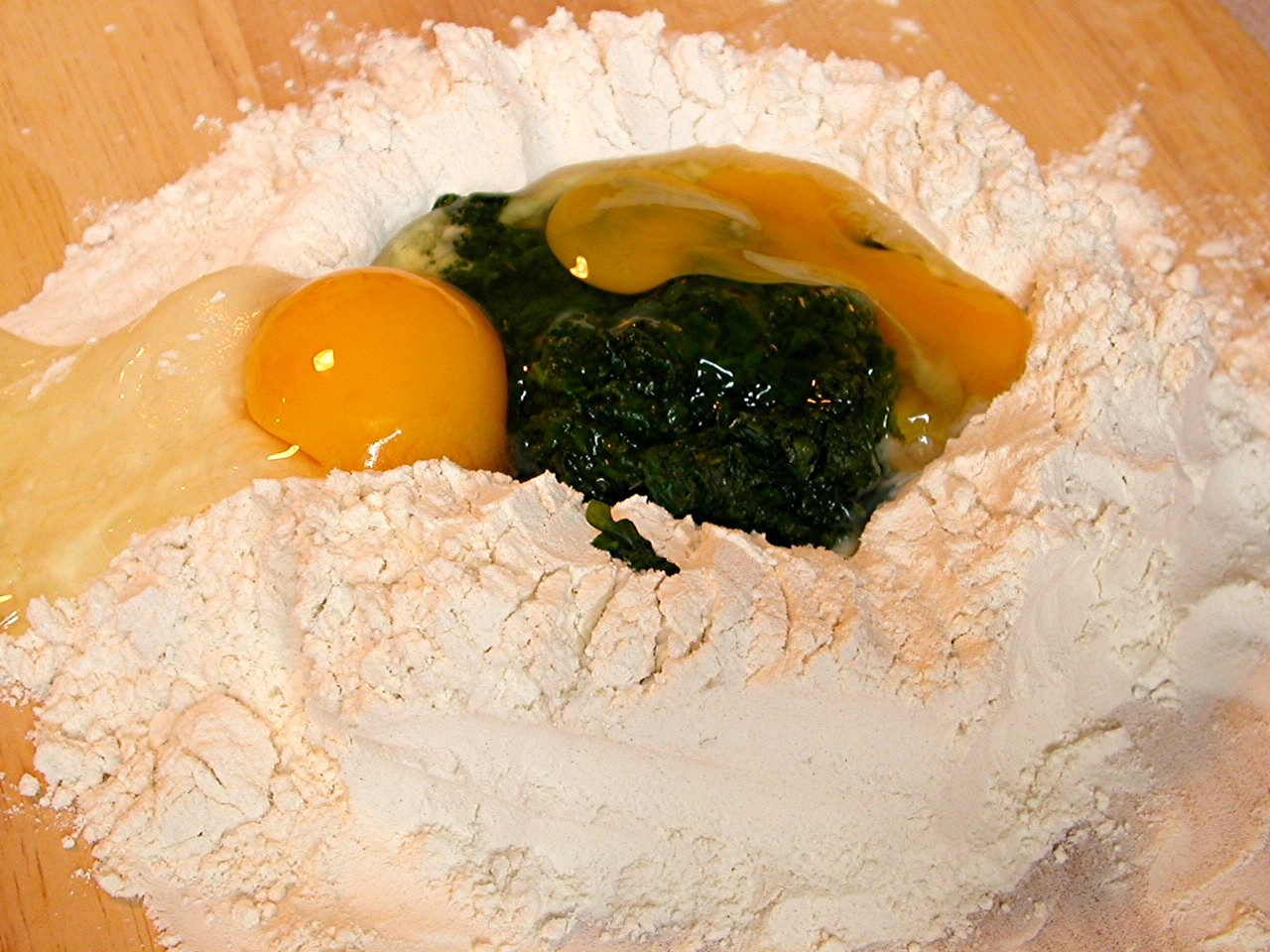
Of course the pasta dough could not be made in the food processor, it must be done by hand. I was determined to follow the recipe exactly, so I trudged on. And this is what I got…

dscn2499.jpg

Obviously the egg is supposed to stay in the well in the center of the flour, not glop out a breach in the side. Next time I’ll mix the egg and spinach together in a bowl, even add some flour to it before I move to a flat work surface to complete the additions of flour.

dscn2501.jpg

This is the first time I’ve rolled out pasta without wanting to scream! Really, rolling out the pasta just went splendidly, and I’m so glad that I finally learned a good technique for this.

dscn2529.jpg

The two sauces are mixed together and alternately layered with pasta. Hazan specifies that there should be at least 6 layers. I lost count, but I know I had more than that, and I only used probably 2/3 of the pasta sheets before I ran out of sauce.

dscn2542.jpg

All in all, the lasagna took about 7 hours, keeping in mind that I was taking my time. Was the recipe worth all this? Well…the short answer is no. It was good, but not that good. Dave and I agreed that it tasted somewhat meatloaf-ish. The long answer is that I was fairly certain going in that there would be things I’d want to change in the recipe for later editions. For one thing, the only cheese in the entire recipe is 2/3 cup of parmesan. I gather (from wikipedia) that this is the traditional Bolognese method for lasagna. But I’m an all-American girl, and I want mozzarella! I’d also like less carrot and celery to counteract the “meatloafness”, and more onion. I want to try adding some flavorings to the béchamel as well.

So I will be attempting this recipe again, but probably in a less authentic Italian form. I trust that it will go much faster now that I understand the methods involved. If nothing else, I’m grateful to have learned how to roll out homemade pasta to the thinnest setting without any swearing.

I’m typing out the whole recipe for you below, so you can see for yourself the pickiness that is a Marcella Hazan recipe. I followed the recipe just about exactly.

Baked Green Lasagne with Meat Sauce, Bolognese Style

Serves 6

Bolognese Sauce
Béchamel Sauce
Green pasta dough
1 tablespoon salt
2 tablespoons butter, plus more for greasing a 9- by 12-inch bake-and-serve lasagna pan, no less than 2½ inches high
2/3 cup fresh grated parmigiano-reggiano cheese

1. Prepare the meat sauce and set aside.

2. Prepare the béchamel, keeping it rather runny, somewhat like sour cream. When done, keep it warm in the upper half of a double boiler, with the heat turned to very low. If a film should form on top, just stir it when you are ready to use it.

3. Make green pasta dough. Roll it out as thin as it will come. Leave the strips as wide as they come from the rollers, and cut them into 10-inch lengths.

4. Set a bowl of cold water near the range, and lay some clean, dry cloth towels flat on a work counter. Bring 4 quarts of water to a rapid boil, add 1 tablespoon salt, and as the water returns to a boil, slip in 4 or 5 of the cut pasta strips. Cook very briefly, just seconds after the water returns to a boil after you dropped in the pasta. Retrieve the strips with a colander scoop of slotted spatula, and plunge them into the bowl of cold water. Pick up the strips, one at a time, rinse them under cold running water, and rub them delicately, as though you were doing fine hand laundry. Squeeze each strip very gently in your hands, then spread if flat on the towel to dry. When all the pasta is cooked in the manner, 4 or 5 strips at a time, and spread out to dry, pat it dry on top with another towel.

*Explanatory note: The washing, wringing, and drying of pasta for lasagna is something of a nuisance, but it is necessary. You first dip the partly cooked pasta into cold water to stop the cooking instantly. This is important because if lasagna pasta is not kept very firm at this stage it will become horribly mushy later when it is baked. And you must afterward rinse off the moist starch on its surface, or the dough will become glued to the towel on which it is laid out to dry, and tear when you are ready to use it.

5. Preheat the oven to 400 degrees.

6. Thickly smear the bottom of a lasagna pan with butter and about 1 tablespoon of béchamel. Line the bottom of the pan with a single layer of pasta strips, cutting them to fit the pan, edge to edge, allowing no more than ¼ inch for overlapping.

7. Combine the meat sauce and the béchamel and spread a thin coating of it on the pasta. Sprinkle on some grated parmesan, then add another layer of pasta, cutting it to fit as you did before. Repeat the procedure of spreading the sauce and béchamel mixture, then sprinkling with Parmesan. Use the trimmings of pasta dough to fill in gaps, if necessary. Build up to at least 6 layers of pasta. Leave yourself enough sauce to spread very thinly over the topmost layer. Sprinkle with parmesan and dot with butter.

*Ahead-of-time note: The lasagna may be completed up to 2 days in advance up to this point. Refrigerate under tightly sealing plastic wrap.

8. Bake on the uppermost rack of the preheated oven until a light, golden crust formed on top. It should take between 10 and 15 minutes. If after the first few minutes you don’t see any sign of a crust beginning to form, turn up the oven another 50 to 75 degrees. Do not bake longer then 15 minutes altogether.

9. Remove from the oven and allow to settle for about 10 minutes, then serve at table directly from the pan.

Bolognese Sauce:
1 tablespoon oil
3 tablespoon butter
½ cup chopped onion
2/3 cup chopped celery
2/3 cup chopped carrot
3/4 pound ground beef chuck
salt
black pepper, ground fresh from the mill
1 cup whole milk
whole nutmeg
1 cup dry white wine
1½ cup canned imported Italian plum tomatoes, cut up, with their juice

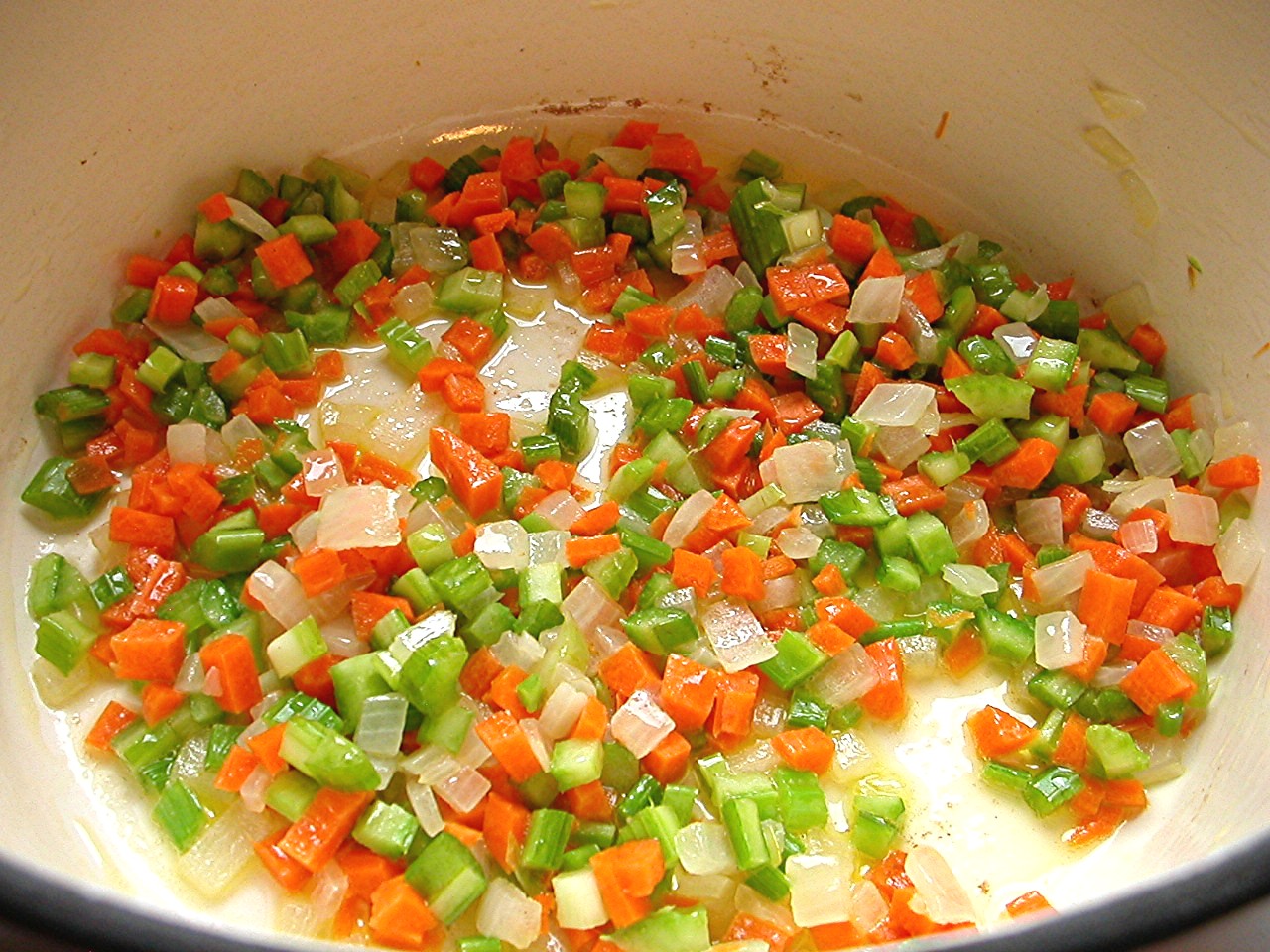
1. Put the oil, butter and onion in the pot, and turn the heat on to medium. Cook and stir the onion until is has become translucent, then add the chopped celery and carrot. Cook for about 2 minutes, stirring the vegetables to coat them well.

2. Add the ground beef, a large pinch of salt, & a few grindings of pepper. Crumble the meat with a fork and cook until beef has lost its raw, red color.

3. Add the milk and let simmer gently, stirring frequently, until it has bubbled away completely. Add a tiny grating – about 1/8 teaspoon – of nutmeg and stir.

4. Add the wine, let simmer until it has evaporated, then add the tomatoes and stir thoroughly to coat all ingredients well. When the tomatoes begin to bubble, turn the heat down so that the sauce cooks at the laziest of simmers, with just an intermittent bubble breaking through the surface. Cook, uncovered, for 3 hours or more, stirring from time to time. While the sauce is stirring, you are likely to find that it begins to dry out and the fat separates from the meat. To keep it from sticking, continue the cooking, adding ½ cup of water whenever necessary. At the end, however, no water at all must be left and the fat must separate from the sauce. Taste and correct for salt.

Béchamel Sauce:
3 cups milk
6 tablespoons butter
4½ tablespoons flour
¼ teaspoon salt

1. Put the milk in a saucepan, turn the heat to medium-low, and bring the milk just to the verge of boiling, to the point when it begins to form a ring of small, pearly bubbles.

2. While heating the milk, put the butter in a heavy-bottomed, 4- to 6-cup saucepan, and turn the heat to low. When the butter has melted completely, add the flour and stirring it with a wooden spoon. Cook, while stirring constantly, for about 2 minutes. Do not allow flour to become colored. Remove from heat.

3. Add the hot milk to the flour-and-butter mixture, no more than 2 tablespoons of it at a time. Stir steadily and thoroughly. As soon as the first 2 tablespoons have been incorporated into the mixture, add 2 more, and continue to stir. Repeat this procedure until you have added ½ cup milk; you can now put in the rest of the milk ½ cup at a time, stirring steadfastly, until all the milk has been smoothly amalgamated with the flour and butter.

4. Place the pot over low heat, add the salt, and cook, stirring without interruption, until the sauce is as dense as thick cream. If you find any lumps forming, dissolve them by beating the sauce rapidly with a whisk.

Pasta:
6 ounces fresh spinach, cooked, or 1/3 package frozen leaf spinach
2 large eggs
1½ cups unbleached flour

Pour the flour onto a work surface, shape it into a mound, and scoop out a deep hollow in its center. Break the eggs and add the chopped spinach into the hollow.

Beat the eggs and spinach lightly with a fork for about 2 minutes as though you were making an omelet. Draw some of the flour over the eggs, mixing it in with the fork a little at a time, until the eggs are no longer runny. Draw the sides of the mound together with your hands, but push some of the flour to one side, keeping it out of the way until you find you absolutely need it. Work the eggs and flour together, using your fingers and the palms of your hands, until you have a smoothly integrated mixture. If it is still moist, work in more flour.

When the mass feels good to you and you think it does not require any more flour, wash your hands, dry them, and run a simple test: Press you thumb deep into center of the mass; if it comes out clean, without any sticky matter on it, no more flour is needed. Put the egg and flour mass to one side, scrape the work surface absolutely clear of any loose or caked bits of flour and of any crumbs, and get ready to knead.

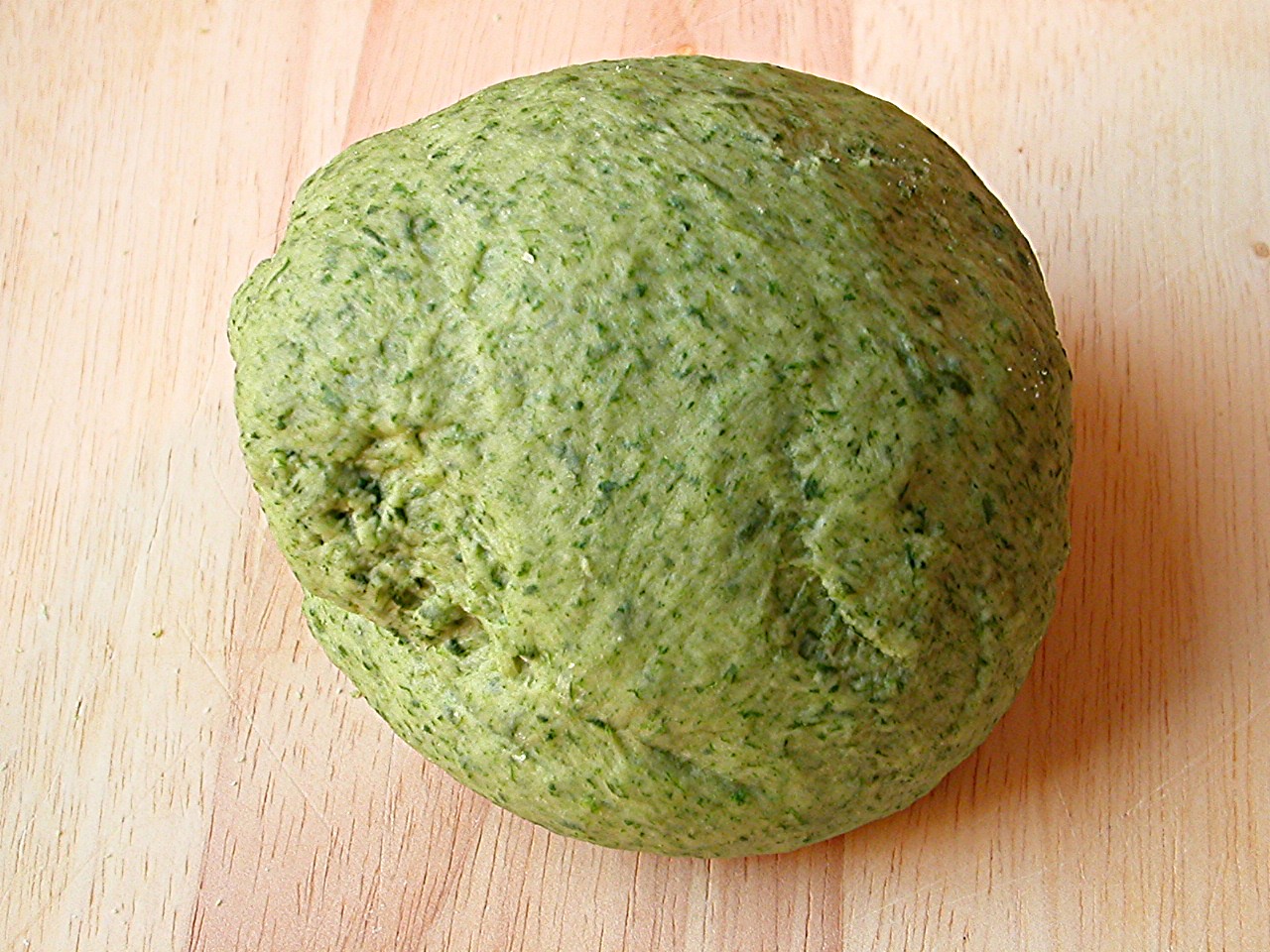
Return to the mass of flour and eggs. Push forward against it using the heel of your palm, keeping your fingers bent. Fold the mass in half, give it a half turn, press hard against it with the heel of your palm again, and repeat the operation. Make sure that you keep turning the ball of dough always in the same direction, either clockwise or counterclockwise, as you prefer. When you have kneaded it thus for 8 full minutes and the dough is as smooth as baby skin, it is ready for the machine.

Cut the ball of dough into 6 equal parts.

Spread clean, dry, cloth dish towels over a work counter near where you’ll be using the machine.

Set the pair of smooth cylinders, the thinning rollers, at the widest opening. Flatten one of the pieces of dough by pummeling it with your palm, and run it through the machine. Fold the dough twice into a third of its length, and feed it by its narrow end through the machine once again. Repeat the operation 2 or 3 times, then lay the flattened strip of pasta over a towel on the counter. Since you are going to have a lot of strips, start at one end of the counter, leaving for for the others.

Take another piece of dough, flatten it with your hand, and urn it through the machine exactly as described above. Lay the strip next to the previously thinned one on the towel, but do not allow them to touch or overlap, because they are still moist enough to stick to each other. Proceed to flatten all the remaining pieces in the same manner.

Close down the opening between the machine’s rollers by one notch. Take the first pasta strip you had flattened and run it once through the rollers, feeding it by its narrow end. Do not fold it, but spread it flat on the cloth towel, and move on to the next pasta strip in the sequence.

When all the pasta strips have gone through the narrower opening once, bring the rollers closer together by another notch, and run the strips of pasta through them once again, following the procedure described above. You will find the strips becoming longer, as they get thinner, and if there is not enough room to spread them out on the counter, you can let them hand over the edge. Continue thinning the strips in sequence, progressively closing down the opening between the rollers one notch at a time. This step-by-step thinning procedure, which commercial makers of fresh pasta greatly abbreviate or skip altogether, is responsible, along with proper kneading, for giving good pasta its body and structure.

dscn2562.jpg

happy birthday to the husband (banana cream pie)

dscn2396.jpg

Dave’s birthday is today! He’s a few years older than me, which can be nice sometimes. It’s not that I think I’m old, or that I get all “I can’t believe I’m [blank] already.” But I can’t deny that when I hit those landmark numbers, those ages when it’s hard not to think “I’m [blank], and this is where I am in life?”, that the impact is lessened a bit by the fact that my husband’s been there for a few years.

Every year on his birthday, Dave requests banana cream pie. I’ve tried a number of recipes, and so far, according to Dave, none of them have lived up to Baker’s Square Restaurant. I’m pretty sure he hasn’t had Baker’s Square pie in quite a few years, and if he were to try it now (after living with me), he’d have a different opinion. But until then, I’ll just make my own favorite recipe.

This recipe starts with a graham cracker crust, which I’m a big fan of, especially for custard pies. The crust has a bit of banana right in it, which is a really great touch.

dscn2339.jpg

The custard is undeniably rich. I have no problems with that! After both the crust and custard have cooled to room temperature, two layers of banana and three layers of custard are filled into the crust. Then the pie is covered and chilled for at least eight hours to set the custard and soften the crust. Yeah right. I wasn’t that organized. We ate it after four hours of chilling.

dscn2360.jpg

It’s so good! It may not live up to Baker’s Square fame, but Dave had a number of complimentary comments to give, including “Scrumdelilicious.”

The original recipe is from epicurious.com, but I’m going to give my own adaptations below. The original is made in a 10-inch pie pan, which seems silly, because most people, including myself, don’t have such a beast. The recipe I’ve given below is adjusted for a standard 9-inch pie pan. I also made a few tweaks to the crust.

Banana Cream Pie (adapted from epicurious.com)

Serves 8

Crust:
9 graham crackers, processed to fine crumbs (about 1 cup)
2 tablespoons sugar
½ banana
2½ tablespoons unsalted butter, melted

Filling
6½ tablespoons (2.8 ounces) sugar
¼ cup (1.1 ounces) cornstarch
1/4 teaspoon salt
1¼ cups whipping cream
1¼ cups whole milk
3 large egg yolks
½ vanilla bean, split lengthwise
1½ tablespoons unsalted butter
¾ teaspoon vanilla extract

4½ ripe bananas, peeled, cut crosswise into 1/4-inch-thick slices

For crust:
Preheat oven to 350 degrees. Process graham cracker crumbs, sugar, and banana until evenly mixed and there are no visible chunks of banana. Add unsalted butter and process to moisten evenly. Press onto bottom and up sides of 9-inch glass pie dish. Chill until firm, about 30 minutes. Bake crust until set and pale golden, about 15 minutes. Cool completely.

For filling:
Whisk sugar, cornstarch, and salt in heavy medium saucepan to blend. Gradually whisk in whipping cream and whole milk, then egg yolks. Scrape in seeds from vanilla bean; add vanilla bean. Whisk over medium-high heat until custard thickens and boils, about 6 minutes. Pour through mesh strainer into medium bowl. Whisk in unsalted butter and vanilla extract. Cool completely, whisking occasionally, about 1 hour. Remove vanilla bean.

Stir custard to loosen, if necessary. Spread ¾ cup custard over bottom of prepared crust. Top with half of sliced bananas, then ¾ cup custard, covering bananas completely. Repeat layering with remaining bananas and remaining custard. Chill banana cream pie until filling is set and crust softens slightly, at least 8 hours and up to 1 day. Cut pie into wedges and serve with sweetened whipped cream, if desired.

dscn2402.jpg

old classics (macaroni and cheese)

dscn1854.jpg

A few years ago, I did some research and then decided to stop eating processed foods. It really hasn’t been difficult, especially after the first couple of months. And I’ve found that most natural products are far tastier than processed. There is one exception, and that is macaroni and cheese. Every single time I walk down that aisle in the grocery store and see all the little blue boxes full of noodles and powdered cheese, my mouth waters.


Photo 10.30.08

Homemade macaroni and cheese is just as good. (Although not really in the same food category – to me, one is a snack and the other is a meal.) This recipe has one optional ingredient that I eschewed the first few times I made the recipe, but eventually decided to try. It’s cayenne powder, and it is such a great addition. It doesn’t make the macaroni and cheese at all spicy, but it does add just a bit of complexity to what can otherwise be a rather one-dimensional dish.

dscn1849.jpg

The recipe is from Cooks Illustrated (if you read my blog regularly, you may be seeing a pattern…). They found that the recipe worked best when the whole thing was cooked on the stove, which just a brief visit under the broiler to brown the buttered bread crumbs. Macaroni and cheese served with broccoli is such a great comforting meal.

dscn1850.jpg

Classic Macaroni and Cheese (from Cooks Illustrated – no changes)
Serves 6-8 as a main dish

Update 05/05/08 – I recently made the following changes to this recipe. I reduced the monterey jack to 7 ounces and increased the cheddar to 9 ounces. I think 6 ounces monterey jack and 10 of cheddar would be even better. I skipped the bread crumb topping and replaced it with an additional 2 ounces (4 would have been better) of cheddar before broiling.

Update 11/17/08 – I tried the changes in the previous update – using 6 ounces monterey jack and 10 ounces cheddar in the sauce, and replacing the bread crumbs with 4 ounces of cheddar.  It was great!  The sauce was still smooth, but it had a stronger cheese flavor.  I replace the bread crumbs just because I prefer my mac and chz without them.

Bread Crumb Topping:
6 slices white sandwich bread (good-quality, about 6 ounces), torn into rough pieces
3 tablespoons unsalted butter (cold), cut into 6 pieces

Pasta and Cheese:
1 pound elbow macaroni
1 tablespoon table salt
5 tablespoons unsalted butter
6 tablespoons all-purpose flour
1½ teaspoons powdered mustard
¼ teaspoon cayenne pepper (optional)
5 cups milk
8 ounces Monterey Jack cheese , shredded (2 cups)
8 ounces sharp cheddar cheese , shredded (2 cups)
1 teaspoon table salt

1. For the bread crumbs: Pulse bread and butter in food processor until crumbs are no larger than 1/8 inch, ten to fifteen 1-second pulses. Set aside.

2. For the pasta and cheese: Adjust oven rack to lower-middle position and heat broiler. Bring 4 quarts water to boil in Dutch oven over high heat. Add macaroni and 1 tablespoon salt; cook until pasta is tender. Drain pasta and set aside in colander.

3. In now-empty Dutch oven, heat butter over medium-high heat until foaming. Add flour, mustard, and cayenne (if using) and whisk well to combine. Continue whisking until mixture becomes fragrant and deepens in color, about 1 minute. Gradually whisk in milk; bring mixture to boil, whisking constantly (mixture must reach full boil to fully thicken). Reduce heat to medium and simmer, whisking occasionally, until thickened to consistency of heavy cream, about 5 minutes. Off heat, whisk in cheeses and 1 teaspoon salt until cheeses are fully melted. Add pasta and cook over medium-low heat, stirring constantly, until mixture is steaming and heated through, about 6 minutes.

4. Transfer mixture to broiler-safe 9 by 13-inch baking dish and sprinkle evenly with bread crumbs. Broil until crumbs are deep golden brown, 3 to 5 minutes, rotating pan if necessary for even browning. Cool about 5 minutes, then serve.

dscn1862.jpg

improvements (oatmeal)

dscn1804.jpg

Before we were married, everyday for breakfast my husband would mix quick oats with boiling water and just a bit of brown sugar. It was terrible – bland and mushy. At least he was eating healthy. But oatmeal doesn’t have to be bad.

The first trick is to toast the oats. Do it. Every time. It’s so much tastier. This recipe uses just a bit of butter to toast the oats on the stove, which I know makes the uber-healthy oatmeal just a tad less healthy. But one time I used quick oats to weigh down a blind-baked pie shell, and later on, those oats made some very tasty oatmeal. So no matter what kind of oats you’re using and how you toast them – get them toasted!

dscn1787.jpg

I also like to use steel-cut oats. The resulting oatmeal has a texture more like hot tapioca pudding than a bowl of mush. They do take a lot longer to cook, relegating this recipe to a weekend morning. But what better way to start out a weekend than this filling and warm bowl of goodness?

Oatmeal (from Cooks Illustrated – no changes)
Serves 3 to 4

One thing to note – if you don’t make a full recipe, you’ll want to use a bit less liquid and a tad lower temperature.

3 cups water
1 cup whole milk
1 tablespoon unsalted butter
1 cup steel-cut oats
¼ teaspoon table salt

1. Bring water and milk to simmer in large saucepan over medium heat. Meanwhile, heat butter in medium skillet over medium heat until just beginning to foam; add oats and toast, stirring constantly with wooden spoon, until golden and fragrant with butterscotch-like aroma, 1½ to 2 minutes.

2. Stir toasted oats into the simmering liquid, reduce heat to medium-low; simmer gently, until mixture thickens and resembles gravy, about 20 minutes. Add salt and stir lightly with spoon handle. Continue simmering, stirring occasionally with wooden spoon handle, until oats absorb almost all liquid and oatmeal is thick and creamy, with a pudding-like consistency, about 7 to 10 minutes. Off heat, let oatmeal stand uncovered 5 minutes. Serve immediately with brown sugar or maple syrup.

prepping and chopping and prepping… (pad thai)

dscn2233.jpg

I always seem to fool myself into thinking that pad thai is a good weeknight meal. Then I’ll get home from work and start prepping ingredients, and then I’m prepping and prepping and finally asking Dave to help because I’ve been in the kitchen over half an hour and I haven’t even started cooking yet. Fortunately, once the cooking starts, it only takes 10 minutes or so. That short cooking time is what always tricks me into making this on a weeknight.

One of the most difficult tasks with making pad thai is finding at least some of the authentic ingredients. I love tamarind, and I’m always disappointed when I order pad thai in a restaurant and find that they’ve skipped the tamarind. Tamarind is sold in several forms – the whole pods, the pulp of the pods, and a liquid concentrate. I use the pulp. If you really can’t find any, a mixture of lime juice and water can do in a pinch.

dscn2199.jpg

Pad thai has so many freakin’ ingredients, which is the only reason it takes a while to prepare. Another of my favorites, that might be hard to find, is dried shrimp. Mmm…like shrimp jerkey, so salty and good. I tried salted radish and absolutely hated it. Definitely a textural issue. I’ve seen recipes that called for salted cabbage instead of salted radish, so I want to try that too.

dscn2221.jpg

There are so many ingredients, and the cooking happens so fast, that I have to line up all of the ingredients in the order that they’re cooked, so I don‘t have to look at the recipe at all. Sometimes I have Dave read the recipe to me as I stand over the stove doing the fun part.

dscn2230.jpg

Ah, but pad thai is so worth all the chopping and prep work. It’s so good – and healthy!

Pad Thai (from Cooks Illustrated – no adaptations)
Serves 4 as a main dish

Although pad thai cooks very quickly, the ingredient list is long, and everything must be prepared and within easy reach at the stovetop when you begin cooking. For maximum efficiency, use the time during which the tamarind and noodles soak to prepare the other ingredients. Tofu is a good and common addition to pad thai. If you like, add 4 ounces of extra-firm tofu or pressed tofu (available in Asian markets) cut into ½-inch cubes (about 1 cup) to the noodles along with the bean sprouts.

If you’re using tamarind concentrate instead of pulp, mix 1 tablespoon with 2/3 cup hot water. If you can’t find any tamarind, mix 1/3 cup of water with 1/3 cup of lime juice; replace granulated sugar with brown sugar. Do not serve this version with lime wedges.

2 tablespoons tamarind paste or substitute
¾ cup water (boiling)
3 tablespoons fish sauce
1 tablespoon rice vinegar
3 tablespoons granulated sugar
¾ teaspoon cayenne pepper
4 tablespoons peanut oil or vegetable oil
8 ounces dried rice stick noodles, about 1/8 inch wide (the width of linguine)
2 large eggs
¼ teaspoon table salt
12 ounces medium shrimp (31/35 count), peeled and deveined, if desired
3 cloves garlic, pressed through garlic press or minced (1 tablespoon)
1 medium shallot, minced (about 3 tablespoons)
2 tablespoons dried shrimp, chopped fine (optional)
2 tablespoons Thai salted preserved radish (optional)
6 tablespoons chopped unsalted roasted peanuts
3 cups bean sprouts (6 ounces)
5 medium scallions, green parts only, sliced thin on sharp bias
¼ cup fresh cilantro leaves (optional)
lime wedges

1. Soak tamarind paste in 3/4 cup boiling water for about 10 minutes, then push it through a mesh strainer to remove the seeds and fibers and extract as much pulp as possible. Stir fish sauce, rice vinegar, sugar, cayenne, and 2 tablespoons oil into tamarind liquid and set aside.

2. Cover rice sticks with hot tap water in large bowl; soak until softened, pliable, and limp but not fully tender, about 20 minutes. Drain noodles and set aside. Beat eggs and 1/8 teaspoon salt in small bowl; set aside.

3. Heat 1 tablespoon oil in 12-inch skillet (preferably nonstick) over high heat until just beginning to smoke, about 2 minutes. Add shrimp and sprinkle with remaining 1/8 teaspoon salt; cook, tossing occasionally, until shrimp are opaque and browned about the edges, about 3 minutes. Transfer shrimp to plate and set aside.

4. Off heat, add remaining tablespoon oil to skillet and swirl to coat; add garlic and shallot, set skillet over medium heat and cook, stirring constantly, until light golden brown, about 1 1/2 minutes; add eggs to skillet and stir vigorously with wooden spoon until scrambled and barely moist, about 20 seconds. Add noodles, dried shrimp, and salted radish (if using) to eggs; toss with 2 wooden spoons to combine. Pour fish sauce mixture over noodles, increase heat to high, and cook, tossing constantly, until noodles are evenly coated. Scatter 1/4 cup peanuts, bean sprouts, all but 1/4 cup scallions, and cooked shrimp over noodles; continue to cook, tossing constantly, until noodles are tender, about 2 1/2 minutes (if not yet tender add 2 tablespoons water to skillet and continue to cook until tender).

5. Transfer noodles to serving platter, sprinkle with remaining scallions, 2 tablespoons peanuts, and cilantro; serve immediately, passing lime wedges separately.

dscn2239.jpg